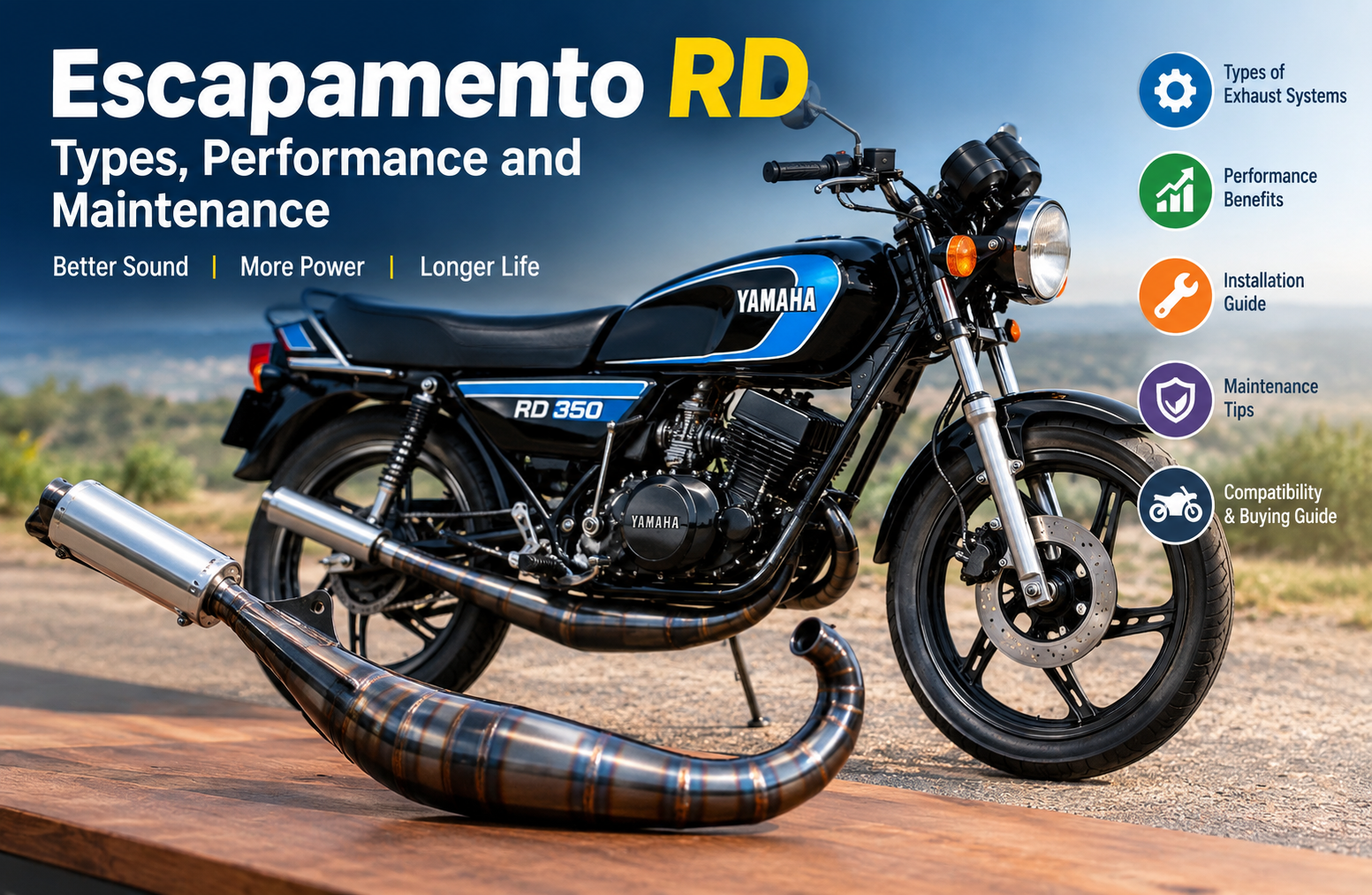
Escapamento RD: Complete Guide to Exhausts, Performance, and Maintenance
The term escapamento rd is commonly associated with the exhaust system used on Yamaha RD motorcycles, especially classic two-stroke models known for their distinctive sound, responsive acceleration, and lightweight design. Choosing the right exhaust involves more than selecting a pipe that looks attractive or produces a louder sound. The exhaust design affects engine performance, power delivery, fuel consumption, noise levels, and the overall riding experience. Understanding how these systems work helps motorcycle owners make informed decisions about replacement parts, restoration projects, and performance upgrades.
For owners and enthusiasts of classic Yamaha RD motorcycles, the exhaust is an important part of the machine’s engineering and character. Two-stroke engines depend heavily on exhaust pressure waves to operate efficiently, so even small changes in pipe dimensions can influence how the engine responds at different engine speeds. A suitable exhaust can preserve the motorcycle’s original behavior, while an unsuitable replacement may reduce low-speed performance or create problems with carburetor tuning.
This guide explains the main types of exhaust systems, how they work, what to consider before buying one, how maintenance affects performance, and which common mistakes motorcycle owners should avoid. It also explores the balance between original specifications, aftermarket components, sound preferences, reliability, and legal requirements.
What Does Escapamento RD Mean?
In Portuguese, escapamento means exhaust or exhaust system, while RD refers to Yamaha’s well-known RD motorcycle family. The phrase is particularly relevant to owners searching for exhaust pipes, expansion chambers, replacement silencers, and performance components for classic two-stroke motorcycles.
The exact meaning depends on the motorcycle and the buyer’s goal. Someone restoring an original RD may be looking for a factory-style exhaust, while a rider interested in performance may want an aftermarket expansion chamber designed for a particular engine configuration.
It is important to identify the exact model before choosing a part. Yamaha RD motorcycles were produced in different engine capacities and configurations, and their exhaust requirements are not interchangeable simply because they share the RD name.
Which Yamaha RD Models Are Relevant?
The following examples illustrate common model distinctions. They are not a universal compatibility list.
| Motorcycle model | Important exhaust consideration |
| Yamaha RD125 | A smaller-capacity engine requires an exhaust designed for its own displacement and port timing. |
| Yamaha RD200 | The exhaust must match the specific engine version and intended riding conditions. |
| Yamaha RD250 | Original-style and tuned aftermarket systems may produce different power characteristics. |
| Yamaha RD350 | Expansion chamber geometry is particularly important for preserving or changing the engine’s power delivery. |
| Yamaha RD400 | The correct exhaust depends on the exact model year, market, and engine configuration. |
| Yamaha RD500 | Its more complex engine configuration makes model-specific fitment especially important. |
These models should not be treated as having interchangeable exhaust systems. Even within one model family, mounting points, clearances, silencer arrangements, and original specifications may differ.
Before ordering a replacement, confirm the motorcycle’s model designation, year, engine code when available, and the manufacturer’s part number. If the motorcycle has been modified, also check whether the engine, cylinder, carburetor, or exhaust mounting arrangement still matches the original specification.
How an RD Exhaust System Works
A motorcycle exhaust system performs several jobs at once. It carries combustion gases away from the engine, influences the pressure conditions around the exhaust port, reduces noise, and helps determine how the engine delivers power.
On a two-stroke engine, the exhaust has an especially important role because the intake, combustion, and exhaust processes overlap during each crankshaft revolution.
1. Exhaust gases leave the cylinder
As the piston moves downward during the power stroke, it uncovers the exhaust port. High-pressure combustion gases begin moving into the exhaust pipe, creating a pressure wave.
The timing of this event depends on the engine’s port geometry and piston movement. The shape and length of the exhaust then influence how the pressure wave travels and returns.
2. The expansion chamber creates pressure waves
Many performance-oriented two-stroke exhausts use a shaped pipe known as an expansion chamber.
Its main sections usually include:
- Header: The initial section connected to the engine’s exhaust port.
- Diffuser cone: A widening section that creates a reflected low-pressure wave.
- Belly: The larger central portion of the chamber.
- Baffle cone: A narrowing section that reflects a positive pressure wave toward the cylinder.
- Stinger and silencer: The outlet components that allow exhaust gases to escape and reduce noise.
These sections are designed to work together rather than simply provide a path for gases to leave the engine.
The returning waves can help remove exhaust gases and recover some fresh fuel-air mixture that would otherwise escape through the exhaust port. The result depends on the chamber’s dimensions, the engine’s port timing, exhaust temperature, and operating speed.
For a more technical explanation, the specialist resource RD350 expansion chamber guide discusses the geometry and pressure-wave principles behind tuned two-stroke pipes.
3. The exhaust influences the power band
A tuned chamber is designed to work most effectively within a particular engine-speed range.
When the pressure waves arrive at the appropriate time, the engine may produce stronger power near its intended operating speed. Outside that range, the same exhaust can provide less effective gas exchange.
This explains why a motorcycle can feel stronger at high revolutions after an exhaust change but less responsive at low speeds.
A pipe designed for racing is not automatically the best choice for ordinary road use. Riders who need smooth acceleration, predictable throttle response, and frequent low-speed operation may prefer a different design from riders seeking maximum output near the top of the rev range.
Main Types of Escapamento RD
Different exhaust configurations serve different purposes. The right choice depends on whether the priority is originality, daily usability, sound, performance, or restoration.
Original-style replacement exhaust
An original-style replacement aims to preserve the motorcycle’s factory appearance, fitment, and general operating characteristics.
This is often the most practical option for a restoration project or a motorcycle used regularly on public roads.
Potential advantages include:
- A more authentic appearance.
- Better compatibility with original mounting points when the part is correctly specified.
- A greater chance of retaining the intended factory power characteristics.
- Easier integration with an otherwise standard engine.
- A suitable starting point for owners who prioritize originality.
However, an original-style appearance does not guarantee original internal construction. Some reproduction parts differ in chamber dimensions, internal baffles, metal thickness, or silencer design.
When originality matters, compare the part with reliable model-specific references instead of relying on appearance alone.
Performance expansion chamber
A performance chamber is designed to change the way exhaust pressure waves interact with the engine.
Depending on its design and the engine setup, it may improve power in a selected RPM range, alter the shape of the torque curve, or make the engine more responsive when it enters its tuned range.
The main benefits may include:
- Stronger acceleration in the intended operating range.
- Better performance when matched to suitable port timing and carburetion.
- Opportunities to tailor the motorcycle to road or competition use.
- A different exhaust note and visual appearance.
There are also trade-offs. Some performance chambers narrow the useful power band, increase noise, require carburetor adjustments, or reduce low-speed flexibility.
A performance exhaust should therefore be evaluated as part of the complete engine setup, not as an isolated accessory.
Aftermarket exhaust with a silencer
Aftermarket systems vary widely. Some are designed as direct replacements, while others use a tuned chamber and a separate silencer.
The quality of construction, internal dimensions, welds, mounting brackets, and noise-control components can vary between manufacturers.
A well-made system should fit without placing excessive stress on the cylinder connection or frame mounts. It should also provide adequate clearance around the tire, suspension, bodywork, and other heat-sensitive parts.
Before purchase, ask whether the system is intended for a standard engine or a modified one. A pipe designed for altered port timing may not deliver the expected results on a completely standard motorcycle.
Custom-built exhaust
A custom exhaust may be useful when standard parts are unavailable, the motorcycle has undergone extensive modification, or a specific performance target must be met.
However, custom fabrication requires more than copying the general shape of another pipe.
The designer needs to consider:
- Engine displacement and cylinder arrangement.
- Exhaust-port timing and geometry.
- Intended operating RPM.
- Carburetor and ignition configuration.
- Frame and suspension clearances.
- Silencer requirements.
- Heat management and mounting strength.
A pipe that fits physically may still be poorly matched to the engine. Custom construction is most effective when the design is based on measured specifications and validated through careful testing.
Benefits of Choosing the Right Exhaust
Selecting an appropriate system can improve the ownership experience in several ways, even when maximum horsepower is not the main objective.
Better engine response
A correctly matched exhaust helps the engine operate as intended. On a standard motorcycle, preserving the original system’s characteristics may be more valuable than chasing an unverified performance gain.
On a modified motorcycle, a suitable chamber can help the engine take advantage of changes to porting, carburetion, or other components.
More predictable maintenance
A correctly fitted exhaust is less likely to create avoidable problems such as leaking joints, excessive vibration, or interference with nearby components.
Good fitment also makes future inspections and routine servicing easier.
Improved restoration quality
For collectors and restoration enthusiasts, the exhaust can be a major part of the motorcycle’s visual identity.
The correct shape, finish, silencer arrangement, and mounting hardware can help preserve the intended appearance of the machine.
A sound suited to the motorcycle
The exhaust contributes significantly to the character of a two-stroke RD.
A clean, mechanically sound system can preserve the familiar engine note without relying on excessive noise. A louder system is not necessarily a better-performing system, and sound alone cannot establish whether an exhaust is correctly tuned.
Potential performance improvements
A properly designed performance system may increase output in its intended operating range. The size of any improvement depends on the engine, the original exhaust, the replacement design, and the quality of tuning.
Without comparable before-and-after measurements, it is not possible to promise a particular horsepower increase or acceleration improvement.
How to Choose the Correct Escapamento RD
Choosing the right part starts with identifying the motorcycle and defining the desired result.
Step 1: Identify the exact model
Record the model, production year, and engine configuration. If the motorcycle has been restored or modified, check its actual components rather than assuming everything remains original.
This step helps prevent compatibility problems and unnecessary purchases.
Step 2: Decide what you want to achieve
Different goals call for different exhaust designs.
| Your priority | Suitable starting point |
| Factory-style restoration | Correct original specification or a verified reproduction |
| Everyday road riding | A road-oriented system with predictable power delivery and suitable noise control |
| Higher-RPM performance | A tuned chamber matched to the engine’s specifications |
| Custom engine build | A system designed around the modified engine and validated through testing |
| Reduced exhaust noise | A compatible, properly maintained silencer and a system meeting applicable requirements |
These are starting points, not guarantees. The final choice should account for the motorcycle’s condition and intended use.
Step 3: Check physical compatibility
Before purchasing, verify:
- Exhaust-port connection dimensions.
- Gasket and flange arrangement.
- Mounting bracket positions.
- Overall pipe length and shape.
- Clearance from the frame, tire, swingarm, and foot controls.
- Silencer connection and mounting points.
Do not force a poorly fitting pipe into position by tightening the mounting bolts. Doing so can place stress on the cylinder flange, studs, brackets, and exhaust joints.
Step 4: Investigate construction quality
Inspect the available product information and, where possible, the physical part.
Look for consistent welds, suitable metal thickness, properly finished edges, secure mounting brackets, and a well-constructed silencer.
Check whether the manufacturer supplies the required gaskets, springs, clamps, and mounting hardware. Also ask about corrosion protection and replacement parts.
A low purchase price may be less attractive if the system needs substantial modification before installation or requires frequent repairs.
Step 5: Confirm the engine setup
If the motorcycle has a standard engine, choose an exhaust intended for that configuration.
If the engine has been modified, determine whether the exhaust was designed around the modified port timing, displacement, and operating range.
Do not assume that a pipe marketed as a high-performance upgrade will work well with every RD engine. A mismatch can produce weaker low-speed performance, poor throttle response, or excessive heat.
Step 6: Check road-use requirements
Noise limits, emissions rules, inspection requirements, and restrictions on modified exhausts vary by location.
Before fitting a nonstandard system, verify the rules that apply to the motorcycle’s registration and intended use. Competition-only equipment may not be legal for public-road use.
Step 7: Compare complete costs
The purchase price is only one part of the total expense.
Consider the cost of installation, gaskets, mounting hardware, carburetor adjustments, silencer maintenance, corrosion protection, and any professional testing.
A moderately priced system that fits properly and works well with the existing engine can be a better investment than an expensive racing pipe that requires extensive additional work.
Installation: What Motorcycle Owners Should Know
Correct installation is essential for reliability. Even a well-designed exhaust can cause problems if its joints leak, its brackets are under tension, or its outlet is obstructed.
For a valuable classic motorcycle, installation should preserve both the exhaust and the surrounding components.
Prepare the motorcycle
Allow the engine and exhaust to cool completely before starting work. Hot exhaust components can cause serious burns.
Place the motorcycle on a stable stand and make sure it cannot move unexpectedly. Gather the correct tools, replacement gaskets, and any model-specific hardware required by the installation instructions.
If the motorcycle has unusual modifications or damaged mounting points, identify those issues before removing the existing system.
Remove the old exhaust carefully
Inspect the mounting bolts, springs, clamps, and flange before applying force. Older motorcycles may have corroded fasteners or fragile mounting points.
Use an appropriate penetrating product when necessary and avoid excessive force on cylinder studs. Damaged studs can turn a straightforward replacement into a more involved repair.
Once the exhaust is removed, inspect the exhaust-port area and surrounding components for signs of leakage, damage, or carbon buildup.
Install new seals where required
Exhaust gaskets and sealing rings should be inspected and replaced when their condition or the manufacturer’s instructions require it.
A damaged or incorrectly fitted gasket can allow exhaust gases to escape at the cylinder connection. This may create a sharp ticking sound, visible residue, or signs of leakage near the joint.
Do not compensate for a damaged sealing surface by applying excessive tightening force. Follow the correct service procedure and specified torque values for the exact motorcycle.
Align the exhaust before tightening
Position the exhaust so that its connections and brackets line up naturally.
Install the fasteners loosely at first, where the service procedure permits, and confirm that the pipe sits correctly. Check clearance from nearby parts before tightening the connections in the prescribed sequence.
The exhaust should not need to be pulled into position by the mounting bolts. Forced alignment can cause leaks, cracked welds, broken studs, and persistent vibration.
Inspect the finished installation
Before riding, check the following:
- All mounting points are secure.
- The exhaust joints are correctly seated.
- The pipe does not contact the frame or suspension.
- The tire and wheel have sufficient clearance throughout the relevant movement.
- The silencer is properly attached.
- No tools or loose hardware remain near the engine.
- There are no obvious signs of exhaust leakage.
Follow the manufacturer’s instructions for the first start and any post-installation inspection. If a leak, abnormal noise, or unusual engine behavior appears, stop and investigate before continuing to ride.
Maintenance Tips for a Long-Lasting RD Exhaust
Regular inspection helps protect the exhaust, preserve engine performance, and identify small faults before they become expensive repairs.
The appropriate maintenance schedule depends on the motorcycle’s service manual, riding conditions, exhaust construction, and modifications.
1. Inspect the exhaust joints
Check the cylinder connection, gaskets, springs, clamps, and silencer joints periodically.
Signs of a possible leak include:
- Soot around a connection.
- A sharp ticking or puffing sound.
- Oil residue concentrated around a joint.
- Loose or visibly displaced mounting hardware.
Oil residue alone does not prove that a joint is leaking, especially on a two-stroke motorcycle. Look at the full set of symptoms before deciding what needs repair.
2. Watch for rust and corrosion
Classic exhausts may have spent years exposed to moisture, road dirt, and temperature changes.
Inspect the underside of the pipe, welded seams, mounting brackets, and areas where water or road debris can collect.
Surface rust may be manageable with appropriate cleaning and refinishing. Deep corrosion, perforations, cracked welds, or weakened mounting points may require specialist repair or replacement.
Use coatings designed for the temperatures and materials involved. Ordinary paint is not a suitable substitute for a high-temperature exhaust finish.
3. Check the silencer
The silencer helps reduce exhaust noise and may contain packing material or internal components that deteriorate with use.
Depending on the design, maintenance may involve checking the outlet, inspecting the internal structure, cleaning deposits, or replacing serviceable packing material.
Not every silencer is designed to be opened or repacked. Confirm the construction and follow the manufacturer’s service instructions before attempting internal maintenance.
4. Inspect for carbon buildup
Two-stroke engines can leave oil and carbon deposits in the exhaust system. Excessive buildup may reduce effective flow and affect engine performance.
A blocked or heavily contaminated silencer can contribute to poor throttle response, reduced power, or unusual running behavior.
However, a loss of performance does not automatically mean that the exhaust is clogged. Ignition problems, carburetor faults, damaged reeds where fitted, worn engine components, and air leaks can produce similar symptoms.
A proper diagnosis should distinguish between exhaust restriction and other mechanical problems.
5. Check for loose brackets and vibration
Engine vibration and repeated heat cycles can gradually loosen hardware or reveal cracks.
Pay particular attention to mounting tabs, spring hooks, welded joints, and the areas where the pipe is supported by the frame.
Do not keep riding with a visibly cracked bracket or a pipe that moves excessively. A failed mount can allow the exhaust to contact the tire, damage nearby components, or place stress on the cylinder connection.
6. Monitor engine behavior after maintenance
After cleaning, repairing, or replacing an exhaust, pay attention to starting behavior, idle quality, acceleration, and the way the engine responds under load.
A change in exhaust configuration may alter the engine’s operating characteristics. If the motorcycle suddenly runs differently, check for installation faults and leaks before attempting more extensive tuning.
Keep records of the work performed and the symptoms observed. This makes it easier to identify patterns and avoid replacing parts unnecessarily.
Carburetor Tuning After an Exhaust Change
Carburetor tuning deserves special attention on two-stroke motorcycles because incorrect fuel delivery can contribute to overheating and engine damage.
Changing the exhaust may change the engine’s gas-exchange behavior. Depending on the particular engine and replacement system, the existing carburetor settings may no longer be ideal.
That does not mean every exhaust replacement automatically requires a larger main jet. The correct setting must be established for the actual motorcycle and its operating conditions.
Why jetting matters
The carburetor meters fuel in relation to airflow and throttle position. Its settings influence how the engine runs from low throttle openings through the higher-load operating range.
If the mixture is too lean under demanding conditions, combustion temperatures and engine stress may rise. In a vulnerable two-stroke engine, unsuitable tuning can contribute to piston damage or seizure.
An excessively rich mixture can also cause problems, including poor response, increased fuel consumption, and deposits.
What should be checked?
A careful tuning process should consider:
- Whether the engine is mechanically healthy.
- Whether the exhaust and intake connections are sealed correctly.
- Whether the carburetor is clean and functioning as intended.
- Whether the ignition system is operating correctly.
- Whether the existing jetting matches the modified configuration.
- Whether performance and engine behavior remain consistent under controlled testing.
Changes should be made methodically, with suitable measurements and reference information for the exact engine.
Avoid copying jet sizes from another motorcycle without checking whether the carburetor, engine modifications, fuel, air filter, altitude, and exhaust design are comparable.
When professional tuning is worthwhile
Professional help is especially valuable when the motorcycle has modified cylinders, altered port timing, a nonstandard expansion chamber, or a history of overheating.
A specialist familiar with two-stroke engines can assess the complete setup rather than treating the exhaust as the only variable.
The goal is not simply to make the engine rev higher. It is to achieve reliable combustion, appropriate operating temperatures, predictable throttle response, and performance suited to the motorcycle’s intended use.
Common Problems and Their Possible Causes
Understanding common symptoms can help owners decide what to inspect first. The symptoms below are diagnostic clues, not definitive diagnoses.
| Symptom | Possible causes | Recommended first check |
| Exhaust noise becomes unusually sharp | Loose connection, damaged gasket, crack, or silencer problem | Inspect joints and mounting points |
| Acceleration becomes weaker | Exhaust restriction, poor carburetor settings, ignition fault, or engine wear | Check the full intake, ignition, engine, and exhaust system |
| Engine struggles at low RPM | Exhaust mismatch, carburetor fault, or another engine problem | Confirm the exhaust specification and basic engine condition |
| Engine becomes unusually hot | Incorrect mixture, ignition issue, restricted exhaust outlet, or other mechanical fault | Stop demanding riding and investigate the cause |
| Oil or soot appears around a joint | Exhaust leak, normal two-stroke residue, or a combination of factors | Clean the area and inspect for fresh leakage |
| Exhaust vibrates or rattles | Loose hardware, failed mount, internal silencer damage, or contact with another component | Check fasteners, brackets, clearances, and the silencer |
| Rust or a small hole appears | Corrosion, damaged coating, or structural deterioration | Assess the metal thickness and repairability |
A motorcycle that suddenly loses power or shows signs of overheating should not be repeatedly tested at high throttle while the cause remains unknown. Continuing to operate a damaged or poorly tuned two-stroke engine can make a relatively minor problem much more expensive.
Performance Versus Reliability: Finding the Right Balance
The most suitable exhaust is not necessarily the one advertised as producing the most horsepower.
A tuned pipe can move the engine’s strongest output toward a higher RPM range. This may be useful for racing, but it can make the motorcycle less convenient in slow traffic or when accelerating without downshifting.
For a road-going classic, smooth and predictable power may be more useful than a narrow peak-power advantage.
Consider the complete motorcycle
An exhaust works alongside the cylinder, piston, crankshaft, carburetor, ignition system, intake, and transmission.
If one component has been modified without considering the others, the result may be disappointing. A pipe designed for a heavily modified engine may not match a standard cylinder, and a powerful engine setup may expose weaknesses elsewhere.
For restoration projects, preserving the original configuration often simplifies troubleshooting and helps maintain the intended character of the motorcycle.
For performance builds, document each change and evaluate the combined result. This makes it easier to determine which modifications actually improve the machine.
Avoid judging performance by sound
A louder exhaust can feel more powerful because the sound is more noticeable. That impression is not a reliable measurement of engine output.
Similarly, a visually larger pipe does not automatically provide better gas exchange. The internal dimensions, pressure-wave behavior, and compatibility with the engine matter more than appearance alone.
If a meaningful performance comparison is needed, use consistent testing conditions and suitable measurement equipment. Record the motorcycle’s configuration before and after the change so that the results can be interpreted fairly.
Buying a Used or Reproduction RD Exhaust
Finding the right part for an older motorcycle can be challenging, especially when original components are scarce or expensive.
A used exhaust may be a practical option, but its external appearance does not always reveal its internal condition.
Inspect used parts carefully
Check for:
- Corrosion that has weakened the metal.
- Repairs or patches around the chamber and mounting brackets.
- Cracks near welds and support points.
- Dents that may affect internal volume or pipe shape.
- Missing silencer components.
- Evidence of previous cutting or fabrication.
- Damaged mounting holes and connection surfaces.
Small cosmetic marks may not affect performance, but substantial deformation or internal damage deserves closer inspection.
Ask the seller for clear photographs from several angles, including the connection to the cylinder, mounting points, underside, and silencer outlet.
If possible, compare the part with a known example or a reliable parts reference for the exact model.
Questions to ask the seller
Before committing to a purchase, establish whether the exhaust is original, a reproduction, or an aftermarket performance design.
Ask which model and year it fits, whether it has been modified, whether the silencer is complete, and whether the seller has evidence of correct fitment.
For a used performance pipe, ask whether it was previously fitted to a standard engine or a modified one. This information can help explain its intended operating range.
Be cautious about claims such as guaranteed horsepower gains or universal compatibility unless the seller provides credible supporting evidence.
Consider originality and resale
For a collector-focused restoration, originality may be more important than a potential performance increase.
A replacement exhaust that closely matches the correct factory specification can help preserve the motorcycle’s historical appearance. Keeping original components, when practical, may also be useful for future restoration work.
For a modified motorcycle, a well-documented aftermarket system may be appropriate. The key is to understand how the choice affects the bike’s purpose, service needs, and long-term value.
Legal, Noise, and Environmental Considerations
Exhaust modifications can affect noise emissions, exhaust emissions, and compliance with road-use regulations.
Requirements differ by country and sometimes by vehicle category, registration status, or inspection system. A part that is permitted for competition use may not be legal on public roads.
Before purchasing or modifying an exhaust, check the relevant local requirements. Pay particular attention to noise limits, required silencers, restrictions on modifications, and any applicable emissions or vehicle inspection rules.
Excessive noise can also affect nearby residents and other road users. A properly maintained silencer helps reduce unnecessary disturbance while preserving the motorcycle’s intended operation.
Environmental considerations matter as well. Older two-stroke motorcycles can produce more visible smoke and unburned hydrocarbon emissions than many modern four-stroke motorcycles, depending on their design, condition, and operating setup.
An exhaust modification should not be treated as a substitute for correct maintenance. Leaks, unsuitable carburetor settings, excessive oil consumption, and engine wear should be investigated rather than ignored.
Is an Aftermarket Exhaust Worth the Cost?
Whether an upgrade is worthwhile depends on the condition of the current system and the owner’s priorities.
If the existing exhaust is badly corroded, leaking, or structurally unsafe, a correctly specified replacement may be justified primarily for reliability.
If the original system is in good condition, replacing it purely for sound or appearance may offer little practical benefit.
For a performance project, the value of an aftermarket system depends on how well it matches the engine and whether the improvement justifies the additional tuning and maintenance.
Consider these factors before deciding:
- Compatibility: Does the exhaust fit the exact motorcycle without forced modifications?
- Performance: Is there credible evidence that it suits the engine and intended operating range?
- Durability: Are the materials, welds, mounts, and corrosion protection appropriate?
- Maintenance: Are serviceable silencers, gaskets, and replacement components available?
- Noise: Is the sound level appropriate for the intended use?
- Total cost: Will installation, tuning, and ongoing maintenance add significantly to the initial price?
A practical decision weighs the entire ownership experience rather than focusing on a single advertised feature.
Practical Checklist Before Choosing an Exhaust
Before making a final decision, use this checklist to compare the available options.
Exhaust selection checklist
0 of 8
Confirm the exact Yamaha RD model and year.
Identify whether the engine is standard or modified.
Decide between original-style replacement and performance tuning.
Verify mounting points, dimensions, and physical clearance.
Inspect materials, welds, corrosion protection, and silencer quality.
Check whether carburetor or ignition adjustments may be needed.
Confirm local noise and road-use requirements.
Compare the total cost, including installation and maintenance.
Reset checklist
This checklist is particularly useful when comparing several exhausts for a restoration or performance project. It keeps the decision focused on compatibility, mechanical condition, and intended use rather than appearance alone.
Frequently Asked Questions
1. What is an escapamento RD?
An escapamento RD is an exhaust system associated with Yamaha RD motorcycles. Depending on the model and application, it may be an original-style replacement, a reproduction, or an aftermarket performance exhaust designed for a two-stroke engine.
2. Does a performance exhaust increase Yamaha RD horsepower?
It can increase power within a particular RPM range when correctly matched to the engine. However, the result depends on exhaust geometry, port timing, carburetor settings, and the engine’s overall condition. Not every aftermarket pipe produces a measurable improvement.
3. Can I install an RD exhaust without changing the carburetor settings?
Sometimes, particularly when replacing a system with an equivalent design. However, a different expansion chamber can change engine behavior and may require carburetor tuning. Check the engine’s condition and mixture settings before demanding high performance.
4. How do I know whether an RD exhaust is compatible with my motorcycle?
Confirm the exact model, production year, engine configuration, connection dimensions, mounting points, and clearance requirements. If the engine has been modified, verify compatibility with the actual components rather than relying on the motorcycle’s model name alone.
5. Why is my Yamaha RD exhaust leaking?
Common causes include worn gaskets, loose connections, damaged sealing surfaces, cracked welds, and corrosion. Inspect the affected area when the exhaust is cold. Replace damaged seals or repair structural faults using the correct procedure.
6. How often should a two-stroke RD exhaust be cleaned?
There is no single interval that applies to every RD model and exhaust design. Inspect the system according to the service manual and the motorcycle’s use. Clean or service the silencer when deposits, restriction, or the manufacturer’s maintenance instructions justify it.
Conclusion
Choosing the right exhaust for a Yamaha RD requires an understanding of the motorcycle’s engine, intended use, and mechanical condition. The exhaust is not simply a metal pipe that carries gases away. On a two-stroke engine, its design influences pressure waves, cylinder scavenging, and the RPM range in which the engine delivers its strongest performance.
An original-style replacement is often the sensible choice for a restoration or a standard road motorcycle. A performance expansion chamber may be more suitable for a modified engine or a specific performance objective, but its benefits depend on correct matching and tuning. Custom systems require even greater attention to dimensions, operating speed, mounting, and heat management.
Maintenance is equally important. Regularly inspecting exhaust joints, gaskets, brackets, corrosion, and silencer condition helps prevent avoidable failures. After changing the exhaust, owners should also monitor engine behavior and investigate any signs of overheating, leakage, or unusual power loss.
Ultimately, the best choice is the exhaust that fits the exact motorcycle, meets its intended requirements, and provides an appropriate balance of performance, reliability, noise control, and long-term maintenance.