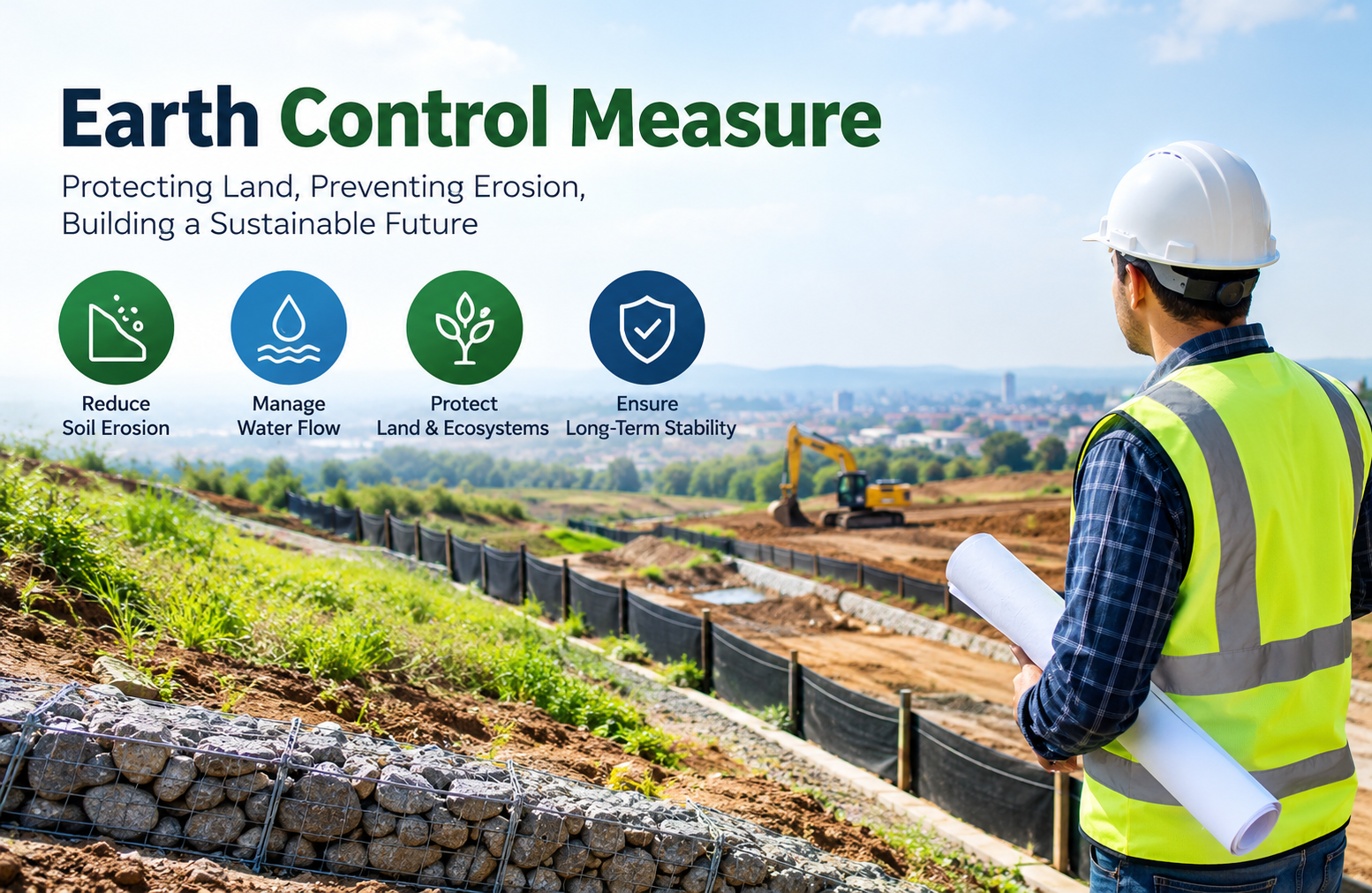
Earth Control Measure: A Complete Guide to Soil and Erosion Management
Earth control measure refers to a set of practical methods used to manage disturbed soil, reduce erosion, control sediment movement, and protect surrounding land and water during construction, excavation, landscaping, and other earthworks. These measures help prevent loose soil from being washed into drains, rivers, and nearby properties while keeping work sites safer, cleaner, and more environmentally responsible.
Soil is one of the most important natural resources on Earth. It supports plant growth, stores water, provides habitats for countless organisms, and forms the foundation for roads, buildings, and other infrastructure. However, when land is cleared, excavated, or exposed to wind and rain, its natural protective cover is removed. Without suitable controls, even a relatively small work site can contribute to muddy runoff, blocked drainage systems, unstable slopes, and damage to nearby ecosystems.
Understanding how soil protection works is essential for construction managers, civil engineers, contractors, landowners, environmental professionals, and anyone responsible for managing disturbed ground. The right approach depends on the type of soil, the slope of the land, expected rainfall, drainage patterns, project size, and the length of time the ground will remain exposed.
This guide explains the meaning of earth control practices, their main types, how they work, their benefits and limitations, and how to plan an effective control system. It also explores common mistakes, maintenance requirements, practical examples, and the principles that help projects reduce environmental damage without creating unnecessary costs or delays.
What Is an Earth Control Measure?
An earth control measure is a planned action or physical system designed to prevent soil erosion, reduce sediment transport, manage surface runoff, and protect land during activities that disturb the ground.
These controls are particularly important when vegetation is removed or soil is exposed through construction, road development, trenching, grading, mining, agriculture, or landscaping.
The term can describe several related activities, including:
- Erosion prevention: Keeping soil in place before water or wind can carry it away.
- Sediment control: Capturing or slowing soil particles that have already entered runoff.
- Stormwater management: Directing rainwater safely through or away from a disturbed area.
- Slope stabilization: Reducing the risk of soil movement on sloping ground.
- Site restoration: Re-establishing vegetation or other protective cover after earthworks are completed.
- Environmental protection: Preventing sediment and associated pollutants from reaching sensitive areas.
Although these activities work together, they do not perform exactly the same function. Erosion control focuses on stopping soil from becoming detached. Sediment control focuses on keeping detached particles from leaving the site. Stormwater management controls how water moves across the land.
A successful plan usually combines several methods rather than relying on a single barrier.
For example, a construction project may protect exposed soil with mulch, divert clean water around the work area, use a stabilized entrance to reduce tracking of mud onto roads, and install sediment barriers where runoff leaves the site.
The precise combination should reflect the site’s actual risks instead of simply following a standard list of equipment.
Why Earth Control Measures Are Important
Disturbed soil can create problems that extend beyond the boundary of a project. Rainwater flowing across bare ground may carry fine particles into roadside drains, streams, ponds, and reservoirs. These particles can affect water quality, damage habitats, and increase the amount of sediment that must be removed from drainage systems.
Effective controls address these risks at their source.
1. Preventing Soil Erosion
Erosion occurs when soil particles are detached and transported by water, wind, or other forces. Vegetation naturally reduces this risk by shielding the surface from raindrops and helping bind the soil with roots.
When vegetation is removed, the soil becomes more vulnerable. Water may form small channels, wash away the fertile top layer, and gradually create deeper erosion gullies.
Protective ground cover, drainage management, and appropriate stabilization techniques help limit these effects.
2. Protecting Rivers, Lakes, and Groundwater
Sediment entering waterways can increase turbidity, reduce light penetration, and interfere with aquatic habitats. Deposited sediment may cover spawning areas, smother sensitive organisms, or reduce the capacity of drainage channels.
Soil particles can also carry attached pollutants, depending on the land use and site history. These may include nutrients, oils, metals, or other contaminants.
Keeping sediment on the work site therefore provides benefits beyond reducing visible muddy water.
3. Maintaining Drainage Performance
Sediment accumulation can reduce the capacity of storm drains, culverts, channels, and other drainage structures. During heavy rainfall, this can contribute to localized flooding or costly maintenance.
Preventing sediment from entering the drainage network reduces the burden on downstream infrastructure.
4. Improving Site Safety
Uncontrolled runoff can wash material into access routes, create slippery surfaces, undermine exposed ground, and contribute to unstable slopes. Erosion around foundations, temporary roads, and excavations may also interfere with construction activities.
Appropriate controls help maintain safer working conditions, although they must be designed and inspected properly to avoid creating new hazards.
5. Supporting Regulatory Compliance
Many jurisdictions require construction and land-disturbance projects to manage stormwater, prevent pollution, and protect nearby waterways. The exact requirements depend on the location, project size, receiving environment, and type of work.
Planning controls early makes it easier to identify permit conditions, inspection duties, discharge limits, and documentation requirements.
A measure that is acceptable at one site may not satisfy the rules at another. Project teams should therefore verify the relevant local requirements before construction begins.
6. Reducing Long-Term Costs
Erosion may appear to be a minor issue at first, but its effects can spread. Lost topsoil, blocked drains, damaged landscaping, muddy public roads, and repeated cleanup work can increase project costs.
Preventive measures often reduce these avoidable expenses. Their value is greatest when they are installed before soil becomes exposed and maintained throughout the project.
How Soil Erosion and Sediment Movement Occur
To choose suitable controls, it helps to understand how erosion develops.
The process generally involves four stages: soil detachment, transport, deposition, and possible remobilization.
Soil Detachment
Raindrops strike exposed soil and dislodge particles. Flowing water may then lift and carry those particles away. Wind can also remove dry, loose soil, particularly from open areas with little vegetation.
Soil structure, moisture, particle size, compaction, and organic matter all influence how easily the surface erodes.
Sediment Transport
Once particles become detached, runoff can carry them downslope. The amount transported depends on factors such as water velocity, flow depth, slope, rainfall intensity, and particle size.
Fine particles may remain suspended for longer than heavier grains. As a result, water can continue carrying sediment well beyond the original disturbed area.
Deposition
When water slows, some particles settle. This may occur in a sediment basin, a roadside drain, a low-lying section of a site, or a natural waterway.
Deposition inside a properly designed containment system can be useful. Deposition in an undersized culvert or sensitive habitat may cause serious problems.
Remobilization
Sediment that has already settled can move again during later rainfall if the deposited material is not protected or removed when necessary.
This is why sediment traps, basins, and drainage channels need regular inspection. Installing a control structure is not the end of the process.
Main Types of Earth Control Measures
Different controls serve different purposes. The following methods are commonly used in construction and land management, but their suitability depends on the site and applicable standards.
1. Vegetation and Ground Cover
Vegetation is one of the most effective ways to protect stable soil surfaces. Grass, shrubs, and other suitable plants reduce the direct impact of rainfall and help bind soil through their roots.
Ground cover also slows near-surface water movement and can improve infiltration where soil conditions allow it.
Common methods include:
- Establishing grass or other suitable vegetation.
- Applying mulch to protect exposed soil.
- Using erosion-control blankets on vulnerable surfaces.
- Planting native species suited to local conditions.
- Retaining existing vegetation wherever practical.
Vegetation is especially useful for completed slopes, landscaped areas, road verges, and land that will not need further excavation.
However, planting is not an instant solution. Seeds need suitable moisture, temperature, and time to establish. During the establishment period, temporary protection may still be necessary.
The choice of species also matters. Plants that grow well in one climate or soil type may perform poorly elsewhere.
2. Silt Fences and Sediment Barriers
Silt fences are permeable barriers commonly used to slow shallow runoff and retain sediment near disturbed areas. They are often made from geotextile fabric supported by posts.
A properly installed fence allows water to pass through the fabric at a controlled rate while retaining some suspended soil particles.
These barriers are generally most suitable for relatively small drainage areas with shallow, sheet-like flow.
They should not be treated as dams or installed across concentrated streams of water. Excessive flow can cause overtopping, tearing, or failure of the barrier.
For effective performance:
- Install the fence according to the approved design and manufacturer’s instructions.
- Secure the lower edge in the soil as required by the design.
- Maintain suitable post spacing and support.
- Avoid placing it where concentrated runoff will overwhelm it.
- Inspect for damage, undercutting, and sediment buildup.
- Remove accumulated sediment when it begins to reduce the barrier’s useful capacity.
A silt fence is a sediment-control device, not a substitute for stabilizing a large exposed slope.
3. Sediment Traps and Sediment Basins
Sediment traps and basins provide space for runoff to slow down so that suspended particles can settle before water leaves the site.
A sediment trap is generally used for a smaller contributing area, while a sediment basin is typically designed for larger runoff volumes or more substantial drainage areas. Exact definitions and sizing rules vary by jurisdiction.
Their performance depends on storage volume, particle size, flow rate, residence time, inlet design, and outlet arrangement.
A basin that is too small may fill quickly or allow sediment-laden water to pass through without adequate settling. Fine clay particles can be particularly difficult to remove through gravity settling alone.
A well-planned system should include safe access for sediment removal, appropriate outlet protection, and a way to manage overflow without creating new erosion.
Sediment basins require regular inspection after rainfall and whenever the contributing area changes significantly.
4. Diversion Drains and Runoff Channels
Diversion drains and channels direct water away from vulnerable areas or carry it toward an appropriate treatment or discharge point.
One important principle is to keep clean water separate from sediment-laden runoff wherever practical. Water from an undisturbed area may be routed around the construction zone, reducing the amount of water that needs treatment.
Channels must be designed for expected flows, slope, soil type, and outlet conditions. Depending on the circumstances, they may require grass lining, stone protection, erosion-control mats, or other stabilization.
A poorly designed channel can increase water velocity and cause more erosion than it prevents. The discharge point also needs attention because concentrated flow can damage downstream ground.
5. Slope Stabilization
Slopes require particular care because gravity and flowing water can move soil downslope. The appropriate treatment depends on slope angle, soil strength, groundwater, drainage, and the likelihood of deeper instability.
Common techniques include:
- Establishing vegetation where conditions permit.
- Applying erosion-control mats or blankets.
- Using terracing or properly designed benches where appropriate.
- Installing surface drainage to reduce uncontrolled runoff.
- Applying engineered retaining or reinforcement systems when required.
- Protecting the top and bottom of slopes from concentrated water flow.
Surface erosion and slope failure are not the same problem. A blanket may help prevent surface soil from washing away, but it will not necessarily prevent a deep landslide or structural failure.
Where cracking, bulging, seepage, sudden settlement, or significant movement occurs, a qualified geotechnical professional should assess the slope. Temporary surface measures should not be mistaken for an engineered stability solution.
6. Stabilized Construction Entrances
Vehicles leaving a construction site can carry soil onto public roads. This creates muddy surfaces, drainage problems, and potential traffic hazards.
A stabilized entrance uses an appropriately designed surface, often involving coarse aggregate or another suitable material, to reduce the amount of soil picked up by vehicle tires.
Its effectiveness depends on the underlying ground, vehicle movements, rainfall, aggregate size, and maintenance.
Useful supporting practices include:
- Restricting vehicles to designated access points.
- Maintaining the entrance surface.
- Removing tracked soil from roads promptly.
- Using suitable wheel-cleaning methods when required.
- Preventing wash water from entering storm drains untreated.
Simply spreading gravel over soft soil may not provide reliable control. Some sites need a prepared base, geotextile separation, drainage improvements, or a more robust entrance design.
7. Mulching and Erosion-Control Blankets
Mulch protects the soil surface from rainfall and reduces the force of water moving across exposed ground. Depending on the material, it may also help conserve moisture and support vegetation establishment.
Erosion-control blankets are manufactured materials placed over vulnerable soil. They may be made from natural fibers, synthetic materials, or a combination of products.
These controls are useful on newly seeded slopes, drainage channels designed for suitable blanket products, and areas where vegetation needs time to develop.
The selected material must match the slope, flow conditions, expected service life, and environmental requirements. Incorrect installation can leave gaps where water concentrates and cuts channels beneath the blanket.
8. Dust Suppression and Wind Erosion Control
Not all erosion is caused by rain. Dry, exposed ground can release dust under the influence of wind and vehicle movement.
Dust-control methods may include temporary ground cover, carefully managed watering, wind barriers, stabilization products approved for the site, and prompt revegetation.
Watering can reduce dust, but excessive application may create muddy runoff. Chemical stabilizers also require careful selection because some products can affect soil or water quality.
The aim is to control airborne particles without transferring the problem into the drainage system.
9. Drain Inlet Protection
Drain inlet protection helps prevent sediment from entering stormwater systems through grates or other drainage openings.
Depending on the design, protection may use approved filter devices, barriers, or temporary sediment-control structures.
The control must allow enough water to enter the drainage system to avoid unsafe ponding while retaining sediment as intended. Blocking an inlet completely can create a flooding hazard.
Drain protection should therefore be selected and installed according to the drainage layout and expected flow, not simply placed over every opening in the same way.
10. Soil Stabilization and Surface Treatment
Some projects require temporary or permanent stabilization of exposed ground. Methods may include compaction, suitable binders, geosynthetic materials, or other engineered treatments.
The correct option depends on whether the goal is to reduce erosion, improve bearing capacity, control dust, or achieve a combination of outcomes.
Compaction can be useful for construction platforms and access roads, but it does not automatically solve erosion problems. Highly compacted soil may reduce infiltration and increase surface runoff.
Chemical treatments should be assessed for environmental compatibility and used according to applicable requirements.
How to Select the Right Control System
There is no single measure that works best for every site. Good selection starts with a site assessment rather than purchasing equipment first.
Step 1: Assess the Site
Before work begins, identify:
- Soil type and erodibility.
- Existing vegetation and areas worth protecting.
- Slope direction and steepness.
- Natural drainage paths.
- Nearby drains, waterways, wetlands, and properties.
- Areas where runoff may collect.
- Expected rainfall and seasonal conditions.
- The duration and sequence of planned earthworks.
This assessment helps reveal where erosion is most likely and where sediment could travel.
Step 2: Divide the Site Into Drainage Areas
A drainage area is the land that contributes runoff to a particular outlet or low point.
Mapping these areas makes it easier to estimate which parts of the site need protection and where controls should be located.
A small, flat area with limited runoff may need only basic ground cover and perimeter protection. A steep site with several drainage outlets may need a coordinated network of diversions, slope treatments, sediment traps, and stabilized discharge points.
Step 3: Prioritize Prevention
The most efficient strategy is often to avoid disturbing soil that does not need to be disturbed.
Retaining existing vegetation, limiting clearing, and completing work in stages can reduce the exposed area and the amount of runoff requiring treatment.
Prevention also lowers the pressure on downstream sediment controls, which may struggle during intense storms.
Step 4: Separate Clean Water From Dirty Water
Where feasible, divert runoff from undisturbed land around the active work area. This reduces the volume of sediment-laden water that must be managed.
Water that passes through disturbed soil should be directed through suitable control measures before it leaves the site, in accordance with local requirements.
The system must be designed carefully so that diversion does not increase erosion or send water toward neighboring land.
Step 5: Combine Complementary Controls
A layered approach is generally more reliable than a single device.
For example, ground cover reduces soil detachment, a diversion channel limits runoff through the exposed area, and a sediment basin captures particles from water that still becomes contaminated.
Each measure should have a clear role in the overall plan.
Step 6: Consider Maintenance and Access
A control system is only effective if workers can inspect, repair, and maintain it.
The plan should identify who is responsible for inspections, how sediment will be removed, where maintenance equipment can operate, and how damaged materials will be replaced.
Controls that are difficult to access may be neglected until a problem becomes obvious.
Step 7: Verify Local Requirements
Check the applicable construction permits, stormwater regulations, environmental rules, and engineering standards.
Some projects require an erosion and sediment control plan, inspection records, certified personnel, or approval before earthworks begin.
The requirements should be confirmed with the relevant authority or a qualified environmental professional.
A Practical Example: Managing Runoff at a Construction Site
Consider a hypothetical building project on sloping ground. Vegetation has been removed from part of the site, excavated soil is stored nearby, and a storm drain sits close to the lower boundary.
If the site is left exposed, rain may wash loose soil downslope. Sediment could enter the drain, collect in nearby channels, and spread onto surrounding roads or properties.
A coordinated control plan would address the problem at several points.
First, the project team would limit clearing to the areas needed for the next stage of work. Undisturbed vegetation would remain wherever possible.
Second, clean runoff from higher ground would be directed around the disturbed area through a suitable, stabilized drainage route.
Third, exposed soil and stockpiles would receive appropriate temporary protection. Stockpiles would be placed away from drainage paths and protected against runoff and wind, as required by site conditions.
Fourth, suitable sediment barriers would be installed where shallow runoff could leave the work area. A properly designed sediment trap or basin might be required if the drainage area and runoff volume justify it.
Fifth, the construction entrance would be stabilized to reduce mud tracking onto public roads.
Finally, the team would inspect the site after rainfall, repair damaged controls, remove accumulated sediment when needed, and stabilize completed areas as soon as practical.
The key lesson is that the system addresses the entire route from rainfall to discharge. It does not depend on a single fence or drain to solve every problem.
Benefits of Effective Earth Control Planning
A well-designed control plan can produce environmental, operational, and financial benefits.
Environmental Benefits
Keeping soil in place reduces the amount of sediment reaching waterways. It can also help preserve topsoil, protect vegetation, reduce disturbance to aquatic habitats, and limit the movement of pollutants attached to sediment.
Construction Benefits
Cleaner access routes, better drainage, and fewer erosion problems can help crews work more efficiently. Well-maintained controls may also reduce interruptions caused by emergency repairs or sediment removal.
Financial Benefits
Prevention can reduce the need to replace lost soil, repair damaged surfaces, clean blocked drains, and address complaints or compliance problems.
The savings depend on the project, local conditions, and the cost of implementation. Controls still require investment, and poorly selected systems may not deliver their expected value.
Community Benefits
Managing runoff reduces the chance that muddy water, dust, or sediment will affect neighboring properties and public roads.
This can improve the relationship between a project team and the surrounding community while reducing avoidable disruption.
Long-Term Land Protection
After construction, suitable stabilization can help preserve soil structure, support vegetation, and reduce ongoing erosion.
Long-term success depends on choosing treatments that fit the final use of the land rather than relying only on temporary construction controls.
Common Challenges and Why Controls Fail
Even a well-intended plan can fail when the measures do not match the site or are not maintained.
Choosing the Wrong Measure
A silt fence cannot safely handle every type of runoff. A grass cover may not establish quickly enough before a rainy period. A sediment basin may not provide enough capacity for the drainage area.
The solution is to match each measure to the actual flow conditions, soil properties, and project requirements.
Poor Installation
Incorrectly secured barriers, gaps beneath fabric, unstable channel outlets, and improperly placed materials can create paths for sediment to escape.
Installation should follow the approved design and product instructions. Critical systems may need inspection before they are relied upon.
Neglecting Maintenance
Sediment gradually fills traps and basins. Fabric can tear, channels can erode, and vegetation can fail.
Inspections should be scheduled according to local requirements and adjusted after significant rainfall, visible damage, or major changes in site activity.
Disturbing Too Much Ground at Once
Large areas of exposed soil generate more potential runoff and make controls harder to manage.
Phased construction reduces the amount of land that remains vulnerable at any one time.
Ignoring Stockpiles
Excavated material is often loose and easy to erode. If stockpiles sit near drains or on exposed slopes, they can become a major source of sediment.
Locate them carefully, stabilize their surfaces, and provide suitable runoff protection.
Underestimating Heavy Rainfall
A control system designed for ordinary conditions may be overwhelmed by a severe storm. Water can overtop barriers, bypass channels, or erode outlets.
Design should account for the rainfall and runoff criteria required by the applicable standards. Where appropriate, the plan should also consider safe overflow routes and emergency response procedures.
Failing to Protect Discharge Points
A channel may convey water effectively but cause erosion where it releases that water.
Outlets need suitable energy dissipation, surface protection, or other engineering measures where flow velocity and ground conditions require them.
Confusing Surface Erosion With Deep Instability
Surface protection cannot correct every geotechnical problem. Slopes with groundwater pressure, weak layers, or deep movement may require a professional investigation and engineered stabilization.
Recognizing the difference is important for both safety and cost control.
Inspection and Maintenance: Keeping Controls Effective
Installation is only the first part of a successful system. Regular inspection helps confirm whether controls are functioning as intended.
A practical inspection routine should cover the following areas.
Inspect Before and During Work
Check controls before earthworks begin and while the site changes. New excavation, altered drainage, or the movement of stockpiles may make existing measures unsuitable.
Inspect After Rainfall
Rainfall can reveal problems that are not visible during dry conditions. Look for sediment deposits, overtopping, damaged barriers, channel erosion, and water flowing around intended control points.
Follow the inspection frequency and timing required by the project’s permit or approved plan.
Remove Sediment When Necessary
Sediment traps, basins, and barriers lose capacity as material accumulates. Remove deposits according to the design criteria and local requirements.
Removed material should be placed or disposed of in a way that prevents it from washing back into the drainage system.
Repair Damaged Measures Promptly
Repair torn fabric, displaced materials, eroded outlets, and failed ground cover as soon as practical. If a control repeatedly fails, investigate the underlying cause rather than repeating the same repair.
Keep Records
Inspection logs can record the date, observed conditions, defects, corrective actions, and responsible personnel.
Good records help project managers track recurring issues and demonstrate that the control plan is being implemented.
Stabilize Completed Areas
Once an area no longer needs to remain exposed, restore suitable ground cover or install the required permanent treatment.
Temporary controls should remain in place until the area is sufficiently stable and the approved plan permits their removal.
Earth Control Measures in Different Industries
Although construction is a major application, soil protection is relevant to many other activities.
Road Construction
Road projects may expose long strips of soil, create cut and fill slopes, and alter natural drainage paths. Controls often need to be coordinated across multiple work fronts.
Temporary drains, stabilized slopes, sediment barriers, and protected outlets may be used together. Work sequencing is particularly important because runoff can travel long distances along road corridors.
Agriculture
Agricultural land may experience erosion due to tillage, bare soil, irrigation, and overgrazing.
Practices such as cover crops, contour farming, vegetated buffer strips, reduced tillage, and appropriate drainage can help reduce soil loss.
The best approach depends on crop type, climate, slope, soil characteristics, and farm operations.
Landscaping and Land Development
Landscaping can disturb large amounts of soil during grading, planting, and the installation of paths or utilities.
Keeping undisturbed areas protected, covering exposed ground, and managing runoff during planting can reduce erosion before permanent vegetation becomes established.
Mining and Quarrying
Mining can create large disturbed areas, stockpiles, haul roads, and drainage challenges.
Control systems may need to address sediment, dust, contaminated runoff, and long-term land rehabilitation. Depending on the site, specialized engineering and environmental monitoring may be essential.
Utility Installation
Water, sewer, electricity, and telecommunications projects often require trenches that cross roads, fields, and developed land.
Trench spoil should be managed carefully, runoff should be controlled, and disturbed surfaces should be restored as work progresses. Temporary controls may need to move with the construction sequence.
Residential Properties
Homeowners may encounter erosion when building extensions, creating driveways, landscaping slopes, or repairing drainage.
Small projects can still affect neighboring land. Simple measures such as protecting bare soil, directing roof and surface runoff appropriately, and stabilizing disturbed areas can reduce avoidable damage. Larger or steep sites may require professional design.
Environmental Standards, Planning, and Responsibilities
The rules governing erosion and sediment control vary by country, state, province, and local authority. They may also differ according to land use, project size, and proximity to protected waterways.
For that reason, there is no single universal checklist that guarantees compliance everywhere.
In the United States, the Environmental Protection Agency provides information about construction stormwater permits and pollution prevention under the National Pollutant Discharge Elimination System. Its guidance can help project teams understand why construction runoff requires planning and how regulatory obligations may apply.
For reliable starting information, consult the U.S. Environmental Protection Agency’s construction stormwater guidance.
Projects outside the United States should consult the relevant environmental regulator and local permitting authority. Requirements may specify minimum control measures, design standards, inspections, reporting, and restrictions on discharges.
Responsibility should also be clear within the project team. Depending on the contract and applicable law, the owner, designer, principal contractor, site supervisor, and environmental consultant may have different duties.
A practical management plan identifies who installs controls, who checks them, who approves changes, and who responds when a failure occurs.
Measuring Whether the Control Plan Is Working
A project should not judge success only by the presence of equipment. The important question is whether the system is reducing erosion and preventing harmful sediment from leaving the site.
Useful indicators include:
- Visible erosion on exposed ground and slopes.
- Sediment accumulation in traps and drainage channels.
- Signs of runoff bypassing installed controls.
- Mud tracked onto public roads.
- Damage to vegetation and stabilized surfaces.
- Sediment entering downstream drains or waterways.
- Repeated failures after rainfall.
- Completion of required inspections and corrective actions.
Where the project has permit conditions or water-quality monitoring requirements, those criteria should guide evaluation.
Water clarity alone does not prove that runoff is free of pollutants. Fine sediment may remain suspended, and some contaminants are not visible. Monitoring methods should therefore reflect the risks and legal requirements of the site.
A recurring failure should trigger a review of the system’s design, placement, capacity, installation, or maintenance. Repeatedly cleaning up the same problem without changing its cause wastes time and resources.
A Practical Checklist Before Starting Earthworks
Before work begins, the project team should confirm that the main risks have been assessed and that the necessary controls are ready.
- Review the site: Identify slopes, soil types, drainage routes, and nearby sensitive areas.
- Confirm requirements: Check permits, environmental standards, and inspection obligations.
- Limit disturbance: Clear only the land needed for the current stage of work.
- Plan drainage: Separate clean runoff from water that crosses exposed soil wherever practical.
- Select controls: Match barriers, ground cover, basins, channels, and other measures to site conditions.
- Protect access routes: Reduce soil tracking and manage mud on public roads.
- Secure stockpiles: Keep loose material away from drainage paths and provide suitable protection.
- Assign responsibilities: Identify the people responsible for installation, inspections, repairs, and records.
- Prepare for rainfall: Check that the system has appropriate capacity and safe overflow arrangements.
- Restore completed areas: Stabilize soil promptly when further disturbance is no longer necessary.
This checklist supports planning, but it does not replace a site-specific erosion and sediment control plan where one is required.
The Difference Between Temporary and Permanent Controls
Temporary controls protect land while construction or another disturbance is underway. They may include silt fences, temporary diversion channels, sediment traps, stockpile covers, and construction entrance stabilization.
Permanent controls are intended to manage conditions after the project is completed. These may include established vegetation, permanent drainage channels, retaining structures, engineered slope treatments, and long-term stormwater facilities.
Some systems serve both purposes, but their design and maintenance requirements may differ.
Temporary controls should not be removed simply because major construction has ended. The underlying soil must be sufficiently stabilized, and the removal must be consistent with the approved plan and applicable rules.
Permanent measures also need long-term ownership and maintenance. A drainage channel that is not inspected or a landscaped slope that loses vegetation may gradually become an erosion problem again.
Future Trends in Soil and Sediment Management
Soil protection is increasingly treated as part of integrated site management rather than as a separate environmental task.
Digital site plans, drone surveys, remote sensing, rainfall monitoring, and automated inspection records can help project teams identify exposed areas and track changes over time. Their usefulness depends on data quality, appropriate interpretation, and the project’s resources.
New materials may also provide improved surface protection or simplify installation. However, a newer product is not automatically better than a conventional solution. Performance evidence, environmental compatibility, durability, and maintenance requirements remain important.
Another useful direction is to plan for soil restoration from the start. Protecting topsoil during excavation, storing it appropriately, and returning it to suitable areas can improve later revegetation and reduce the need to import replacement soil.
The most reliable long-term approach combines sound engineering, careful construction sequencing, regular maintenance, and responsible land restoration.
Frequently Asked Questions
1. What is an earth control measure?
An earth control measure is a method used to prevent soil erosion, manage runoff, and reduce the movement of sediment from disturbed land. Common examples include vegetation, erosion-control blankets, silt fences, sediment basins, and stabilized drainage channels.
2. Why are earth control measures important in construction?
They help protect nearby waterways, maintain drainage capacity, reduce mud on roads, limit soil loss, improve site safety, and support compliance with applicable environmental requirements.
3. What is the difference between erosion control and sediment control?
Erosion control aims to prevent soil particles from being detached and carried away. Sediment control captures or slows soil particles that have already entered runoff. A well-designed project often uses both.
4. Which earth control method is the most effective?
There is no single method that works best for every site. The most suitable solution depends on soil type, slope, rainfall, drainage area, exposed ground, and local requirements. Combining prevention, runoff management, sediment capture, and maintenance is often more reliable than using one control alone.
5. How often should erosion and sediment controls be inspected?
Inspection frequency depends on local regulations, permit conditions, the approved plan, and site risks. Controls should also be checked after significant rainfall and whenever damage or changes in drainage are observed.
6. Can earth control measures prevent all soil erosion?
No. They can reduce erosion and sediment movement when properly selected, installed, and maintained, but extreme weather, unsuitable designs, or changing site conditions can still cause failures. Regular inspection and timely repairs are essential.
Conclusion
Earth control planning is an important part of responsible construction, land development, agriculture, and environmental management. Exposed soil can be carried away by rainwater and wind, affecting drainage systems, neighboring properties, and natural waterways. Effective prevention reduces these risks while helping projects protect soil resources and maintain safe working conditions.
The strongest approach begins with a clear understanding of the site. Soil characteristics, slope, drainage patterns, rainfall, and the extent of planned disturbance should guide the choice of controls. Ground cover, sediment barriers, drainage channels, sediment basins, stabilized entrances, and slope treatments each serve different purposes, so they should be selected as parts of a coordinated system.
Installation alone is not enough. Regular inspections, prompt repairs, sediment removal, suitable records, and timely restoration determine whether the system continues to work throughout the project. Where slopes are unstable, runoff is substantial, or regulatory requirements are complex, qualified engineering and environmental advice may be necessary.
Ultimately, effective soil protection depends on preventing problems before they spread, keeping water under control, and maintaining the measures for as long as the land remains vulnerable. A site-specific and well-maintained approach offers the best foundation for reducing erosion, protecting water quality, and supporting sustainable land use.