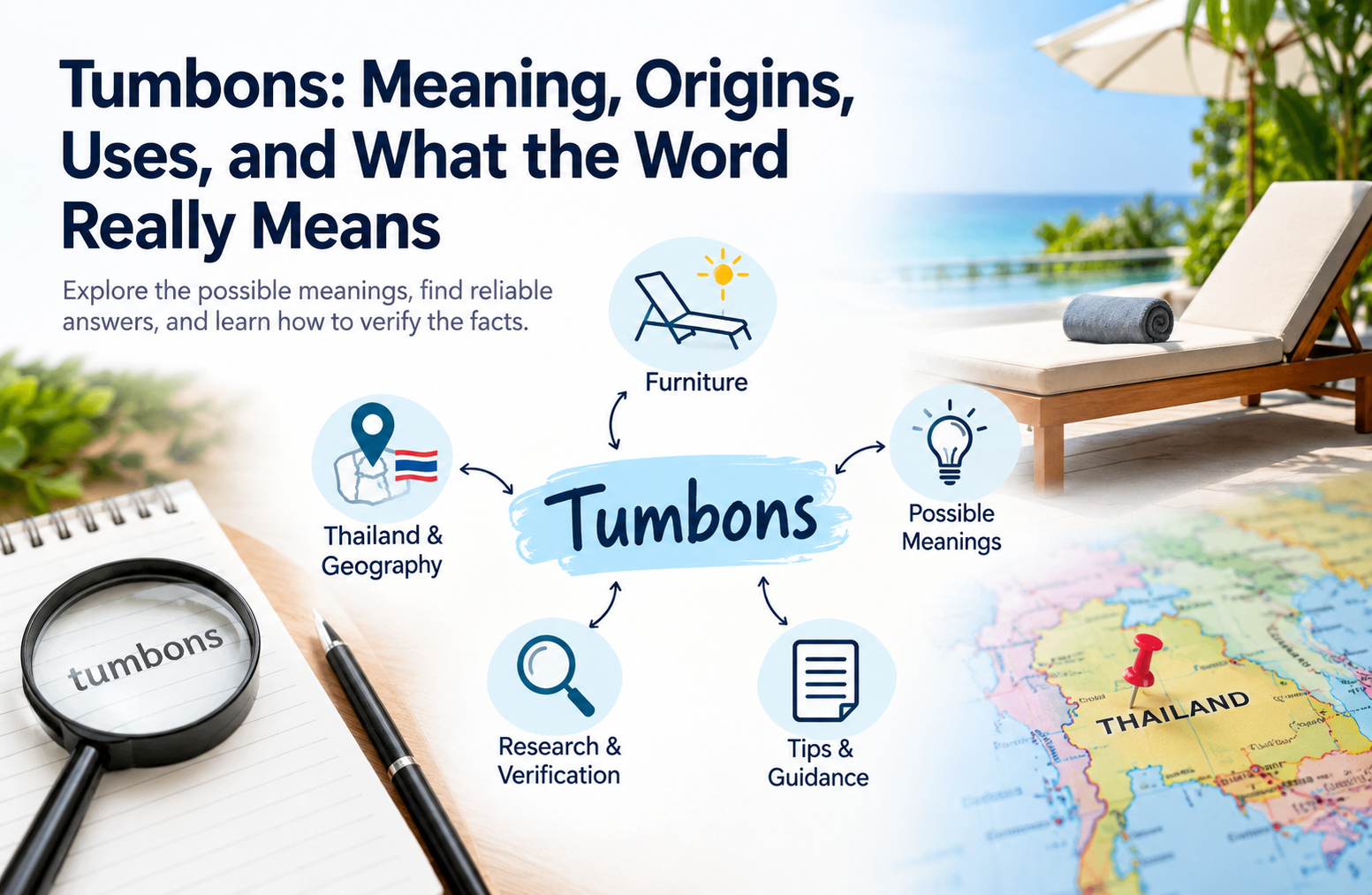
Tumbons: Meaning, Origins, Uses, and What the Word Really Means
The word tumbons can be confusing because it does not have one clearly established meaning in standard English. People searching for this term may be trying to understand a word they found online, identify a type of outdoor furniture, learn about Thai administrative areas, or investigate a term used on a website or social media platform. The key to understanding it is to examine the context rather than assume that every explanation is correct.
This guide explores the meaning of tumbons, possible linguistic connections, common interpretations, practical applications, and ways to verify information about unfamiliar words. It also separates established terminology from claims that appear in online articles without strong supporting evidence. This distinction matters because a word can attract search interest before its meaning, origin, or accepted usage has been properly established.
What Does Tumbons Mean?
At present, tumbons does not have one universally recognized definition in English that can confidently explain every use of the term. Its meaning depends on where it appears and what the surrounding information says.
Several online articles associate the spelling with different subjects, including reclining furniture, lifestyle ideas, textiles, and local administrative areas. However, these descriptions do not all have the same level of reliability. Repeated claims across websites are not sufficient evidence that a word has an established historical or linguistic meaning.
There are three important distinctions to understand:
- An established word: A term with a documented meaning supported by reliable dictionaries, official records, or recognized specialist references.
- A variant spelling: A form that may result from a typing mistake, transliteration, regional usage, or confusion with another word.
- A newly coined or niche term: A word that may have meaning within a particular website, business, community, or online conversation without being widely recognized.
The spelling tumbons could fit one of the latter two categories, depending on the source in which it appears. Without that context, assigning it a definite origin or a single meaning would be misleading.
For readers, the most useful starting point is to identify the subject of the original page. If the discussion concerns travel in Thailand, an administrative term may be relevant. If it concerns poolside furniture, the intended word may be related to a sun lounger. If it appears as a product name or username, it may have a meaning specific to that context.
Understanding the Possible Origins of Tumbons
To investigate an unfamiliar term properly, it helps to distinguish between its spelling, its possible linguistic roots, and the meaning assigned to it by individual websites.
1. The possibility of a spelling variation
One explanation is that tumbons may be a misspelling or an informal variation of another word. Online searches often contain spelling differences because people type unfamiliar terms phonetically, remember a word incorrectly, or encounter inconsistent translations.
A single letter can make a major difference. Two words may look similar while referring to completely different things. For this reason, readers should compare the spelling against the terminology used by authoritative sources in the relevant field.
For example, a furniture listing might use a regional word for a reclining chair, while a travel website might contain a similar-looking term associated with a location. These similarities do not automatically establish a shared origin.
2. A possible connection with reclining furniture
Some websites describe tumbons as comfortable outdoor chairs or loungers. This interpretation may reflect confusion with the Spanish word tumbona, which refers to a reclining chair or deckchair.
However, there is an important linguistic distinction. The Spanish word tumbona is established vocabulary, while tumbons should not automatically be treated as its standard plural form. In Spanish, the plural is tumbonas.
Anyone researching the furniture interpretation can check the Spanish Royal Academy’s dictionary entry for tumbona.
This distinction is useful when shopping internationally. Product descriptions sometimes combine English and foreign-language terms, and spelling differences can affect search results. If you are looking for an outdoor lounger, searching for sun lounger, reclining garden chair, deckchair, or tumbona may produce more relevant results than searching for tumbons alone.
3. A possible connection with Thailand
Another interpretation arises from the Thai administrative term tambon. In Thailand, a tambon is a subdistrict-level administrative area. It is associated with local communities and villages and forms part of the country’s administrative structure.
The word tumbons resembles this term, but resemblance alone does not prove that tumbons is an accepted alternative spelling. When researching Thai geography, it is more reliable to use the established spelling tambon and verify names through official geographical or government records.
This distinction matters for travelers, researchers, students, and anyone reading about local government in Thailand. Confusing a geographical term with a furniture term can lead to entirely unrelated search results.
4. A possible coined or brand-specific term
Tumbons could also be a coined name used by a company, website, online community, or individual. Businesses and digital creators regularly develop distinctive names that do not appear in traditional dictionaries.
In that situation, the intended meaning would need to be established from the original source. Useful evidence might include a product description, company profile, official website, trademark record, or an explanation from the person who created the term.
Without this evidence, claims about a specific inventor, launch date, cultural tradition, or historical background should be treated cautiously.
Why Is Tumbons Difficult to Define?
The difficulty is not simply that the word is unfamiliar. It is that online explanations may present different interpretations as though each were an established fact.
A search result can be useful as a starting point, but it is not proof of a definition. Search engines index content published by many types of websites, including personal blogs, commercial pages, and sites that repeat information from other sources.
Several factors can make an unfamiliar term difficult to interpret.
Inconsistent online descriptions
One article might describe a term as a furniture category, while another presents it as a cultural concept. A third may connect it to a geographical location. If these articles do not provide reliable references, the reader cannot confidently determine which explanation, if any, reflects established usage.
The best approach is to compare the claims with primary sources rather than simply counting how many websites repeat them.
Limited dictionary evidence
Established words often have entries in dictionaries, specialist glossaries, or official terminology databases. A word that cannot be located in these references may still be a valid local expression, brand name, or emerging slang term.
Absence from a dictionary does not prove that a word is meaningless. It does, however, mean that a writer should avoid presenting an unverified definition as universally accepted.
Confusion between similar words
Words that share a similar spelling can have unrelated meanings. This problem becomes more common when content crosses languages or uses transliteration, which represents words from one writing system in another.
For instance, a reader who encounters tumbons in an article about Thailand should investigate the administrative term tambon. A reader who sees it in a garden furniture catalogue should investigate the product category instead.
Repetition mistaken for evidence
A claim does not become reliable merely because multiple websites repeat it. If several pages derive their explanations from the same unsupported statement, they do not necessarily provide independent confirmation.
A trustworthy explanation should identify its evidence and make clear what is known, what is inferred, and what remains uncertain.
Tumbons and Outdoor Furniture: What Buyers Should Know
If you encountered tumbons while searching for garden furniture, poolside seating, or beach equipment, the intended product may be a reclining lounger. It is important, however, to confirm the product’s actual name and specifications before buying anything.
A reclining outdoor chair is designed to support a seated or partially reclined position. Depending on its construction, it may be suitable for a garden, balcony, patio, swimming pool, or beach.
The following considerations are more useful than relying on an unfamiliar label.
Materials and durability
Outdoor furniture needs to withstand the conditions in which it will be used.
Common materials include:
- Aluminium: Lightweight and generally resistant to corrosion, making it useful for portable outdoor furniture.
- Steel: Often strong and stable, although its protective coating and exposure to moisture affect durability.
- Wood: Can provide a natural appearance but may require cleaning, sealing, or other maintenance.
- Synthetic woven materials: Often used for outdoor seating because they can offer a balance of appearance, comfort, and weather resistance.
- Textile mesh: Common in reclining chairs because it allows airflow and can dry relatively quickly.
No material is automatically the best choice for every setting. Coastal environments, strong sunlight, frequent rain, and limited storage space can all influence which option makes sense.
Comfort and adjustability
A chair that looks attractive may not provide good support for extended use.
Before purchasing a lounger, check the following:
- Whether the backrest can be adjusted to a comfortable angle.
- Whether the seat supports your body without excessive sagging.
- Whether the frame feels stable when you shift position.
- Whether the armrests and edges feel comfortable.
- Whether the manufacturer’s weight limit suits the intended user.
If the chair will be used for reading or working outdoors, an upright position may be more practical than a fully reclined one. For sunbathing, a flatter position may be preferable.
Portability and storage
Foldable furniture is useful when space is limited. However, folding mechanisms introduce additional parts that can wear out or become loose.
Look for secure locking mechanisms, accessible adjustment controls, and clear instructions for folding and unfolding the chair. Check its folded dimensions if it must fit in a cupboard, car boot, or small storage area.
Portability is especially important for people who move furniture frequently between a garden, balcony, and indoor storage area.
Cleaning and maintenance
Outdoor furniture usually lasts longer when it is cleaned and stored appropriately.
Simple maintenance practices include removing dirt regularly, following the manufacturer’s cleaning instructions, checking joints and fasteners, and storing cushions in a dry place. Furniture exposed to severe weather may benefit from suitable protective covers.
These recommendations apply to outdoor loungers generally. They should not be mistaken for confirmed specifications of a product called tumbons unless the manufacturer identifies that product and provides supporting details.
Tumbons in Travel and Local Geography
If the term appears in a travel guide, a discussion of local government, or a map of Thailand, the relevant subject may be the Thai tambon rather than furniture.
Understanding the administrative context helps readers interpret the information accurately.
What is a tambon?
A tambon is a subdistrict administrative unit in Thailand. It is generally situated below the district level and includes a number of communities or villages, depending on the area.
The exact administrative arrangements and local government responsibilities can vary. Therefore, a writer should consult official Thai government sources before describing the responsibilities of a particular tambon or naming its officials.
Why the distinction matters to travelers
Administrative place names can help visitors understand addresses, local services, and geographical descriptions. When researching accommodation, transport, or attractions, the correct spelling may improve search accuracy.
If an itinerary mentions a tambon, check the district and province as well. A place name alone may not identify a location uniquely.
How researchers can verify a location
A practical verification process includes:
- Checking the spelling against an official map or government source.
- Confirming the district and province.
- Comparing the location with the address provided by the relevant institution or business.
- Avoiding assumptions based on similar English spellings.
- Recording the original spelling when citing a geographical name.
This process is particularly valuable for academic writing, travel planning, and administrative research.
How to Research Tumbons Accurately
If you want a reliable answer about tumbons, use a structured research process rather than choosing the first definition you encounter.
Step 1: Identify where the word appeared
Start with the original context. Was it in a product listing, a travel article, a social media post, a person’s name, or a general discussion?
The surrounding words often provide the strongest clue. References to cushions, folding frames, and garden seating suggest a furniture-related search. References to districts, villages, and provinces suggest a geographical one.
Step 2: Search for established alternatives
Try spelling variations and related terms without assuming that they are interchangeable.
For example:
- For furniture, search for sun lounger, deckchair, or tumbona.
- For Thai geography, search for tambon alongside the relevant province or district.
- For a business or product, search for the exact name in quotation marks and look for its official website.
This method can reveal whether the original term is a typo, a translation issue, or a specialized name.
Step 3: Check authoritative sources
The appropriate source depends on the subject.
| Research topic | Useful evidence |
| Language and spelling | Established dictionaries and language authorities |
| Thai geography | Official maps and government records |
| Outdoor furniture | Manufacturer specifications and product documentation |
| Brand or business | Official company website and relevant registration records |
| Cultural or historical claims | Academic publications and credible historical sources |
A source should support the specific claim being made. A dictionary can establish a word’s recorded meaning, but it may not prove how a particular company uses the same spelling.
Step 4: Separate facts from interpretations
During research, divide findings into three groups:
- Verified facts: Information directly supported by reliable evidence.
- Reasonable possibilities: Interpretations that fit the context but have not been confirmed.
- Unsupported claims: Statements that lack credible sources or contradict established references.
This simple method prevents speculation from becoming an apparent fact in a published article.
Step 5: Check the date and original source
New terms can emerge, and existing words can develop specialized meanings. A recent product launch or a niche community may introduce a term that has not yet entered mainstream dictionaries.
Look for the earliest reliable source available, check whether later articles cite it, and distinguish original reporting from copied descriptions.
The goal is not to reject every unfamiliar word. It is to understand the strength of the evidence behind the explanation.
Benefits of Understanding Unfamiliar Terms Correctly
Researching a word such as tumbons may seem like a small task, but it illustrates several useful skills that apply to everyday online research.
Better search results
Using the correct spelling helps you find relevant products, places, and reference materials. It also reduces the chance of confusing unrelated subjects.
More informed purchasing decisions
If you are shopping for a particular type of chair, knowing the accepted product name makes it easier to compare dimensions, materials, weight limits, and warranties. You can make decisions based on measurable features rather than vague marketing language.
More accurate travel information
Correct geographical terminology helps travelers identify locations and understand addresses. This can be especially useful when navigating places whose names are transliterated into English.
Stronger writing and research
Writers benefit from checking terminology before publishing. A clear explanation that acknowledges uncertainty is more trustworthy than a confident definition unsupported by evidence.
For bloggers, students, and researchers, this practice also reduces the risk of spreading misinformation through repeated use of an inaccurate definition.
Common Mistakes to Avoid When Researching Tumbons
Several common mistakes can lead to incorrect conclusions.
Assuming that every website agrees. Multiple pages may repeat similar claims without providing independent evidence. Check the original sources rather than treating repetition as confirmation.
Inventing a historical origin. An unfamiliar word may look as though it comes from a particular language, but appearance alone cannot establish its etymology. Historical claims need linguistic or documentary support.
Confusing a product description with a dictionary definition. A company can give a name to a product category or individual item. That usage does not automatically establish a general English meaning.
Treating a possible connection as a proven fact. Tumbons may resemble established words, but resemblance is only a starting point for investigation.
Ignoring the surrounding context. The same spelling may be used as a brand, username, typo, or niche expression. The source determines which interpretation deserves further investigation.
Publishing unverified claims. When reliable evidence is unavailable, it is better to state that the meaning remains uncertain than to invent an explanation.
These mistakes are avoidable. A few minutes spent checking reliable references can produce a more accurate answer than reading several articles that all make unsupported claims.
How Tumbons Should Be Used in Writing
Because the term’s meaning is uncertain, writers should use it carefully and explain the intended meaning whenever possible.
In informational articles
Introduce the spelling, acknowledge the uncertainty, and identify the context in which it appears. If the intended word is tambon or tumbona, explain that distinction clearly.
In product descriptions
Use the manufacturer’s actual product name and recognized furniture terminology. Include measurable information such as dimensions, materials, adjustment settings, and weight capacity where those details are available.
In travel content
Use the established geographical spelling and identify the relevant district and province. Confirm the location with an official source.
In creative or branded content
A creator may define a new term for a particular project. In that case, explain the intended meaning and use it consistently. Readers should be able to distinguish a deliberate coined expression from an established dictionary word.
In academic or professional writing
Avoid treating the term as a recognized technical expression without supporting evidence. If it appears in a source, quote or describe that source accurately and explain any uncertainty about its usage.
The central principle is straightforward: terminology should help readers understand a subject, not create additional confusion.
Frequently Asked Questions About Tumbons
1. What does tumbons mean?
Tumbons does not have one clearly established, universally accepted meaning in standard English. Its intended meaning depends on context and may involve a spelling variation, a niche term, or confusion with another word.
2. Is tumbons a real English word?
Its use can be found online, but online appearances alone do not establish it as a standard English word. A reliable dictionary or specialist reference would be needed to confirm a recognized definition.
3. Are tumbons and tambons the same?
Not necessarily. Tambon is an established term for a subdistrict-level administrative area in Thailand. Tumbons should not automatically be treated as an accepted alternative spelling.
4. Does tumbons refer to outdoor furniture?
Some online articles associate the term with reclining outdoor chairs. However, that interpretation is not sufficient to establish tumbons as a standard furniture name. Search terms such as sun lounger, deckchair, and tumbona may be more useful.
5. What is the difference between tumbons and tumbonas?
Tumbona is a Spanish word for a reclining chair or deckchair, and tumbonas is its Spanish plural. Tumbons is not the standard Spanish plural and should not be assumed to mean the same thing without context.
6. How can I find the correct meaning of tumbons?
Check where you encountered the word, search for possible spelling variations, and consult a reliable dictionary, official geographical record, or product source. If the original context is unavailable, the meaning may remain uncertain.
Conclusion
The term tumbons demonstrates why context and reliable evidence matter when interpreting unfamiliar words. Although online articles associate it with furniture, lifestyle ideas, textiles, and geographical terminology, these interpretations should not be treated as equally established or universally accepted.
The most reliable approach is to identify where the word appears, compare it with recognized terminology, and verify any proposed meaning through an appropriate source. In a furniture context, tumbona may be the relevant Spanish term. In a discussion of Thailand, tambon is the established administrative term. In other situations, tumbons may be a spelling variation or a name whose meaning depends on its creator.
Ultimately, accurate research requires a clear distinction between verified facts and plausible interpretations. Recognizing that distinction helps readers find better information, make informed decisions, and avoid repeating unsupported claims.