Utah Jazz vs Orlando Magic Match Player Stats
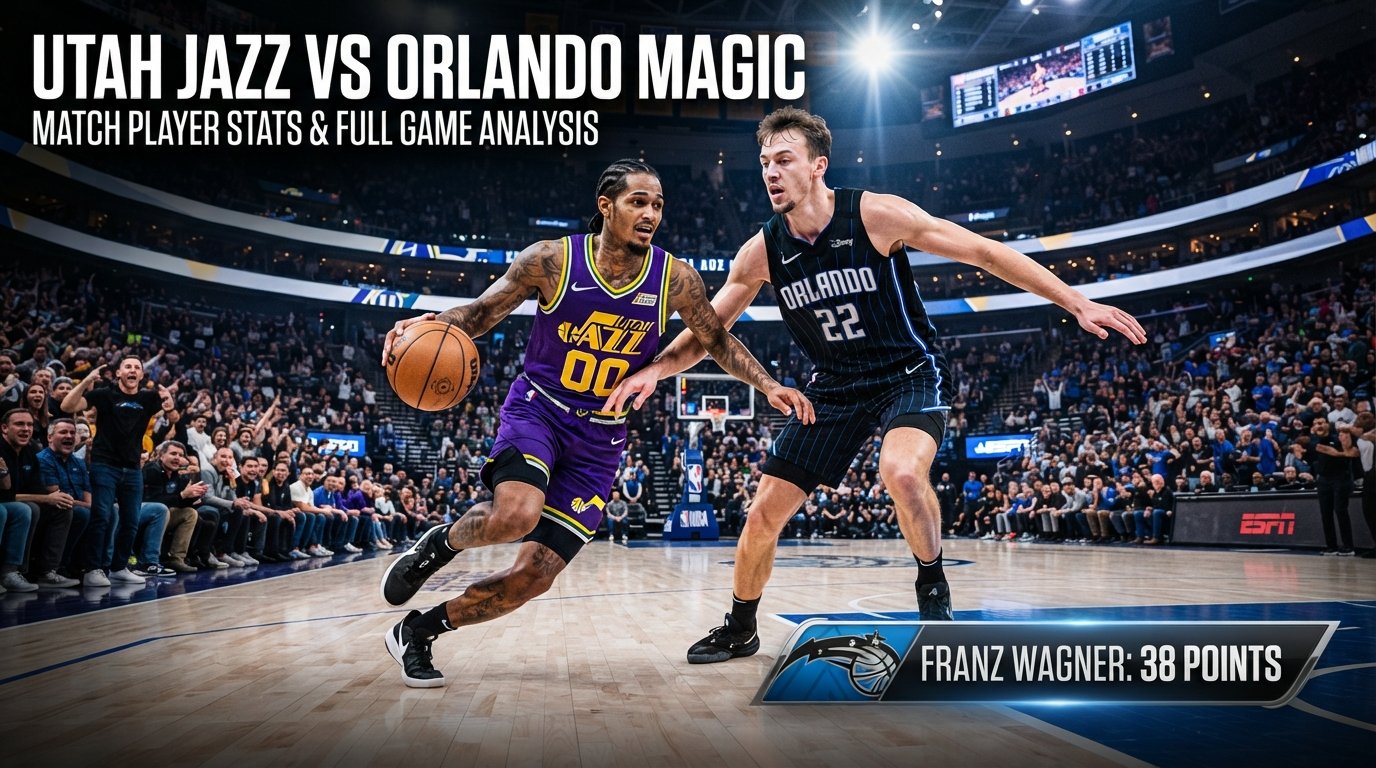
The utah jazz vs orlando magic match player stats from November 12, 2026, tell the story of a game that changed dramatically in its final quarter. The Orlando Magic defeated the Utah Jazz 123-108 at the Delta Center in Salt Lake City. Franz Wagner led Orlando with 38 points and eight rebounds, while Desmond Bane contributed 25 points and Anthony Black added 22 points, eight assists, and seven rebounds. Utah remained competitive through three quarters, but Orlando’s 38-point fourth-quarter performance proved too much for the home team. The final statistics reveal how shooting efficiency, perimeter scoring, rebounding, and late-game execution shaped the result.
Match Overview: Orlando Magic vs Utah Jazz
The matchup featured two teams with different levels of offensive consistency. Utah started strongly and looked capable of controlling the game, but Orlando gradually found better scoring opportunities and finished with greater efficiency.
Game information
| Match detail | Information |
| Matchup | Orlando Magic vs Utah Jazz |
| Date | November 12, 2026 (Salt Lake City local date) |
| Venue | Delta Center |
| Location | Salt Lake City, Utah |
| Attendance | 17,867 |
| Final score | Orlando 123, Utah 108 |
| Winning team | Orlando Magic |
| Winning margin | 15 points |
| Season series | Orlando led 1-0 |
The game is listed as November 11 on some US-based NBA schedules because of the local time and date presentation. The November 12 date corresponds to the game information supplied for the matchup.
NBA.com+1
Utah Jazz vs Orlando Magic Match Player Stats: Complete Game Results
The individual performances explain why Orlando eventually created separation. Wagner was the leading scorer, Bane supplied valuable perimeter shooting, and Black helped organize the offense.
Utah also had several productive players. Darryn Peterson led the Jazz scoring effort, while Brice Sensabaugh provided an important contribution from the bench.
Orlando Magic player statistics
| Player | Points | Rebounds | Assists |
| Franz Wagner | 38 | 8 | 1 |
| Desmond Bane | 25 | 3 | 2 |
| Anthony Black | 22 | 7 | 8 |
| Jevon Carter | 11 | 3 | 4 |
| Wendell Carter Jr. | 9 | 7 | 3 |
| Jase Richardson | 6 | 1 | 2 |
| Alex Morales | 5 | 4 | 3 |
| Goga Bitadze | 4 | 7 | 0 |
| Nikola Vucevic | 3 | 5 | 1 |
| Colin Castleton | 0 | 0 | 0 |
Statistics are from the reported game box score. Players who did not participate are discussed separately.
NBA.com+1
Utah Jazz player statistics
| Player | Points | Rebounds | Assists |
| Darryn Peterson | 22 | 4 | 5 |
| Brice Sensabaugh | 19 | 3 | 1 |
| Ace Bailey | 18 | 7 | 1 |
| Keyonte George | 13 | 7 | 7 |
| Jaxson Hayes | 8 | 5 | 2 |
| Svi Mykhailiuk | 3 | 0 | 2 |
| Josh Okogie | 4 | 3 | 0 |
| Isaiah Collier | 7 | 3 | 2 |
The table highlights the leading reported Utah contributors. Individual totals should be checked against the official box score when publishing a complete statistical record.
FlashSport+1
Franz Wagner Leads Orlando With 38 Points
Orlando Magic | Leading scorer
Franz Wagner Injury Update: Who is the Fantasy Basketball ‘Next Man Up’ for Orlando?
38 PTS
Franz Wagner
8 rebounds · 1 assist · 13-of-23 field goals
Franz Wagner delivered the most influential individual performance of the matchup. His 38 points gave Orlando a dependable scoring option throughout the contest and helped the Magic recover from an early deficit.
He finished with 13 successful field goals from 23 attempts, an impressive shooting percentage of approximately 56.5%. He also converted nine of his 10 free throws and made three three-pointers.
What makes this performance particularly interesting is the timing of his scoring. Wagner was not simply collecting points while Orlando already controlled the game. He helped the Magic establish their halftime advantage and remained important when Utah threatened to regain control in the second half.
His eight rebounds also added value beyond scoring. For a forward, contributing on the defensive glass helps a team finish possessions and prevents opponents from receiving additional opportunities.
Wagner’s performance demonstrated three important strengths:
- Scoring consistency: He converted more than half of his field-goal attempts.
- Free-throw reliability: Nine successful attempts from the line helped maintain Orlando’s scoring pressure.
- All-around contribution: Eight rebounds and a steal complemented his offensive production.
The 38-point performance matched his career high according to the Associated Press game report.
ESPN+1
Why Wagner’s scoring mattered
Utah needed to contain Orlando’s primary scoring options to protect its early lead. Wagner made that difficult because he could contribute through different types of possessions.
His field goals, perimeter attempts, and free throws gave Orlando multiple ways to maintain offensive production. This reduced the pressure on other players to create every scoring opportunity.
His performance was especially important because Orlando did not have a comfortable advantage throughout the game. The Magic needed a reliable offensive leader, and Wagner supplied exactly that.
Desmond Bane Adds 25 Points With Outstanding Three-Point Shooting
Cleveland Cavaliers v Orlando Magic #5 by Fernando Medina
25 PTS
Desmond Bane
3 rebounds · 2 assists · 7-of-11 three-pointers
Desmond Bane provided Orlando with another major scoring threat. His 25 points were particularly valuable because he converted seven of his 11 three-point attempts.
That represents approximately 63.6% shooting from beyond the arc, an outstanding result in a game where perimeter efficiency played a major role.
Bane’s shooting complemented Wagner’s scoring rather than simply repeating it. Wagner supplied Orlando with a high-volume scoring performance, while Bane punished Utah whenever the defense allowed him space outside the three-point line.
His overall shooting numbers were also strong. He made nine of 16 field-goal attempts and finished with a plus-minus rating of +16.
The importance of his contribution becomes clearer when considering Utah’s defensive choices. Giving Wagner additional attention could leave Bane with more opportunities beyond the arc. Focusing too heavily on Bane could create better scoring conditions for Wagner.
This offensive balance made Orlando harder to defend.
Anthony Black Contributes 22 Points and Eight Assists
22 PTS
Anthony Black
7 rebounds · 8 assists · 3 steals?
Anthony Black delivered one of Orlando’s most complete performances. His 22 points were supported by seven rebounds and eight assists, making him an important contributor in both scoring and playmaking.
Black converted six of 14 field-goal attempts and made three of six shots from three-point range. He also converted seven of nine free throws.
His eight assists are especially important when examining the Magic’s overall offensive performance. Orlando finished with 24 team assists, meaning Black supplied one-third of the team’s total.
This contribution helped distribute scoring responsibility across the lineup.
Instead of depending entirely on Wagner and Bane, Orlando had another player capable of creating opportunities and keeping the offense organized.
Black also finished with a game-best starting-player plus-minus of +19. This means Orlando outscored Utah by 19 points during his time on the court.
His overall contribution highlights why a player’s value cannot always be understood through points alone. Passing, rebounding, defensive activity, and decision-making also influence the result.
Statistical clarification: Black recorded one steal, not three. His key playmaking figures were eight assists and seven rebounds.
NBA.com+1
Jevon Carter Provides Valuable Bench Production
Jevon Carter is proving to be a perfect fit for the Orlando Magic
11 PTS
Jevon Carter
3 rebounds · 4 assists · +24 plus-minus
Jevon Carter was another important part of Orlando’s victory. Although he came off the bench, his contribution was significant.
He finished with 11 points, four assists, three rebounds, and two steals. He also made three of his 10 three-point attempts.
His most impressive statistical figure was his plus-minus rating of +24, the highest recorded by any player in the game.
Plus-minus measures the difference between a team’s points scored and points allowed while a particular player is on the court. A +24 rating means Orlando outscored Utah by 24 points during Carter’s playing time.
This figure does not mean Carter personally created a 24-point advantage. It reflects the combined performance of the team during his minutes. However, it provides useful evidence of how effective Orlando’s lineups were with him involved.
His four assists also helped maintain offensive movement. Rather than relying exclusively on individual scoring, Carter contributed to the distribution of the basketball.
His performance is a good example of why bench production matters in NBA games. A team’s starters may establish the foundation, but reserves often help maintain momentum when rotations change.
Wendell Carter Jr. Supports Orlando’s Frontcourt
Wendell Carter Jr. recorded nine points, seven rebounds, and three assists.
His scoring was not as high as Wagner’s or Bane’s, but his contribution around the basket helped Orlando compete physically.
Carter Jr. made three of his five field-goal attempts and converted all three free throws. His seven rebounds also helped Orlando maintain an advantage on the boards.
His contribution was important because Utah had several players capable of attacking the basket and competing for rebounds.
A frontcourt player’s value extends beyond scoring. Rebounding, positioning, screening, and defensive coverage can all influence how effectively a team performs.
Carter Jr.’s seven rebounds were part of Orlando’s overall 45-rebound performance.
Utah Jazz Player Performance Analysis
The Utah Jazz did not leave the game without positive individual performances. Several players delivered useful offensive contributions, and the team remained competitive for three quarters.
However, the final result showed that individual scoring was not enough to overcome Orlando’s improved fourth-quarter execution.
Darryn Peterson Leads Utah With 22 Points
22 PTS
Darryn Peterson
5 assists · 4 rebounds
Darryn Peterson was Utah’s leading scorer with 22 points. He also recorded five assists and four rebounds.
His scoring gave the Jazz an important offensive option, particularly during stretches when the team needed to respond to Orlando’s runs.
Peterson’s five assists indicate that he was involved in more than individual scoring. He also helped create opportunities for teammates.
For Utah, this type of contribution was important because Orlando had multiple players capable of producing points. The Jazz needed a similarly balanced offensive approach to remain competitive.
Peterson’s performance was one of the main positive aspects of Utah’s offensive display.
However, the team’s overall shooting efficiency remained below Orlando’s level. Even productive individual performances can become less influential when the supporting offense struggles to convert opportunities.
Brice Sensabaugh Scores 19 Points From the Bench
PHOTOS | Best of Brice Sensabaugh 2025-26 Season | Utah Jazz
19 PTS
Brice Sensabaugh
Important bench scoring contribution
Brice Sensabaugh produced 19 points for Utah, making him one of the team’s most important offensive contributors.
His scoring was particularly valuable because it came from the bench. Bench players are often expected to maintain offensive production when starters leave the court.
Sensabaugh gave Utah another scoring option and helped the team remain involved in the contest.
His contribution also demonstrated that Utah had players capable of producing points outside its starting lineup.
However, Orlando’s bench production was more effective collectively. Carter, Bitadze, Richardson, and other reserves helped the Magic maintain their advantage during different rotation periods.
The difference was not simply the number of points scored by individual substitutes. It was how effectively each team’s overall rotation supported its starting lineup.
Ace Bailey Records 18 Points and Four Blocks
Utah Jazz rookie Ace Bailey is developing at his own pace this season
18 PTS
Ace Bailey
7 rebounds · 4 blocks · 2 steals
Ace Bailey delivered an impressive all-around performance for Utah.
He scored 18 points and collected seven rebounds. His defensive production was particularly noteworthy because he recorded four blocks and two steals.
Four blocks represent a significant defensive contribution. They show how a player can influence the opposing offense without necessarily collecting a large number of rebounds or scoring many points.
Bailey’s defensive activity helped Utah contest shots and challenge Orlando around the basket.
His seven rebounds also supported the Jazz’s efforts to compete on the boards.
The interesting aspect of Bailey’s performance is the combination of offensive and defensive production. He contributed to the scoreboard while also providing defensive activity.
Nevertheless, Utah needed more consistent team execution to turn these individual contributions into a victory.
Keyonte George Contributes 13 Points and Seven Assists
Keyonte George finished with 13 points, seven rebounds, and seven assists.
His statistical contribution demonstrated his involvement in several areas of the game.
Seven assists indicate that George helped create scoring opportunities for teammates. His seven rebounds also gave Utah additional support in possession battles.
However, Orlando’s offensive balance made it difficult for Utah to control the game through individual defensive assignments.
George’s contribution was useful, but the Jazz needed more efficient collective shooting and better execution during the final period.
Quarter-by-Quarter Scoring Breakdown
The most revealing part of this matchup is the change in momentum across four quarters.
Utah started with a five-point advantage. Orlando responded in the second quarter, and the teams continued trading control after halftime.
The final quarter completely changed the outcome.
Quarter-by-quarter scoreboard
| Quarter | Orlando Magic | Utah Jazz | Quarter winner |
| First | 29 | 34 | Utah |
| Second | 37 | 25 | Orlando |
| Third | 19 | 28 | Utah |
| Fourth | 38 | 21 | Orlando |
| Final | 123 | 108 | Orlando |
NBA.com+1
Points scored by quarter
Orlando’s 38-point fourth quarter decided the game.
■ Orlando Magic
■ Utah Jazz
First Quarter: Utah Takes Early Control
The Utah Jazz started the game with greater scoring momentum.
They recorded 34 points compared with Orlando’s 29, creating a five-point advantage.
Utah’s opening performance suggested that the home team could compete effectively against Orlando.
The Jazz found scoring opportunities and managed to put pressure on the Magic early.
Orlando, meanwhile, needed time to establish its offensive rhythm.
A five-point deficit is not particularly difficult to overcome in an NBA game, but it placed additional importance on the second quarter.
The Magic needed to improve their shooting and find ways to create more efficient possessions.
Second Quarter: Orlando Changes the Direction
The second quarter was the first major turning point.
Orlando scored 37 points, while Utah managed only 25.
This 12-point quarter advantage completely erased Utah’s opening lead.
The Magic entered halftime with a 66-59 advantage.
Wagner’s scoring was especially important during this period. His offensive production helped Orlando create separation, while the supporting players contributed through shooting and playmaking.
The second quarter demonstrated how quickly an NBA game can change when one team finds a better offensive rhythm.
Utah had started strongly, but Orlando’s improved scoring efficiency allowed the visitors to take control.
Third Quarter: Utah Responds Again
Utah did not allow Orlando to maintain complete control after halftime.
The Jazz scored 28 points in the third quarter, compared with 19 from the Magic.
That nine-point advantage reduced Orlando’s halftime lead.
By the end of the third quarter, Utah had moved ahead 87-85.
This was an important moment because it showed that the Jazz were still capable of competing.
The Magic had controlled the second quarter, but Utah found a way to respond.
For Orlando, the third quarter created a need for better offensive execution. The team had to avoid allowing Utah to carry its momentum into the final period.
For the Jazz, the two-point lead created an opportunity to finish the game strongly.
Fourth Quarter: Orlando Produces a Decisive 38-21 Run
The fourth quarter was the defining period of the matchup.
Orlando scored 38 points, while Utah managed only 21.
The 17-point difference in the final period transformed a two-point deficit into a 15-point victory.
The official game summary describes a decisive Orlando scoring run after Utah had moved ahead 96-95 on a Sensabaugh three-pointer. Orlando responded with an 18-3 run and took control for good.
NBA.com
This sequence highlights the importance of responding to pressure.
Utah had created an opportunity to establish control, but Orlando answered with a much stronger stretch of basketball.
Wagner and Bane supplied scoring, while Black helped organize the offense.
The Magic’s ability to generate points from several players made it difficult for Utah to recover.
The final quarter was not simply about scoring more points. It reflected a difference in offensive execution, shot-making, and momentum management.
Team Statistical Comparison: Magic vs Jazz
The overall team numbers provide a clearer explanation of the result.
Orlando finished with better shooting percentages from both the field and three-point range. The Magic also recorded more rebounds and assists.
Utah matched Orlando in turnovers, but the Jazz did not convert enough scoring opportunities to compensate for the shooting difference.
| Statistical category | Orlando Magic | Utah Jazz |
| Total points | 123 | 108 |
| Field goals | 41/87 | 33/81 |
| Field-goal percentage | 47% | 41% |
| Three-pointers | 18/46 | 14/44 |
| Three-point percentage | 39% | 32% |
| Free throws | 23/28 | 28/34 |
| Free-throw percentage | 82% | 82% |
| Rebounds | 45 | 38 |
| Assists | 24 | 21 |
| Turnovers | 11 | 11 |
| Steals | 7 | 6 |
| Blocks | 4 | 8 |
| Personal fouls | 28 | 23 |
FlashSport+1
Field-Goal Percentage: Orlando Has the Advantage
Orlando converted 41 of 87 field-goal attempts, producing a shooting percentage of approximately 47%.
Utah made 33 of 81 attempts, finishing at approximately 41%.
The six-percentage-point difference is important because it shows that Orlando converted a greater share of its scoring opportunities.
The Magic also attempted six more field goals than Utah.
When a team combines a higher shooting percentage with more attempts, it creates a significant offensive advantage.
Three-Point Shooting: Bane Helps Create Separation
The Magic made 18 of 46 three-point attempts.
Utah converted 14 of 44.
Orlando’s 39% accuracy was higher than Utah’s 32%.
Although the difference may look relatively small, the additional four successful three-pointers represent 12 extra points.
Bane’s seven successful attempts were particularly important.
His perimeter shooting gave Orlando another reliable scoring option and made Utah’s defensive responsibilities more complicated.
Rebounding: Orlando Controls More Possessions
Orlando collected 45 rebounds, compared with Utah’s 38.
That seven-rebound advantage helped the Magic control more possessions and reduce Utah’s opportunities for second-chance scoring.
Rebounding is important because a defensive stop is not always complete when the opponent misses a shot.
The defensive team must also secure possession.
When an opponent collects an offensive rebound, it receives another opportunity to score.
Orlando’s advantage on the boards helped limit those additional opportunities.
Assists: Better Offensive Distribution From Orlando
The Magic finished with 24 assists, while the Jazz recorded 21.
This difference suggests that Orlando was slightly more effective at creating assisted scoring opportunities.
Black’s eight assists were particularly important.
A strong assist total often indicates effective ball movement and successful coordination between players.
However, assists should not be viewed as a complete measure of offensive quality. Some successful scoring possessions come from individual plays, while some passes that create advantages do not lead directly to assists.
In this game, Orlando’s combination of scoring and passing was more productive overall.
Turnovers: Both Teams Finish Level
Both teams committed 11 turnovers.
This is an important detail because Orlando did not win simply by avoiding mistakes while Utah repeatedly lost possession.
Instead, the difference came primarily from shooting efficiency, rebounding, and the ability to execute during the final quarter.
Blocks: Utah Produces More Defensive Stops
Utah recorded eight blocks, compared with Orlando’s four.
This was one of the few major statistical categories in which the Jazz held a clear advantage.
Bailey’s four blocks were particularly notable.
However, a higher block total does not automatically mean a team has performed better defensively.
Blocks represent only one part of defense. Teams must also defend perimeter attempts, prevent easy baskets, secure rebounds, and avoid giving opponents free throws.
Orlando’s overall offensive production remained stronger despite Utah’s advantage in blocks.
How Orlando Won the Game: Three Important Factors
The final score explains who won, but the statistical details explain why Orlando was able to secure the victory.
Three areas were particularly important: offensive efficiency, scoring balance, and fourth-quarter execution.
1. Orlando Had More Reliable Scoring Options
Wagner’s 38 points were the foundation of Orlando’s offense, but the Magic did not depend on him alone.
Bane scored 25 points, while Black added 22.
Together, these three players contributed 85 points.
That represents approximately 69% of Orlando’s total scoring output.
This distribution created an important advantage. Utah could not focus entirely on stopping Wagner because Bane and Black were also producing points.
A team with multiple scoring options can create difficult defensive decisions for its opponent.
If Utah committed additional defenders to Wagner, Bane could receive better perimeter opportunities. If the defense focused on the perimeter, Wagner could find more room to attack.
Orlando benefited from this offensive balance throughout the game.
2. Three-Point Accuracy Created an Important Difference
The Magic converted four more three-pointers than Utah.
That difference contributed 12 additional points from beyond the arc.
Bane’s individual performance was especially valuable because he converted seven of his 11 attempts.
Orlando also received three successful three-pointers from Wagner and three from Black.
This meant the Magic had multiple players capable of producing perimeter scoring.
Utah also made 14 three-pointers, so the Jazz were not completely ineffective from outside.
However, their lower shooting percentage meant they needed more attempts to produce the same scoring output.
When a team consistently converts perimeter opportunities, it can change the defensive positioning of its opponent.
Defenders must move farther away from the basket, creating additional space for drives and inside scoring.
Orlando’s perimeter performance helped create that advantage.
3. The Fourth Quarter Demonstrated Better Execution
The final quarter provided the clearest evidence of Orlando’s advantage.
Utah entered the period with an 87-85 lead.
The Jazz had successfully responded to Orlando’s second-quarter performance and appeared capable of finishing the contest.
However, Orlando produced 38 points in the final period.
Utah managed only 21.
The official game summary reports that Orlando responded to Utah’s 96-95 lead with an 18-3 scoring run.
This sequence changed the direction of the contest.
The Magic created separation, reduced Utah’s opportunity to recover, and maintained their advantage until the final buzzer.
The result demonstrates why performance across all four quarters matters more than simply leading for most of a game.
A team can control three periods and still lose if it struggles during the closing minutes.
The Impact of Bench Players on the Final Result
Bench production is an important part of NBA basketball because teams rarely rely on the same five players throughout an entire game.
Coaches use substitutions to manage fatigue, adjust defensive matchups, and maintain offensive quality.
In this matchup, Orlando received valuable contributions from several reserves.
Orlando’s Bench Contribution
Jevon Carter scored 11 points and recorded four assists.
Goga Bitadze contributed four points, seven rebounds, and two blocks.
Jase Richardson added six points, one rebound, and two assists.
Nikola Vucevic recorded three points and five rebounds.
Colin Castleton appeared briefly without scoring.
These contributions helped Orlando maintain a competitive rotation.
Carter was especially important because he combined scoring with playmaking and defensive activity.
Bitadze’s rebounding and interior defense also provided useful support.
The value of bench players should not be measured only by their points. A reserve can help a team by defending effectively, securing rebounds, limiting turnovers, and creating opportunities for starters.
Utah’s Bench Contribution
Utah received 19 points from Brice Sensabaugh.
That was an important contribution, particularly because he provided scoring beyond the starting lineup.
The Jazz also received production from their other rotation players.
However, Orlando’s overall shooting advantage and stronger final period made its collective performance more effective.
One important lesson from this matchup is that bench production must be considered alongside starting-lineup performance.
A team may have a productive individual reserve but still struggle if its overall rotations cannot maintain defensive pressure or offensive consistency.
Matchup Analysis: Orlando’s Offense Against Utah’s Defense
Orlando’s offensive performance involved several different scoring methods.
The Magic were effective from the field, produced 18 successful three-pointers, and converted 23 free throws.
This variety made their offense difficult to contain.
Utah recorded more blocks, but the team struggled to prevent Orlando from generating efficient shooting opportunities.
Perimeter Defense Was an Important Issue
Orlando’s 39% three-point shooting percentage was higher than Utah’s 32%.
The difference suggests that Utah did not consistently prevent Orlando from converting perimeter opportunities.
Bane’s performance made this especially noticeable.
When a shooter converts seven three-pointers, the defense must reconsider how much space it allows him.
Leaving a player open can create an immediate scoring threat.
However, aggressively closing out on shooters can also create opportunities for drives and passes.
The Magic benefited from this difficult defensive balance.
Interior Defense Did Not Tell the Whole Story
Utah recorded eight blocks, twice Orlando’s four.
This shows that the Jazz had players capable of challenging shots near the basket.
Nevertheless, the Magic still scored 123 points.
The difference highlights an important statistical principle: individual defensive numbers should always be considered alongside overall team performance.
A high block total may indicate effective rim protection, but it does not necessarily demonstrate that a team has defended the entire court successfully.
Orlando’s outside shooting and offensive movement helped offset Utah’s advantage in blocks.
Matchup Analysis: Utah’s Offense Against Orlando’s Defense
Utah’s 108 points demonstrate that the Jazz were capable of producing offense.
The team had four notable individual contributors:
- Darryn Peterson scored 22 points.
- Brice Sensabaugh recorded 19 points.
- Ace Bailey added 18 points.
- Keyonte George contributed 13 points.
These performances gave Utah a reasonable scoring foundation.
However, the team finished with a lower field-goal percentage and three-point percentage than Orlando.
The difference became especially important during the final quarter.
Utah Needed Greater Offensive Consistency
The Jazz scored 34 points in the first quarter and 28 in the third.
Those performances showed that the team could find successful scoring opportunities.
However, the second quarter brought only 25 points, and the fourth quarter produced 21.
This inconsistency made it difficult for Utah to maintain pressure.
A successful offensive approach requires more than occasional scoring runs. Teams must find ways to generate quality possessions even when their initial options are unavailable.
Utah’s fourth-quarter performance was particularly costly because Orlando was able to build a substantial advantage during that period.
Ball Movement Was Another Important Factor
Utah recorded 21 assists, three fewer than Orlando.
The difference was not enormous, but it reflected Orlando’s slightly stronger offensive distribution.
George’s seven assists and Peterson’s five assists were important contributions.
However, the Jazz needed additional consistency from their overall offense to match Orlando’s production.
Better ball movement can create open shots, reduce difficult individual attempts, and help players find more favorable positions.
In a close game, those improvements can make a meaningful difference.
What the Plus-Minus Statistics Reveal
Plus-minus is one of the most interesting figures in the box score because it provides a different way to evaluate player contributions.
Unlike points, rebounds, and assists, plus-minus measures the team’s scoring margin while a particular player is on the court.
Several Orlando players recorded positive figures:
| Orlando player | Plus-minus |
| Jevon Carter | +24 |
| Anthony Black | +19 |
| Desmond Bane | +16 |
| Goga Bitadze | +13 |
| Franz Wagner | +10 |
| Jase Richardson | +4 |
| Wendell Carter Jr. | +2 |
Jevon Carter’s +24 was the highest individual figure in the matchup.
Anthony Black’s +19 and Desmond Bane’s +16 also reflected strong team results during their playing time.
These numbers provide useful context, but they should not be treated as independent proof of individual quality.
Plus-minus is affected by teammates, opponents, substitutions, and the overall flow of the game.
For example, a player can have a strong individual performance but a negative plus-minus because the opposing team scores more during his minutes.
Similarly, a reserve can record a high positive figure because he enters during a particularly productive stretch.
The best approach is to combine plus-minus with traditional statistics and game context.
Shooting Efficiency and Its Importance in Basketball Analysis
One of the most useful lessons from this matchup concerns shooting efficiency.
The Magic scored 123 points on 87 field-goal attempts.
The Jazz scored 108 points on 81 attempts.
Orlando’s higher field-goal percentage indicates that it converted more of its attempts successfully.
However, field-goal percentage does not provide a complete picture.
Three-point shots are worth more than two-point shots, while free throws also contribute to the final score.
A more complete analysis considers:
- Field-goal percentage.
- Three-point percentage.
- Free-throw percentage.
- Offensive rebounds.
- Turnovers.
- Points per possession.
These measurements help explain how effectively a team uses its opportunities.
In this game, Orlando’s advantage in field-goal and three-point shooting was particularly important.
The Magic also secured seven more rebounds, helping them maintain control of the ball.
Utah’s equal turnover total shows that the Jazz did not lose the game simply through excessive possession mistakes.
The overall difference came from how successfully each team converted its offensive opportunities.
Player Availability and Missing Contributors
Player availability is another important factor when evaluating an NBA result.
Both teams had players who did not participate in this matchup.
Orlando Magic: Players Who Did Not Play
The reported game information lists:
- Jamal Cain: Did not play because of a left shoulder issue.
- Tristan da Silva: Did not play because of a left calf issue.
Their absence reduced the available rotation options.
However, Orlando still received substantial production from its active players.
Wagner, Bane, Black, and Carter provided enough offensive production to secure the victory.
Utah Jazz: Players Who Did Not Play
The reported information lists the following Utah players as inactive by coach’s decision:
- Harrison Ingram
- Kyle Filipowski
- Tony Bradley
- Kobe Bufkin
Their absence should be considered when examining the team’s available rotation.
However, it would be inaccurate to claim that these absences directly caused the defeat without additional evidence about the team’s tactical decisions and player roles.
Utah’s active players still managed to produce 108 points.
The more direct statistical explanation for the loss is Orlando’s superior shooting and fourth-quarter scoring.
What the Match Result Means for Both Teams
The 123-108 result provided different lessons for Orlando and Utah.
For Orlando, the victory demonstrated the importance of having several dependable offensive contributors.
For Utah, the game highlighted the need for more consistent shooting and better execution during important stretches.
What Orlando Can Take From the Victory
The Magic can take several positive points from this performance.
First, their scoring balance was effective.
Wagner, Bane, and Black combined for 85 points.
Having three productive players made Orlando’s offense more difficult to defend.
Second, perimeter shooting provided an important advantage.
The Magic converted 18 three-pointers, compared with Utah’s 14.
This difference helped Orlando maintain offensive pressure.
Third, the bench made useful contributions.
Carter’s 11 points and four assists helped support the starting lineup.
Bitadze also contributed seven rebounds and two blocks.
Fourth, the team responded well under pressure.
After Utah took the lead in the third quarter, Orlando delivered its strongest scoring period of the game.
This ability to respond was one of the most important reasons for the victory.
What Utah Can Learn From the Defeat
The Jazz also had several positive individual performances, but the final result exposed areas that required improvement.
First, shooting consistency was a concern.
Utah finished with a 41% field-goal percentage and a 32% three-point percentage.
Improving shot selection and creating better opportunities could help the team become more efficient.
Second, fourth-quarter defense needed improvement.
Allowing 38 points in the final period made it difficult to recover.
Utah needed to find a better way to slow Orlando’s offense.
Third, offensive balance remained important.
Peterson, Sensabaugh, Bailey, and George all made useful contributions.
However, the team needed stronger collective production during the final stretch.
Fourth, defensive rebounds were important.
Utah finished seven rebounds behind Orlando.
Securing more defensive rebounds could help the Jazz prevent second-chance opportunities and create additional offensive possessions.
How to Read an NBA Box Score Correctly
A box score contains much more information than the final score.
For readers who follow basketball statistics, understanding the abbreviations makes it easier to evaluate individual performances.
Here are the most important terms used in the Utah and Orlando matchup.
| Abbreviation | Meaning | What it tells you |
| PTS | Points | Total points scored |
| REB | Rebounds | Total rebounds collected |
| AST | Assists | Passes leading directly to baskets |
| STL | Steals | Opponent possessions taken away |
| BLK | Blocks | Shots blocked defensively |
| TO | Turnovers | Lost possessions |
| FG | Field goals | Successful field goals and attempts |
| 3PT | Three-pointers | Successful shots from outside the arc |
| FT | Free throws | Successful free throws |
| +/- | Plus-minus | Team scoring margin during playing time |
| MIN | Minutes | Time spent on the court |
Why Points Alone Are Not Enough
A player who scores 25 points may appear more productive than a player who scores 15.
However, the second player might contribute more rebounds, assists, steals, and defensive activity.
This is why basketball analysts consider multiple statistical categories.
For example, Anthony Black’s 22 points were supported by eight assists and seven rebounds.
His contribution was more extensive than his scoring total alone suggests.
Similarly, Ace Bailey’s 18 points were accompanied by seven rebounds, four blocks, and two steals.
His defensive production added another dimension to his performance.
Why Shooting Attempts Matter
Two players can score the same number of points while using very different numbers of attempts.
A player who scores 20 points on 10 successful field goals from 15 attempts has been more accurate than a player who needs 20 attempts to score the same amount through field goals.
Free throws and three-point shots also affect the calculation.
For this reason, analysts examine both the total points and the number of attempts required to produce them.
This approach gives readers a better understanding of offensive efficiency.
Historical Context and the Season-Series Result
The November matchup gave Orlando a 1-0 lead in the season series against Utah.
The result was also important in the context of the records displayed alongside the game.
Orlando entered with a reported 4-7 overall record and a 4-3 away record.
Utah entered with a reported 1-11 overall record and a 1-6 home record.
These records help explain the teams’ positions at the time of the matchup.
However, season records should always be associated with their correct date.
A team’s standing can change after every completed game.
For that reason, the later standings displayed on a sports page should not be confused with the records at the time of this contest.
The supplied information also shows later records of 7-8 for Orlando and 3-14 for Utah. Those figures belong to a later standings snapshot and should be treated separately from the pregame records.
The most useful historical takeaway from this matchup is the season-series advantage Orlando established with its 15-point victory.
Official Match Information and Statistical Verification
Readers looking for the complete box score should prioritize official NBA records.
The official league game page provides access to the game summary, player statistics, quarter-by-quarter scoring, and other match information.
For the original statistical record, consult the official NBA Magic vs Jazz box score.
This is particularly useful when checking:
- Individual player minutes.
- Field goals made and attempted.
- Three-point shooting.
- Free throws.
- Offensive and defensive rebounds.
- Assists, steals, and blocks.
- Turnovers and plus-minus ratings.
Using the official record is important because secondary sports pages sometimes display different date formats or rounded statistical values.
For an informational article, the final score and major player performances should be checked against the same game record before publication.
Full Game Scorecard
The following game display provides another way to review the final result and quarter-by-quarter scoring.
Magic vs. Jazz
Delta Center • Salt Lake City, UT
Magic
4 – 7
123
Final
Nov 12
108
Jazz
1 – 11
| Team | Q1 | Q2 | Q3 | Q4 | T |
| https://persistent.oaistatic.com/sonic/logos/nba/583ed157-fb46-11e1-82cb-f4ce4684ea4c/h250-max-resize.png
Magic |
29 | 37 | 19 | 38 | 123 |
| https://persistent.oaistatic.com/sonic/logos/nba/583ece50-fb46-11e1-82cb-f4ce4684ea4c/h250-max-resize.png
Jazz |
34 | 25 | 28 | 21 | 108 |
Frequently Asked Questions
1. Who won the Utah Jazz vs Orlando Magic game on November 12, 2026?
The Orlando Magic defeated the Utah Jazz 123-108. Orlando secured the 15-point victory after scoring 38 points in the fourth quarter.
2. How many points did Franz Wagner score against the Utah Jazz?
Franz Wagner scored 38 points and collected eight rebounds. He made 13 of 23 field-goal attempts and nine of 10 free throws.
3. Who was Utah’s leading scorer against Orlando?
Darryn Peterson led Utah with 22 points and five assists. Brice Sensabaugh followed with 19 points, while Ace Bailey contributed 18 points.
4. How many points did Desmond Bane score?
Desmond Bane scored 25 points. He made seven of 11 three-point attempts, making him one of Orlando’s most effective offensive players.
5. What was the fourth-quarter score between Orlando and Utah?
Orlando scored 38 points in the fourth quarter, while Utah scored 21. The Magic used this 17-point advantage to turn an 87-85 deficit into a 123-108 victory.
6. Which team had better shooting statistics?
Orlando had better shooting percentages in the game. The Magic shot approximately 47% from the field and 39% from three-point range. Utah shot approximately 41% from the field and 32% from three-point range.
Conclusion
The Utah Jazz vs Orlando Magic matchup on November 12, 2026, demonstrated how offensive efficiency and fourth-quarter execution can determine an NBA result.
Orlando secured a 123-108 victory after overcoming Utah’s early advantage and producing an outstanding final period. Franz Wagner led the Magic with 38 points and eight rebounds, while Desmond Bane added 25 points and Anthony Black contributed 22 points, eight assists, and seven rebounds.
Jevon Carter also provided valuable bench production, finishing with 11 points and a game-best +24 plus-minus rating.
For Utah, Darryn Peterson led the scoring with 22 points, followed by Brice Sensabaugh with 19 and Ace Bailey with 18. Keyonte George also contributed 13 points, seven rebounds, and seven assists.
The team statistics reveal the main reasons behind Orlando’s success. The Magic shot more accurately, made more three-pointers, collected more rebounds, and recorded more assists. Both teams committed 11 turnovers, showing that shooting efficiency rather than possession mistakes was a major difference.
The biggest turning point came in the fourth quarter. Utah had taken an 87-85 lead after three periods, but Orlando responded with 38 points and limited the Jazz to 21. That performance secured the 15-point victory and gave Orlando a 1-0 advantage in the season series.
Overall, the individual statistics show the importance of balanced scoring, reliable perimeter shooting, defensive rebounding, and late-game execution. Wagner’s scoring performance was the headline, but Orlando’s collective effort ultimately decided the matchup.