Chicago bulls vs oklahoma city thunder match player stats
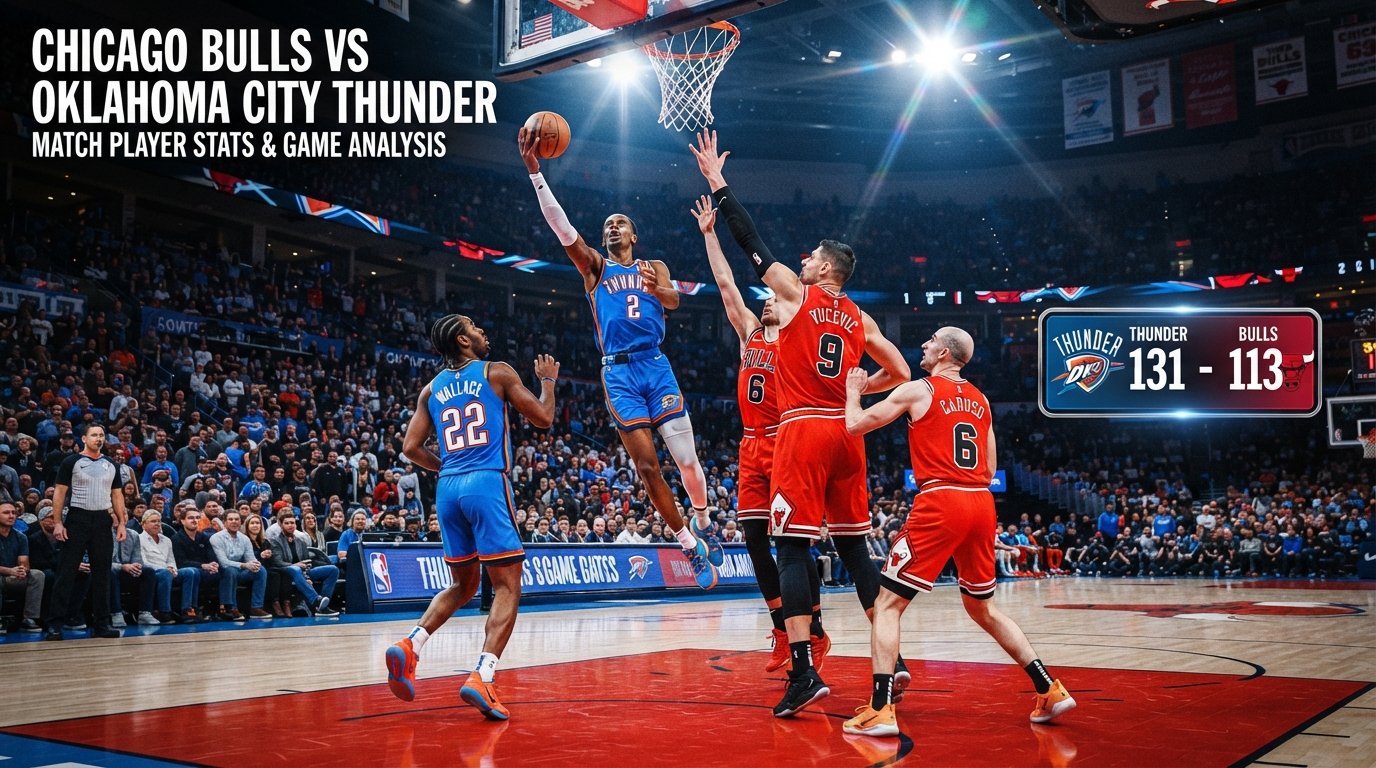
The chicago bulls vs oklahoma city thunder match player stats reveal how Oklahoma City turned a competitive first half into a convincing 131-113 victory over Chicago on March 27, 2026. Despite trailing 67-62 at halftime, the Thunder delivered an impressive second-half performance, combining efficient shooting, strong rebounding, defensive pressure, and balanced scoring to secure the win. Shai Gilgeous-Alexander led Oklahoma City with 25 points, while Cason Wallace contributed 21 points and Jalen Williams added 18 points and eight assists. On Chicago’s side, Collin Sexton scored 22 points off the bench, and Tre Jones finished with 21 points, nine assists, and seven rebounds. The result also completed Oklahoma City’s 2-0 season sweep of the Bulls, highlighting the difference between the teams during the 2025-26 NBA campaign.
Chicago Bulls vs Oklahoma City Thunder Match Player Stats: Game Overview
The matchup between the Chicago Bulls and Oklahoma City Thunder provided an interesting example of how quickly an NBA game can change. Chicago entered halftime with a five-point advantage and appeared capable of challenging one of the strongest teams in the Western Conference.
However, Oklahoma City responded with a much stronger second half. The Thunder improved their offensive execution, controlled the boards, and created additional scoring opportunities through defensive pressure.
The final score was 131-113 in favor of Oklahoma City.
The game took place at Paycom Center in Oklahoma City, where 18,203 fans attended. The Thunder entered the contest with a 58-16 record, including an impressive 30-7 home record. Chicago arrived with a 29-44 record and an 11-24 record away from home.
These records reflected the different positions of the two teams during the season. Oklahoma City was competing at the highest level, while Chicago was looking to find consistency and improve its results against stronger opponents.
Match Information
| Game Detail | Information |
| Teams | Chicago Bulls vs Oklahoma City Thunder |
| Final Score | Thunder 131, Bulls 113 |
| Game Date | March 27, 2026 |
| Venue | Paycom Center |
| Location | Oklahoma City |
| Attendance | 18,203 |
| Halftime Score | Bulls 67, Thunder 62 |
| Winning Team | Oklahoma City Thunder |
| Season Series | Thunder won 2-0 |
| Thunder Record Shown | 58-16 |
| Bulls Record Shown | 29-44 |
The date deserves a small clarification. ESPN’s game title identifies the contest as March 27, while its game-information section displays March 28 at 5:00 a.m. This difference reflects the way the game date and displayed time can vary with time-zone presentation.
For the official scoring information and available box-score details, readers can consult the ESPN NBA box score.
Final Score and Quarter-by-Quarter Breakdown
The final score does not fully explain how the game developed. Chicago actually controlled much of the first half, but Oklahoma City completely changed the momentum after the break.
The most important difference appeared in the third and fourth quarters.
| Quarter | Chicago Bulls | Oklahoma City Thunder |
| First Half | 67 | 62 |
| Third Quarter | 21 | 33 |
| Fourth Quarter | 25 | 36 |
| Second Half Total | 46 | 69 |
| Final Score | 113 | 131 |
Chicago entered halftime with a five-point lead. However, the Thunder outscored the Bulls by 23 points during the second half.
That difference was large enough to transform a competitive contest into an 18-point victory.
First Half: Chicago Builds an Early Advantage
Chicago’s first-half performance demonstrated that the team could create offensive opportunities against Oklahoma City’s defense.
The Bulls reached 67 points before halftime, while the Thunder managed 62. Chicago benefited from contributions across its lineup, with players such as Tre Jones, Isaac Okoro, and Matas Buzelis helping maintain offensive production.
The five-point advantage gave Chicago a reasonable opportunity to compete for the win.
However, a halftime lead does not necessarily indicate control of an entire game. Maintaining offensive efficiency against a team capable of adjusting defensively requires consistent execution.
That became a major challenge for Chicago after the break.
Third Quarter: Oklahoma City Changes the Momentum
The third quarter was one of the most important periods of the contest.
Oklahoma City scored 33 points, while Chicago managed only 21. The 12-point difference erased the Bulls’ halftime advantage and placed the Thunder in control.
The Thunder benefited from improved scoring efficiency and better overall execution.
Cason Wallace’s outside shooting was particularly important. His ability to convert three-point opportunities provided Oklahoma City with another scoring option alongside Shai Gilgeous-Alexander and Jalen Williams.
The Thunder also continued to benefit from their defensive activity and rebounding advantage.
Chicago struggled to maintain the same offensive production it had displayed during the opening half.
Fourth Quarter: Thunder Complete the Comeback
Oklahoma City continued its strong performance in the final quarter, scoring 36 points compared with Chicago’s 25.
Rather than allowing the Bulls to recover, the Thunder maintained their offensive rhythm and extended the lead.
Their balanced scoring made it difficult for Chicago to concentrate its defensive attention on one player.
Shai Gilgeous-Alexander continued to lead the team, while contributions from Wallace, Williams, Isaiah Joe, and Ajay Mitchell provided additional scoring support.
By the end of the fourth quarter, Oklahoma City had secured a comfortable 131-113 victory.
The second-half performance was the defining feature of the matchup.
Oklahoma City Thunder Player Stats and Individual Performances
Oklahoma City’s victory was built around contributions from several players rather than a single outstanding scoring performance.
Shai Gilgeous-Alexander remained the team’s leading scorer, but Cason Wallace, Jalen Williams, Isaiah Joe, Ajay Mitchell, and Jaylin Williams all played important offensive roles.
The team’s ability to generate production from different positions helped create a difficult matchup for Chicago.
Shai Gilgeous-Alexander: 25 Points, 5 Assists and 3 Blocks
Shai Gilgeous-Alexander finished with 25 points, five assists, and three blocks.
His scoring performance made him Oklahoma City’s leading scorer, and his overall contribution demonstrated his importance to the team’s offensive structure.
One particularly interesting detail was his three-point shooting. Gilgeous-Alexander missed all 10 of his attempts from beyond the arc.
Despite that difficult shooting performance, he still reached 25 points.
This is an important distinction when evaluating an individual basketball performance. A player’s offensive value cannot always be measured through three-point shooting alone.
Gilgeous-Alexander continued to produce points through other scoring opportunities and remained involved as a playmaker.
His three blocks also demonstrated defensive involvement beyond his primary scoring responsibilities.
The performance showed how an established offensive leader can influence a game even when one part of his shooting game is not working.
Cason Wallace: 21 Points and Five Three-Pointers
Cason Wallace delivered one of the most important supporting performances for Oklahoma City.
He scored 21 points and made five of seven three-point attempts.
That is approximately 71.4% shooting from three-point range.
His outside shooting gave the Thunder an important offensive advantage, particularly when Chicago needed to pay attention to Gilgeous-Alexander and Jalen Williams.
Wallace also recorded three steals.
His contribution was valuable in two different areas:
- He provided efficient perimeter scoring.
- He generated defensive pressure through steals.
Making five three-pointers on seven attempts is especially impressive because it demonstrates how effectively he converted the opportunities available to him.
His performance also highlights the importance of supporting scorers in a team with a primary offensive star.
When opposing defenses concentrate on the leading scorer, players who can consistently convert open shots become extremely important.
Jalen Williams: 18 Points, 8 Assists and 6 Rebounds
Jalen Williams recorded 18 points, eight assists, and six rebounds.
His performance was one of the clearest examples of Oklahoma City’s balanced offensive approach.
Rather than focusing exclusively on scoring, Williams contributed through playmaking and rebounding.
Eight assists indicate that he was actively involved in creating opportunities for teammates.
His six rebounds also helped Oklahoma City maintain control of possessions.
Williams’ ability to contribute in several statistical categories gives the Thunder flexibility on offense. He can score when opportunities are available, create shots for teammates, and participate in defensive possessions.
His performance was especially valuable in a game where Oklahoma City received production from multiple players.
Isaiah Hartenstein: 16 Rebounds
Isaiah Hartenstein made a major contribution on the boards, collecting 16 rebounds.
Although his scoring total was not included among the supplied leading performances, his rebounding number deserves particular attention.
Rebounding is one of the most important factors in determining how many offensive opportunities a team receives.
A defensive rebound ends an opponent’s possession, while an offensive rebound can create another scoring opportunity.
Hartenstein’s 16 rebounds helped Oklahoma City establish a substantial advantage in this area.
The Thunder finished with 58 total rebounds compared with Chicago’s 47.
His individual contribution was an important part of that team advantage.
Jaylin Williams: 12 Points and 10 Rebounds
Jaylin Williams produced a double-double with 12 points and 10 rebounds.
His performance provided valuable support from the bench.
A double-double demonstrates contributions in two major statistical categories, and his scoring and rebounding helped Oklahoma City maintain production beyond its starting lineup.
The importance of this performance becomes clearer when considering the overall team statistics.
Oklahoma City won the rebounding battle by 11, and Williams contributed directly to that advantage.
Isaiah Joe: 15 Points
Isaiah Joe finished with 15 points.
His scoring contribution helped maintain the Thunder’s offensive balance.
Oklahoma City did not depend entirely on Gilgeous-Alexander to create points. Players such as Joe provided additional production that made the offense more difficult to defend.
His 15-point contribution also demonstrates why bench scoring is important in games involving high-level teams.
Ajay Mitchell: 15 Points
Ajay Mitchell also scored 15 points.
His contribution gave Oklahoma City another reliable scoring option and supported the team’s overall offensive production.
Having multiple players reach double figures allowed the Thunder to maintain pressure throughout the game.
It also reduced the importance of any individual shooting performance.
Even with Gilgeous-Alexander missing all 10 three-point attempts, Oklahoma City still reached 131 points.
That is a strong illustration of the team’s scoring depth.
Chicago Bulls Player Stats and Individual Performances
Chicago had several productive individual performances despite losing the game.
Tre Jones, Collin Sexton, Isaac Okoro, Matas Buzelis, and Leonard Miller all reached double figures.
Josh Giddey also contributed through playmaking and rebounding.
However, the Bulls could not maintain their first-half advantage, and their overall shooting efficiency was lower than Oklahoma City’s.
Collin Sexton: 22 Points Off the Bench
Collin Sexton was Chicago’s leading scorer, finishing with 22 points.
What made his performance particularly interesting was that he produced those points as a bench player.
Sexton converted five of seven three-point attempts, giving him an impressive 71.4% success rate from beyond the arc.
His outside shooting was one of the most efficient individual performances in the game.
The Bulls benefited from his ability to provide immediate offensive production without relying exclusively on their starting lineup.
However, his scoring was not enough to overcome Oklahoma City’s balanced attack.
This illustrates an important aspect of basketball analysis: a strong individual scoring performance does not automatically produce a team victory.
A team also needs defensive stops, efficient possessions, rebounding, and contributions from several players.
Tre Jones: 21 Points, 9 Assists and 7 Rebounds
Tre Jones recorded 21 points, nine assists, and seven rebounds.
His performance demonstrated considerable involvement in Chicago’s offensive system.
The 21 points made him one of the Bulls’ leading scorers, while his nine assists showed his importance as a playmaker.
He also collected seven rebounds, giving him a productive performance across three statistical categories.
Jones came close to recording a triple-double.
A triple-double requires at least 10 in three different statistical categories. His nine assists placed him just one short of that milestone.
His contribution was especially important because Chicago needed consistent offensive creation throughout the game.
Isaac Okoro: 20 Points
Isaac Okoro finished with 20 points.
His scoring performance made him another important contributor for Chicago.
Reaching 20 points demonstrates that the Bulls had more than one player capable of producing significant offensive numbers.
However, the team’s overall shooting percentage remained below Oklahoma City’s.
That difference helps explain why Chicago could not keep pace after halftime.
Okoro’s individual production was valuable, but the team needed more consistent offensive efficiency across the entire lineup.
Matas Buzelis: 15 Points and 9 Rebounds
Matas Buzelis recorded 15 points and nine rebounds.
His performance provided a combination of scoring and rebounding that helped Chicago compete in different areas of the game.
He finished just one rebound short of a double-double.
His nine rebounds also demonstrate his involvement in the team’s effort to control possession.
For a young player, performances that combine offensive production and rebounding are important indicators of versatility.
However, individual contributions must be considered within the larger team context.
Chicago still finished with 11 fewer rebounds than Oklahoma City.
Leonard Miller: 15 Points Off the Bench
Leonard Miller scored 15 points as a reserve.
His contribution gave Chicago additional offensive production from its second unit.
The Bulls received useful scoring from their bench, particularly through Sexton and Miller.
However, their combined production did not prevent Oklahoma City from creating a significant second-half advantage.
Josh Giddey: 5 Points, 11 Assists and 7 Rebounds
Josh Giddey recorded 11 assists and seven rebounds but scored only five points.
His shooting performance was one of the most notable statistical details of the game.
He made just one of 11 field-goal attempts.
That represents approximately 9.1% shooting from the field.
Although his scoring efficiency was poor, his contribution as a playmaker remained significant.
His 11 assists were the highest individual assist total among the players highlighted in the supplied statistics.
This performance demonstrates why evaluating a basketball player requires more than looking at points scored.
Giddey’s passing created opportunities for teammates, and his rebounding helped Chicago in possession-related situations.
Nevertheless, his shooting difficulties reduced his direct scoring contribution.
For Chicago, this was an important area of concern because the team needed consistent scoring efficiency to compete with Oklahoma City’s offensive production.
Complete Player Statistics Comparison
The following table summarizes the individual performances included in the available game information.
Oklahoma City Thunder
| Player | Points | Rebounds | Assists | Other Statistics |
| Shai Gilgeous-Alexander | 25 | Not specified | 5 | 3 blocks |
| Cason Wallace | 21 | Not specified | Not specified | 5-of-7 three-pointers, 3 steals |
| Jalen Williams | 18 | 6 | 8 | Not specified |
| Isaiah Hartenstein | Not specified | 16 | Not specified | Not specified |
| Jaylin Williams | 12 | 10 | Not specified | Double-double |
| Isaiah Joe | 15 | Not specified | Not specified | Not specified |
| Ajay Mitchell | 15 | Not specified | Not specified | Not specified |
Chicago Bulls
| Player | Points | Rebounds | Assists | Other Statistics |
| Collin Sexton | 22 | Not specified | Not specified | 5-of-7 three-pointers |
| Tre Jones | 21 | 7 | 9 | Not specified |
| Isaac Okoro | 20 | Not specified | Not specified | Not specified |
| Matas Buzelis | 15 | 9 | Not specified | Not specified |
| Leonard Miller | 15 | Not specified | Not specified | Not specified |
| Josh Giddey | 5 | 7 | 11 | 1-of-11 field goals |
The table intentionally includes only the individual statistics available in the supplied game information. Missing figures have not been estimated or invented.
This distinction is important for anyone using the numbers for basketball analysis, sports reporting, or historical comparisons.
Team Statistics: Oklahoma City Thunder vs Chicago Bulls
Individual performances help explain the game, but team statistics provide a broader understanding of why Oklahoma City won.
The Thunder were more efficient from the field, collected more rebounds, recorded more assists, and committed fewer turnovers.
These advantages helped them control the second half.
| Statistical Category | Oklahoma City Thunder | Chicago Bulls |
| Final Points | 131 | 113 |
| Field Goal Percentage | 47% | 42% |
| Total Rebounds | 58 | 47 |
| Assists | 29 | 25 |
| Steals | 9 | 4 |
| Blocks | 9 | 5 |
| Turnovers | 9 | 12 |
Field Goal Percentage: Thunder Finish More Efficiently
Oklahoma City shot 47% from the field, compared with Chicago’s 42%.
The five-percentage-point difference is significant because field-goal efficiency directly affects how effectively a team converts possessions into points.
A team can create many shooting opportunities but still struggle if it does not convert enough of them.
The Thunder were more efficient overall.
Their balanced scoring also meant that defensive attention could not be focused on just one player.
Wallace’s outside shooting, Gilgeous-Alexander’s scoring, and contributions from the supporting players all helped Oklahoma City maintain offensive production.
Chicago also had efficient individual shooters, including Sexton, but the team-wide shooting percentage was lower.
Rebounding: Oklahoma City Controls the Boards
Oklahoma City collected 58 rebounds, while Chicago finished with 47.
That created an 11-rebound advantage for the Thunder.
This difference is important because rebounding affects both offensive and defensive possession control.
Defensive rebounds prevent opponents from receiving additional scoring opportunities.
Offensive rebounds can extend a possession and give a team another chance to score.
Isaiah Hartenstein’s 16 rebounds and Jaylin Williams’ double-double were important contributions to Oklahoma City’s overall advantage.
Chicago had several players who contributed on the boards, including Buzelis, Giddey, and Jones.
However, the Bulls could not match the Thunder’s overall rebounding production.
Assists: Better Ball Movement from Oklahoma City
The Thunder recorded 29 assists compared with Chicago’s 25.
Although the difference was only four assists, it provides useful information about the teams’ offensive execution.
Assists generally reflect successful scoring opportunities created through passing.
Oklahoma City’s total demonstrates that several players were involved in creating shots for teammates.
Jalen Williams contributed eight assists, while Gilgeous-Alexander added five.
Chicago also received strong playmaking from Tre Jones and Josh Giddey.
Jones recorded nine assists, and Giddey finished with 11.
Their individual numbers were impressive, but the team still finished behind Oklahoma City in total assists.
This shows that individual playmaking and overall team offensive efficiency are related but different measurements.
Turnovers: Fewer Mistakes Help the Thunder
Oklahoma City committed nine turnovers, while Chicago committed 12.
The Thunder therefore gave away possession three fewer times.
Turnovers are particularly damaging because they end offensive opportunities without guaranteeing a shot attempt.
They can also create transition scoring chances for the opposing team.
Oklahoma City’s ability to limit mistakes helped maintain control of possessions.
Chicago’s higher turnover total placed additional pressure on a team that was already less efficient from the field.
Steals and Blocks: Defensive Activity Makes a Difference
The Thunder recorded nine steals and nine blocks.
Chicago finished with four steals and five blocks.
These numbers show a clear advantage for Oklahoma City in defensive activity.
Steals can immediately create opportunities for transition offense, while blocks can prevent opponents from converting shots near the basket.
Gilgeous-Alexander’s three blocks were a notable individual contribution.
Wallace also added three steals.
Together, these performances demonstrate that the Thunder were productive on both ends of the court.
Five Major Reasons Oklahoma City Won the Game
The final score was influenced by several connected factors. Rather than attributing the result to one player, it is more useful to examine the major differences between the teams.
1. A Dominant Second-Half Performance
The most important factor was Oklahoma City’s 69-46 advantage after halftime.
Chicago led by five points at the break, but the Thunder completely changed the direction of the contest.
Winning the third quarter by 12 points placed Oklahoma City in a strong position.
Winning the fourth quarter by another 11 points allowed the team to extend its advantage.
The 23-point second-half scoring difference was the central reason for the final result.
2. More Consistent Team Shooting
Oklahoma City’s 47% field-goal percentage was better than Chicago’s 42%.
A five-point difference in shooting efficiency can become especially important over an entire game.
The Thunder also had excellent individual three-point performances from Wallace and several other supporting contributors.
Chicago received strong outside shooting from Sexton, but the overall team percentage favored Oklahoma City.
3. Stronger Rebounding Production
The Thunder won the rebounding battle 58-47.
That advantage helped them control possession and limit Chicago’s opportunities.
Hartenstein’s 16 rebounds were particularly important.
Jaylin Williams also provided a double-double, showing that Oklahoma City received meaningful rebounding contributions from multiple players.
4. Better Defensive Statistics
Oklahoma City recorded more steals and blocks than Chicago.
The Thunder also committed fewer turnovers.
These figures point toward better defensive activity and stronger possession management.
Although defensive statistics cannot explain every individual possession, the overall comparison supports the conclusion that Oklahoma City was more effective in several important areas.
5. Contributions Beyond the Leading Scorer
Gilgeous-Alexander scored 25 points, but the Thunder received important support from several teammates.
Wallace scored 21, Jalen Williams added 18, and Joe and Mitchell each contributed 15.
Jaylin Williams also added 12 points and 10 rebounds.
This balanced scoring made the Thunder difficult to defend.
Even when their leading scorer struggled from three-point range, the team continued to produce points.
What the Matchup Reveals About Oklahoma City’s Playing Style
The game provides several useful insights into Oklahoma City’s team structure.
The Thunder did not rely exclusively on individual scoring. They combined perimeter shooting, playmaking, rebounding, and defensive activity.
This balance was particularly important during the second half.
Offensive Flexibility
Oklahoma City’s scoring was distributed across several players.
Gilgeous-Alexander remained the leading scorer, but Wallace, Jalen Williams, Joe, and Mitchell also reached significant scoring totals.
This flexibility makes it difficult for an opponent to build its defensive strategy around stopping one player.
If a defense concentrates on the primary scorer, another player can benefit from additional opportunities.
Wallace’s five successful three-pointers demonstrated exactly how supporting shooters can influence a game.
Defensive Versatility
The Thunder recorded nine steals and nine blocks.
These numbers show that their defensive contributions were not limited to one type of play.
Steals indicate the ability to disrupt passing or ball control, while blocks demonstrate activity in contesting shots.
Gilgeous-Alexander and Wallace both contributed significantly in these categories.
The team also finished with fewer turnovers, allowing it to maintain better possession control.
The Importance of Frontcourt Rebounding
Hartenstein’s 16 rebounds were a major part of Oklahoma City’s statistical advantage.
Rebounding gives a team more control over the rhythm of a game.
It can reduce second-chance opportunities for the opponent and help create additional offensive possessions.
The combined rebounding contribution from Hartenstein and Jaylin Williams helped Oklahoma City establish a substantial advantage in this category.
What the Game Reveals About Chicago’s Performance
Although Chicago lost by 18 points, the team’s individual performances provide several useful observations.
The Bulls were competitive during the first half and had multiple players capable of producing points.
However, their second-half performance did not match their opening-half production.
Positive Scoring Contributions
Sexton, Jones, and Okoro all scored at least 20 points.
This demonstrates that Chicago had multiple players capable of contributing meaningful offense.
Buzelis and Miller also scored 15 points each.
The problem was not a complete lack of individual scoring production.
Instead, Chicago struggled to maintain the same level of overall efficiency as Oklahoma City.
Playmaking Remained a Strength
Tre Jones and Josh Giddey combined for 20 assists.
Jones recorded nine, while Giddey produced 11.
These numbers demonstrate that Chicago had players capable of creating opportunities for teammates.
However, passing production does not always translate into an efficient team offense.
The Bulls still finished with a lower field-goal percentage and fewer total assists than Oklahoma City.
Shooting Efficiency Needs Context
Giddey’s one-of-11 shooting performance was a notable weakness.
However, it would be inaccurate to judge his entire performance using that number alone.
He still produced 11 assists and seven rebounds.
Similarly, Sexton’s five successful three-pointers represented an excellent individual shooting performance.
Both examples demonstrate why basketball analysis should consider multiple statistical categories.
A player can struggle in one area while contributing in another.
Bench Production: A Significant Part of the Story
Bench scoring played an important role in the matchup.
Oklahoma City received 15 points each from Isaiah Joe and Ajay Mitchell, along with 12 points and 10 rebounds from Jaylin Williams.
Chicago received 22 points from Collin Sexton and 15 from Leonard Miller.
These contributions demonstrate that both teams received meaningful production from their reserves.
However, Oklahoma City’s bench contributions were part of a broader team performance that also included better shooting efficiency, rebounding, and defensive statistics.
A strong bench can help maintain offensive production when starters are resting.
It can also provide different combinations of players and create additional tactical options.
In this game, Oklahoma City’s supporting contributions helped sustain its second-half momentum.
Season Series: Oklahoma City Completes a 2-0 Sweep
The March matchup was the second meeting between the Chicago Bulls and Oklahoma City Thunder during the 2025-26 season.
Oklahoma City won both games.
The Thunder had previously defeated Chicago 116-108 in Chicago.
They followed that result with a 131-113 victory at Paycom Center.
| Season Meeting | Winning Team | Final Score |
| First Meeting | Oklahoma City Thunder | 116-108 |
| Second Meeting | Oklahoma City Thunder | 131-113 |
The two results demonstrate Oklahoma City’s consistency against Chicago during the season.
The first meeting was an eight-point victory, while the second ended with an 18-point difference.
The Thunder therefore won both matchups by a combined margin of 26 points.
A season sweep does not automatically determine how two teams would perform in a future playoff series or another season.
However, it does provide useful historical context for understanding their head-to-head results.
For Chicago, the two losses also highlight areas that required improvement, particularly defensive consistency and the ability to maintain offensive efficiency against stronger opponents.
Player Availability and Injury Information
Player availability is an important part of any NBA match analysis.
For this game, the supplied information identifies two Chicago players who were unavailable.
| Player | Team | Reported Issue | Status |
| Nick Richards | Chicago Bulls | Right elbow issue | Did not play |
| Anfernee Simons | Chicago Bulls | Wrist injury | Did not play |
The absence of these players is relevant when evaluating Chicago’s available lineup and overall rotation.
However, it is important not to assume that their absence alone caused the defeat.
The available statistics show several additional factors, including shooting efficiency, rebounding, turnovers, and second-half scoring.
A complete injury analysis would also require information about each player’s usual role, expected minutes, replacement options, and the team’s tactical adjustments.
The available game information does not establish all those details, so conclusions about their precise impact should remain limited.
How to Understand Basketball Player Statistics Properly
The matchup provides a useful example of why basketball statistics should be interpreted together rather than separately.
Points, assists, rebounds, steals, blocks, and shooting percentages measure different parts of a player’s contribution.
Looking at only one number can produce an incomplete understanding of a performance.
Points Per Game and Individual Scoring
Points are the most visible basketball statistic.
They indicate how many points a player scores during a game.
However, scoring totals should be considered alongside shooting efficiency.
For example, Sexton scored 22 points and made five of seven three-point attempts.
Giddey scored only five points on 1-of-11 shooting.
Both numbers tell us something about their offensive performances, but they represent very different scoring outcomes.
Assists and Offensive Creation
Assists measure passes that directly lead to successful field goals.
Tre Jones recorded nine assists, while Giddey recorded 11.
These totals show how important both players were to Chicago’s playmaking.
Jalen Williams contributed eight assists for Oklahoma City.
Assists help explain which players were creating scoring opportunities rather than simply finishing possessions.
Rebounds and Possession Control
Rebounds are collected after missed shots.
They are generally divided into offensive and defensive rebounds.
The supplied information identifies Hartenstein’s 16 rebounds and the teams’ overall totals.
Oklahoma City’s 58-47 advantage demonstrates its stronger overall performance in this area.
Steals and Defensive Pressure
A steal occurs when a defensive player gains possession by taking the ball from an opponent.
Wallace recorded three steals, while the Thunder finished with nine as a team.
These statistics help describe defensive disruption.
However, steals do not capture every type of defensive contribution.
A player can defend effectively without recording a steal.
Blocks and Shot Protection
Blocks occur when a defender legally deflects an opponent’s shot.
Gilgeous-Alexander recorded three blocks, contributing to Oklahoma City’s nine total blocks.
Blocks are useful defensive statistics, but they should be considered alongside positioning, contested shots, and rebounding.
Shooting Percentage and Efficiency
Field-goal percentage measures the percentage of field-goal attempts that become successful shots.
Oklahoma City’s 47% shooting percentage exceeded Chicago’s 42%.
Three-point shooting percentage measures successful three-point attempts relative to total attempts from beyond the arc.
Wallace and Sexton both made five of seven three-point attempts.
These individual results were excellent, although the teams finished with different overall field-goal percentages.
Why the Second Half Matters More Than the Halftime Score
One of the most useful lessons from this matchup is that a halftime advantage does not guarantee a final victory.
Chicago entered the break leading by five points.
At that stage, the Bulls had produced more points and had a reasonable opportunity to compete.
However, the Thunder’s adjustments and improved second-half execution changed the result.
The third-quarter scoring difference was particularly important.
Oklahoma City scored 33 points while Chicago managed only 21.
That allowed the Thunder to move ahead and establish control.
The fourth quarter continued the same pattern.
The Thunder scored 36 points and held Chicago to 25.
This sequence demonstrates how momentum can shift during an NBA game.
It also shows why full-game statistics are more useful than relying exclusively on halftime results.
A team may perform well for two quarters but struggle to maintain the same efficiency over four quarters.
In this case, Oklahoma City’s ability to sustain production was decisive.
Statistical Records That Stand Out From the Match
Several numbers deserve special attention because they provide a clear picture of the game’s defining performances.
25 points from Shai Gilgeous-Alexander: He led Oklahoma City in scoring despite missing all 10 three-point attempts.
21 points from Cason Wallace: His five successful three-pointers provided excellent perimeter scoring.
18 points and eight assists from Jalen Williams: His balanced contribution supported both scoring and playmaking.
16 rebounds from Isaiah Hartenstein: His performance was a major part of Oklahoma City’s rebounding advantage.
22 points from Collin Sexton: He was Chicago’s leading scorer and delivered an excellent three-point shooting performance.
21 points and nine assists from Tre Jones: He contributed as both a scorer and playmaker.
11 assists from Josh Giddey: His passing production remained strong despite a difficult shooting night.
58 total rebounds for Oklahoma City: The Thunder won the rebounding battle by 11.
69 second-half points for Oklahoma City: The difference between the teams after halftime ultimately determined the result.
These figures provide a concise explanation of the individual and team performances that shaped the contest.
Frequently Asked Questions
1. Who won the Chicago Bulls vs Oklahoma City Thunder game?
The Oklahoma City Thunder defeated the Chicago Bulls 131-113 on March 27, 2026. Oklahoma City overcame a five-point halftime deficit by outscoring Chicago 69-46 in the second half.
2. Who was the leading scorer in the match?
Shai Gilgeous-Alexander led Oklahoma City with 25 points. Collin Sexton was Chicago’s leading scorer with 22 points, coming off the bench.
3. How many points did Cason Wallace score against Chicago?
Cason Wallace scored 21 points. He made five of seven three-point attempts and also recorded three steals.
4. What were Josh Giddey’s statistics in the game?
Josh Giddey recorded five points, 11 assists, and seven rebounds. He struggled with his shooting, making just one of 11 field-goal attempts.
5. How did Oklahoma City win despite trailing at halftime?
Oklahoma City improved its second-half performance, scoring 69 points compared with Chicago’s 46. The Thunder also finished with better field-goal efficiency, more rebounds, more assists, more steals, and fewer turnovers.
6. Did Oklahoma City sweep the Chicago Bulls during the 2025-26 season?
Yes. Oklahoma City won both regular-season meetings against Chicago. The Thunder first won 116-108 in Chicago and then secured a 131-113 victory at Paycom Center.
Conclusion
The Chicago Bulls and Oklahoma City Thunder matchup on March 27, 2026, demonstrated the importance of balanced scoring, shooting efficiency, defensive pressure, and rebounding in professional basketball.
Although Chicago entered halftime with a 67-62 advantage, Oklahoma City responded with an outstanding second half to secure a 131-113 victory.
Shai Gilgeous-Alexander led the Thunder with 25 points, while Cason Wallace added 21 points and Jalen Williams contributed 18 points, eight assists, and six rebounds. Isaiah Hartenstein’s 16 rebounds and Jaylin Williams’ double-double also played important roles in the team’s success.
Chicago received strong individual performances from Collin Sexton, Tre Jones, and Isaac Okoro. Sexton finished with 22 points, Jones recorded 21 points and nine assists, and Okoro contributed 20 points. Josh Giddey’s 11 assists were another notable part of the Bulls’ performance.
The overall team comparison explains the final result. Oklahoma City shot 47% from the field, collected 58 rebounds, recorded 29 assists, and committed only nine turnovers. Chicago finished with a 42% field-goal percentage, 47 rebounds, 25 assists, and 12 turnovers.
The most important difference was the Thunder’s second-half dominance. Their 69-46 scoring advantage after halftime transformed a close contest into a comfortable victory.
The result also completed Oklahoma City’s 2-0 season sweep of Chicago, reinforcing the Thunder’s strong position during the 2025-26 campaign.