Research Dossier for Target Company: A Complete Guide
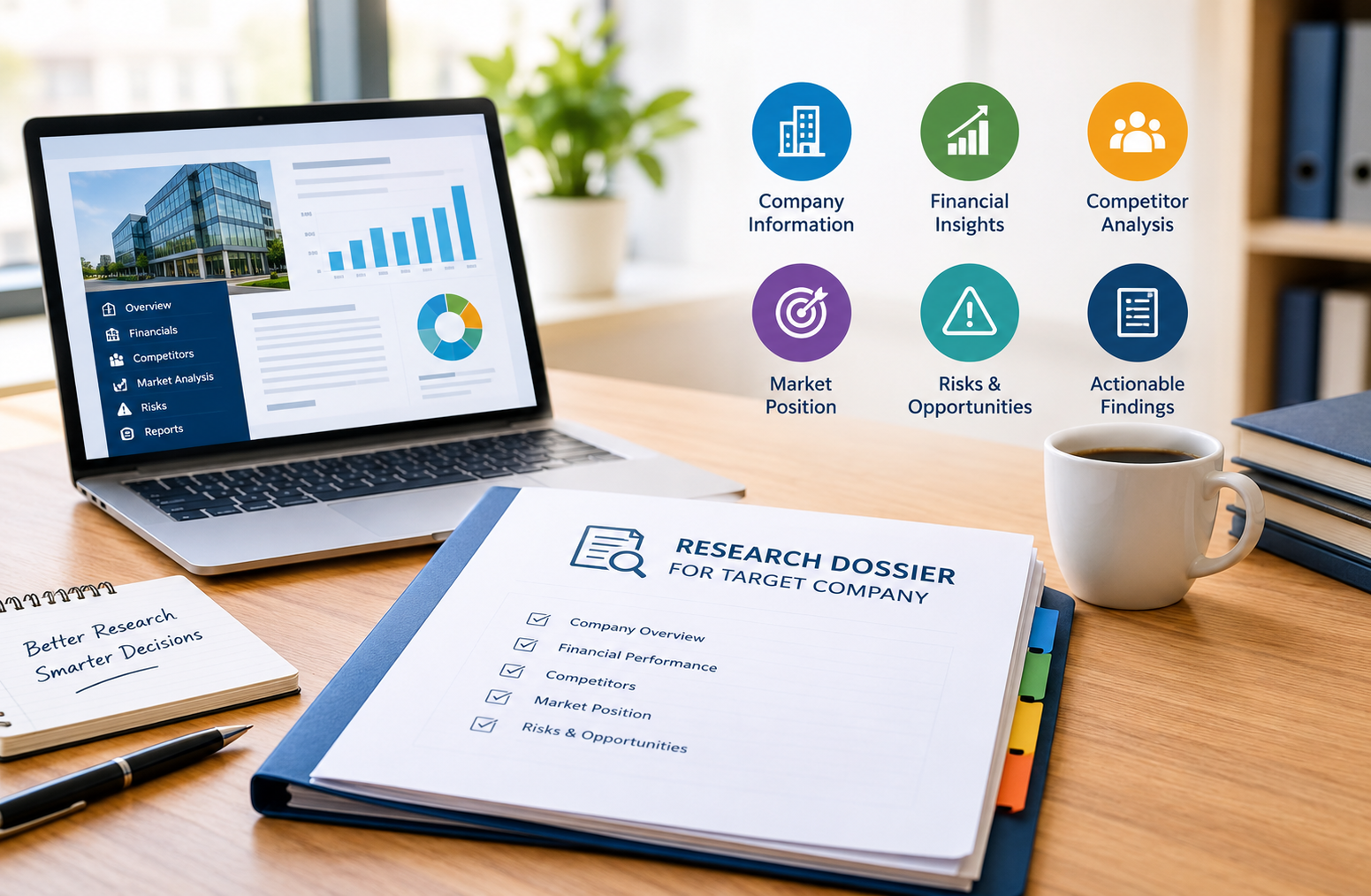
A research dossier for target company is a structured business research report that brings together verified facts, market intelligence, financial information, leadership details, competitive analysis, and potential risks about a specific organization. It helps business owners, investors, sales professionals, analysts, and researchers understand a company before making important decisions. Instead of relying on scattered search results or promotional claims, a well-prepared dossier organizes reliable evidence into a clear, useful document that explains what is known, what remains uncertain, and why the findings matter.
In today’s competitive business environment, information alone is not enough. Professionals need accurate information presented in the right context. A company’s website may explain its products, but it might not reveal how its business model compares with competitors, whether its market position is sustainable, or what risks could affect a future partnership. A structured research process helps answer these questions by combining official records, independent reporting, financial evidence, industry information, and careful analysis.
Whether the objective is to identify potential customers, assess a supplier, evaluate an investment, understand a competitor, or prepare for a business meeting, a systematic approach can save time and improve the quality of decisions. This guide explains what a company research dossier contains, how to prepare one, which sources to trust, how to analyze findings, and how to avoid common research mistakes.
What Is a Research Dossier for Target Company?
A research dossier for target company is a detailed document created to investigate a particular business and understand its position, operations, performance, opportunities, and risks. The word target simply identifies the organization being researched. It does not automatically refer to Target Corporation, the American retail company.
The dossier may cover a small startup, a private company, a multinational corporation, a potential client, a business partner, a supplier, or an acquisition candidate. Its contents depend on the purpose of the investigation.
For example, a sales professional researching a potential customer may focus on its products, business priorities, leadership team, expansion plans, and possible purchasing needs. An investor may require a deeper examination of financial statements, ownership, profitability, market conditions, and business risks.
A useful dossier does more than collect company facts. It connects evidence with interpretation.
Consider the difference between these two statements:
- Basic information: A company sells software to small businesses.
- Research insight: The company sells subscription-based software to small businesses, competes with several established providers, and may depend on customer retention to maintain recurring revenue.
The second statement offers a more useful starting point for further investigation. However, each detail must be supported by evidence before it can be presented as a factual finding about a real organization.
A strong report should help readers answer three fundamental questions:
- What do we know about the company?
- How reliable and current is the available evidence?
- What does the evidence mean for the decision being considered?
These questions form the foundation of effective business research.
Why a Company Research Dossier Matters
Business decisions often involve uncertainty. A potential customer may appear promising but have limited purchasing capacity. A supplier may offer competitive prices while presenting operational concerns. An investment opportunity may show strong sales growth without demonstrating sustainable profitability.
A research dossier provides a consistent framework for examining these situations.
It Improves Decision-Making
When information is collected from multiple sources, it becomes easier to compare facts and identify important patterns. Decision-makers can evaluate a company’s capabilities, market position, financial condition, and potential limitations without relying on a single impression.
For example, a business considering a new distribution partner may need to understand the partner’s operating locations, delivery capabilities, reputation, ownership, and experience. Bringing these findings into one report helps the team identify unanswered questions before committing resources.
It Saves Research Time
Repeatedly searching for the same information wastes time and creates inconsistencies. A centralized dossier records useful findings, source links, publication dates, and verification notes in one place.
Team members can review existing evidence instead of repeating the same searches. They can also identify outdated information and update specific sections when circumstances change.
It Reveals Opportunities
Company research can uncover potential opportunities that are not immediately obvious.
These may include an underserved customer segment, a new geographic market, a complementary product, a supplier relationship, or a competitor’s weakness.
Such opportunities should be treated as research hypotheses rather than established conclusions until supporting evidence is available.
It Helps Identify Risks
A dossier can also reveal warning signs that deserve further investigation.
Examples include inconsistent company information, unclear ownership, repeated customer complaints, declining reported performance, dependence on a limited number of customers, or significant regulatory exposure.
None of these signals automatically proves that a company is unsuitable. Their importance depends on the available evidence, the industry, and the decision being considered.
It Creates a Record of the Research Process
A documented research process makes conclusions easier to review and challenge. If a team later questions a decision, it can examine the evidence that supported the original assessment.
This is particularly useful when several people contribute to research or when the same company must be evaluated again after a period of time.
Who Should Prepare a Target Company Research Dossier?
Different professionals use company research for different reasons. Understanding the intended audience helps determine which information deserves the most attention.
Business Owners and Entrepreneurs
Entrepreneurs can investigate competitors, potential suppliers, distributors, and strategic partners. Their research may focus on product positioning, customer needs, pricing, market gaps, and operational capabilities.
For example, a business preparing to introduce a new product might study competing products, their intended audiences, customer feedback, distribution channels, and publicly available pricing.
Sales and Business Development Teams
Sales teams can use company research to prepare for prospecting, meetings, and partnership discussions.
Relevant information may include:
- The company’s main products and services.
- Its customer segments and geographic reach.
- Recent expansion or product announcements.
- Relevant decision-makers and their publicly documented responsibilities.
- Business challenges that the seller’s offering could address.
- Potential objections or purchasing constraints.
The goal is to understand the prospective customer rather than send a generic sales message.
Investors and Financial Analysts
Investors may need information about a company’s revenue, expenses, profitability, debt, cash flow, ownership, competitive position, and growth prospects.
For publicly traded businesses, regulatory filings and audited financial statements can provide valuable evidence. For private businesses, comparable information may be limited or unavailable.
A research dossier can support preliminary analysis, but it should not be treated as a substitute for professional financial, legal, or investment due diligence.
Procurement and Supply Chain Professionals
Procurement teams can investigate a supplier’s operating history, production capacity, geographic footprint, quality standards, financial stability, and exposure to supply disruptions.
The appropriate research depends on the importance of the supplier. A minor office supplier may require limited screening, while a critical manufacturing partner may justify extensive financial, operational, cybersecurity, and compliance reviews.
Job Seekers and Professionals
People considering a new employer can research its business model, leadership, products, workplace reputation, recent developments, and career opportunities.
Publicly available information can help candidates prepare thoughtful interview questions and understand the organization’s direction. Anonymous reviews may provide useful leads, but they should not be treated as definitive evidence of workplace conditions.
What Should a Research Dossier Include?
The most useful structure depends on the research objective. However, several core sections can help create a balanced and informative company report.
1. Company Overview and Identity
Start by establishing exactly which business is being researched.
Record the following details where they are available:
- Legal company name.
- Trading names and former names.
- Official website and relevant domains.
- Headquarters and operating locations.
- Founding date and business history.
- Industry and principal activities.
- Public or private ownership status.
- Parent companies and subsidiaries.
- Relevant company registration details.
Correct identification is essential because businesses may share similar names. Confusing two organizations can lead to incorrect conclusions about revenue, ownership, leadership, or legal history.
Where possible, verify the legal identity through an official company registry or relevant government record.
2. Products and Services
The next section should explain what the company actually sells or provides.
Describe its principal products, services, business units, and customer problems. Identify which offerings appear central to its operations and whether it serves businesses, individual consumers, government agencies, or several groups.
Avoid copying marketing descriptions without analysis. Promotional language such as “industry-leading” or “revolutionary” does not establish that a product performs better than competing alternatives.
Instead, investigate specific features, publicly stated prices, service coverage, distribution arrangements, and independently supported customer feedback.
If the company offers multiple product lines, distinguish between its core offerings and newer or less established activities.
3. Business Model and Revenue Sources
A business model explains how an organization creates value and earns money.
Investigate whether the company operates through product sales, subscriptions, licensing, advertising, transaction fees, service contracts, manufacturing, distribution, or a combination of these approaches.
Also examine the relationships between its customers, suppliers, distribution partners, and revenue sources.
For instance, a subscription business may depend heavily on renewals and customer retention. A manufacturer may be more exposed to raw material costs, production capacity, and inventory management.
These are general analytical considerations, not conclusions about a specific company. A real dossier should support its description of revenue sources with company disclosures or other credible evidence.
4. Leadership and Ownership
Leadership and ownership information can help explain how a company is organized and who is responsible for important decisions.
Research publicly available details about founders, senior executives, directors, major shareholders, and parent organizations where relevant.
Record each person’s current role and the date on which the information was checked. Former executives should not be presented as current leaders.
For private businesses, ownership structures may be difficult to establish through public sources alone. Distinguish confirmed ownership records from media reports, estimates, and unverified claims.
Avoid unnecessary personal information. Focus on professional responsibilities and facts that are relevant to the business question.
5. Financial Performance
Financial research helps readers understand the company’s reported economic position and performance.
Depending on availability, useful information may include:
- Revenue and revenue growth.
- Gross profit and operating profit.
- Net income or loss.
- Operating cash flow.
- Total assets and liabilities.
- Debt and financing arrangements.
- Cash reserves.
- Capital expenditure.
- Funding rounds and disclosed investment amounts.
Do not assume that every company publishes all these figures. Public corporations often provide more detailed financial disclosures than privately held businesses.
Each figure should include its reporting period, currency, source, and relevant context. A revenue figure without a date can quickly become misleading.
It is also important to distinguish revenue from profit. A company may generate substantial sales while operating at a loss. Similarly, an increase in revenue does not automatically mean that cash flow or financial stability has improved.
Where possible, compare several reporting periods rather than relying on a single year.
6. Industry and Market Position
A company does not operate in isolation. Its performance is influenced by customer demand, economic conditions, technological change, regulation, and competitive pressure.
This section should describe the company’s industry, major market segments, geographic exposure, and publicly supported competitive position.
Useful questions include:
- Which customers does the company serve?
- What needs does it address?
- Which industry trends may affect demand?
- What barriers make it difficult for new competitors to enter?
- Is the market highly fragmented or dominated by a few established providers?
- Which external factors could affect future performance?
Use reliable market research and official statistics where available. Market size estimates should identify their source, publication date, geographic scope, and definition.
Do not describe a company as a market leader simply because its website uses that phrase.
7. Competitor Analysis
Competitor research helps explain the company’s relative position.
Identify direct competitors offering similar products to similar customers. Then consider indirect competitors that solve the same customer problem through a different approach.
Compare relevant factors such as pricing, product range, geographic reach, distribution, customer support, technology, and publicly reported performance.
A competitor comparison should be fair and consistent. Comparing one company’s current financial results with another company’s figures from several years earlier can distort the analysis.
It is also useful to distinguish between established facts and interpretations. A lower advertised price may indicate a pricing advantage, but it does not prove that the company has lower operating costs or a stronger overall value proposition.
8. Customers and Customer Relationships
Customer research can reveal how a business serves its market and where its revenue may be concentrated.
Investigate publicly disclosed major customers, customer segments, case studies, contract announcements, retention figures, and customer feedback.
Where the company reports customer concentration, examine whether a small number of customers account for a significant share of its revenue. Such dependence can be relevant when assessing resilience, although its actual importance varies by industry and contract structure.
Treat testimonials and case studies carefully. Company-published examples may demonstrate a particular customer’s experience, but they do not necessarily represent the experience of every customer.
Customer reviews can also be biased, outdated, or unrepresentative. Look for recurring patterns across multiple independent sources instead of relying on an isolated complaint or unusually positive review.
9. Technology and Intellectual Property
For technology companies and businesses whose operations depend on specialized systems, technical research can be important.
Relevant subjects may include publicly documented software platforms, patents, trademarks, product development, cybersecurity disclosures, technical partnerships, and research activities.
The level of detail should reflect the company and the purpose of the dossier.
A software vendor assessment, for example, may require information about data handling, security certifications, system integrations, and service availability. A manufacturing company may require more attention to production technology, patents, and equipment.
Do not assume that a company owns a technology simply because it uses it. Licensing arrangements, third-party services, and ownership rights may differ.
10. Legal, Regulatory, and Operational Risks
A balanced dossier should examine risks that could affect the company or the proposed relationship.
Depending on the industry, relevant areas may include litigation, regulatory enforcement, licensing requirements, product safety, data protection, employment obligations, intellectual property disputes, environmental rules, and operational disruptions.
Use official court records, regulator publications, company disclosures, and credible reporting where available.
Legal allegations must be described accurately. An allegation, an ongoing case, a settlement, and a final court judgment are not interchangeable.
The absence of publicly identified legal problems does not prove that a company has no legal exposure. It may simply mean that the research did not reveal relevant records or that the information is not publicly accessible.
11. Recent Developments and Strategic Direction
Recent developments can change how a company should be evaluated.
Look for announcements about acquisitions, funding, leadership appointments, new products, market entry, major contracts, restructuring, partnerships, and regulatory changes.
Build a dated timeline that distinguishes confirmed events from proposed plans.
A company announcement that it intends to enter a new market does not establish that the expansion has succeeded. Likewise, a proposed acquisition should not be described as completed until the available evidence supports that conclusion.
12. Research Findings and Unanswered Questions
The final analytical section should summarize the most important findings and the evidence behind them.
Identify strengths, potential opportunities, material risks, and information gaps relevant to the original objective.
For example, a supplier dossier might find that the company has the necessary product range but that its delivery capacity has not been independently verified. The appropriate conclusion would be to investigate capacity further, rather than assume that the supplier is either reliable or unsuitable.
This section turns the dossier from a reference document into a practical decision-support resource.
How to Prepare a Research Dossier for Target Company Step by Step
A repeatable process improves consistency and reduces the likelihood of missing important information.
Step 1: Define the Research Objective
Begin with a clear statement of what the research must establish.
Examples include:
- Assess whether a company is a suitable potential supplier.
- Prepare for a meeting with a prospective customer.
- Compare a business with its principal competitors.
- Conduct preliminary research before considering an investment.
- Understand an organization’s products and market position.
The objective determines the level of detail required. Researching a potential sales lead is different from investigating a business before a major acquisition.
Step 2: Identify the Correct Legal Entity
Confirm the company’s official name, website, location, and relevant corporate structure.
Check whether the business has subsidiaries, former names, related brands, or similarly named entities.
This step prevents information from unrelated organizations from entering the report.
Step 3: Establish a Source Hierarchy
Not all sources have equal evidential value.
Start with primary sources such as official filings, company reports, government records, regulatory announcements, and documented statements from the organization.
Then consult credible independent sources for context, comparison, and verification.
The OECD Due Diligence Guidance for Responsible Business Conduct discusses the importance of evaluating information quality, considering publication dates, and comparing sources when assessing risks.
A company’s own report may be the best source for its announced strategy, but independent evidence may be needed to assess whether that strategy is producing the claimed results.
Step 4: Collect Evidence Systematically
Organize research according to the dossier’s main sections.
Useful source categories include:
- Official company websites and annual reports.
- Government business registries.
- Securities and regulatory filings.
- Investor relations announcements.
- Official intellectual property databases.
- Court and regulator records.
- Industry publications.
- Credible business journalism.
- Public product documentation.
- Customer reviews and independently published case studies.
Record the source of each significant claim while collecting information. Trying to reconstruct sources after writing the report increases the risk of errors.
Step 5: Verify Important Claims
Major claims should be checked against the strongest available evidence.
For example, verify a company’s reported revenue against the relevant financial statement when possible. Confirm leadership changes through current company announcements or official records. Check the date and status of legal matters before describing them.
When two sources disagree, investigate why. They may refer to different reporting periods, subsidiaries, geographic regions, or definitions.
Do not automatically choose the larger figure, the newer-looking webpage, or the source that supports an existing assumption.
Step 6: Analyze the Evidence
Once the facts are collected, determine how they relate to the research objective.
Ask what the evidence supports, what alternative explanations may exist, and which findings are most important.
A useful analysis distinguishes three categories:
Confirmed facts: Information supported by reliable evidence.
Reasonable interpretations: Conclusions drawn from several relevant facts, clearly identified as analysis.
Unresolved questions: Matters for which the available evidence is incomplete or inconclusive.
This distinction prevents assumptions from becoming apparent facts through repetition.
Step 7: Write an Executive Summary
Prepare the executive summary after completing the main research.
It should briefly explain the purpose of the investigation, the most important findings, the main uncertainties, and the implications for the decision.
Avoid filling this section with every company statistic. Senior readers often need the most relevant information first, with supporting details available in the full dossier.
Step 8: Review and Date the Report
Before finalizing the document, check names, dates, financial figures, quotations, source links, and descriptions of legal matters.
Record the date on which the dossier was prepared or last reviewed. Flag information that needs regular updating.
A report should never imply that a time-sensitive fact is current when its last verification occurred months or years earlier.
How to Evaluate Source Credibility
The quality of the dossier depends on the quality of its evidence.
A source should be evaluated according to its authority, relevance, accuracy, independence, and recency.
Prefer Primary Evidence for Key Facts
Official filings, regulatory records, published financial statements, and original company announcements often provide the clearest evidence for specific factual claims.
However, primary sources also have limitations. Company announcements may emphasize favorable developments, while public records may omit information that is not legally required to be disclosed.
Source selection should reflect the claim being investigated.
Cross-Check High-Impact Information
For material findings, seek independent corroboration whenever practical.
For example, a company may announce a major partnership, while the partner’s own announcement confirms the relationship. Two independent records can provide stronger support than repeating the same press release across several websites.
Multiple articles are not necessarily independent sources if they all repeat the same original report.
Track Dates and Definitions
Financial data, employee numbers, product availability, and leadership roles can change.
Every time-sensitive fact should be linked to a relevant period or date. When two figures differ, check whether one covers a subsidiary, a fiscal year, a calendar year, or a different business segment.
Treat Estimates as Estimates
Private company revenue, workforce size, market share, and valuation are sometimes reported as estimates.
Label them accordingly and explain their origin where possible. If no sufficiently credible estimate is available, state that the information could not be verified.
An honest information gap is more useful than a precise but unsupported number.
Common Mistakes to Avoid
Even a detailed research report can be misleading if its preparation is careless.
Confusing Companies With Similar Names
Always confirm the identity of the business before attaching financial, leadership, or legal information to it.
Using Outdated Information
A former executive, old product price, or historical revenue figure may no longer describe the current business.
Relying Only on Company Marketing
Company websites explain how organizations present themselves. They should not be the sole basis for conclusions about competitive advantage, customer satisfaction, or market leadership.
Treating Every Search Result as Reliable
Search ranking does not establish factual accuracy. Check the publisher, original source, publication date, and evidence supporting the claim.
Ignoring Contradictory Evidence
A balanced dossier should record important evidence that challenges the initial hypothesis. Selective research can produce a convincing report that nevertheless leads to a poor decision.
Confusing Correlation With Causation
Two developments occurring at the same time do not necessarily mean one caused the other. For example, a company’s revenue growth and a rise in industry demand may be related, but additional evidence is needed to determine how much growth came from market conditions versus company-specific performance.
Making Conclusions Stronger Than the Evidence
Use measured language when information is incomplete. A limited public record should not be described as proof of misconduct, financial weakness, or business failure.
Challenges and Limitations of Company Research
Public information is useful, but it rarely provides a complete picture of a business.
Limited Disclosure by Private Companies
Private companies may not publish detailed financial statements, customer concentration figures, internal operating metrics, or ownership information.
The dossier should clearly identify these gaps and explain which conclusions cannot be reached from public evidence alone.
Inconsistent Information Across Sources
Sources may report different dates, figures, or descriptions. These differences can reflect errors, changes over time, or different measurement methods.
Record the discrepancy and investigate it instead of silently choosing one version.
Rapidly Changing Business Conditions
Leadership changes, acquisitions, financial results, regulations, and market conditions can make a previously accurate report outdated.
The more dynamic the company or industry, the more frequently important information may need to be reviewed.
Bias and Conflicts of Interest
Company marketing, sponsored research, anonymous reviews, and competitor commentary may reflect specific interests.
This does not make such material automatically useless, but its purpose and limitations should be considered before relying on it.
Incomplete Public Records
Some jurisdictions provide more accessible corporate and financial records than others. Information about smaller businesses, international subsidiaries, and private ownership structures may be difficult to verify.
A research dossier should reflect these limitations rather than suggest that every relevant detail has been established.
A Practical Framework for Organizing Findings
A consistent framework makes company reports easier to read, compare, and update.
For each important finding, record the following:
Research question: What needs to be established?
Finding: What does the available evidence indicate?
Evidence: Which source supports the finding?
Date: When was the source published, and when was it checked?
Confidence: Is the finding confirmed, reasonably supported, or uncertain?
Business relevance: Why does it matter for the decision?
Next step: What further investigation, if any, is required?
For example, a supplier assessment might record that the supplier publicly lists a particular service, link to the relevant official product page, and note that actual delivery capacity has not been independently confirmed.
The finding is useful because it distinguishes a documented offering from an unverified operational capability.
A confidence rating should be based on evidence quality, not personal preference. A simple scale such as high, medium, and low can help teams communicate uncertainty, provided the criteria are defined consistently.
Measuring the Quality of a Research Dossier
A longer report is not necessarily a better report. Quality depends on whether the document answers the original question accurately and efficiently.
Consider these evaluation criteria:
Accuracy
Are important facts supported by appropriate sources? Have dates, names, reporting periods, and units been checked?
Completeness
Does the report cover the information necessary for its stated purpose? Are important gaps identified?
Relevance
Does each section contribute to understanding the company or the decision? Unnecessary detail should not obscure the most important findings.
Transparency
Can another reader trace important claims back to their sources and distinguish facts from interpretation?
Balance
Does the report include material risks, conflicting evidence, and limitations as well as favorable findings?
Usability
Can the intended reader find the key information quickly and understand what remains uncertain?
These criteria help turn research quality into something that can be reviewed instead of judged solely by appearance or length.
How Often Should a Company Research Dossier Be Updated?
The appropriate update schedule depends on the research purpose and how quickly the relevant information changes.
A dossier prepared for a meeting may need a brief review shortly before the meeting. A supplier assessment may need updates when ownership, financial stability, certifications, or operational capabilities change. An investment research document may require review after financial results, material announcements, or major market developments.
An effective update process should include:
- Rechecking time-sensitive facts before important decisions.
- Reviewing new company announcements and relevant regulatory records.
- Updating financial information when new reporting periods become available.
- Recording significant changes in ownership, leadership, products, and operations.
- Revising conclusions when new evidence changes the original assessment.
- Preserving the source and date history for important findings.
Not every section needs to be rewritten whenever a new development occurs. Targeted updates are often more efficient, provided the report clearly identifies which information has been reviewed and which may be outdated.
Frequently Asked Questions
What is a research dossier for target company?
A research dossier for target company is an organized report containing verified information and analysis about a specific business. It may cover company history, ownership, leadership, finances, products, competitors, market position, and potential risks.
What information should a company research dossier include?
It should include the information required for the research objective. Common sections cover company identity, business model, leadership, financial performance, customers, competitors, industry conditions, recent developments, risks, and supporting sources.
Is a company research dossier the same as due diligence?
No. A research dossier organizes evidence and analysis to support a decision. Formal due diligence may require a more extensive review of financial records, contracts, legal obligations, taxes, operations, technology, and other areas.
Where can I find reliable company information?
Start with official company websites, annual reports, government registries, regulatory filings, and relevant public records. Use credible independent reporting and industry sources to provide context and verify important claims.
Can I prepare a research dossier for a private company?
Yes. A private company can be researched using available corporate records, company announcements, product information, industry sources, and credible news coverage. However, some financial and ownership information may not be publicly available.
How long should a company research dossier be?
There is no universal length. A brief prospecting report may need only a few pages, while an investment or acquisition assessment may require a much more detailed document. The report should be long enough to address its objective without unnecessary repetition.
Conclusion
A research dossier for target company provides a structured way to understand a business before making an important decision. By combining company background, products, ownership, financial information, competitive analysis, customer insights, recent developments, and risk assessment, researchers can build a clearer picture of an organization’s position and potential.
The most important part of the process is not the amount of information collected. It is the quality of the evidence and the care taken when interpreting it. Reliable research identifies its sources, records relevant dates, distinguishes facts from assumptions, and acknowledges information that remains uncertain.
A well-prepared dossier should also reflect its purpose. Sales teams need insights relevant to customer relationships, investors need evidence about financial performance and risk, and procurement professionals need information about supplier reliability and operational capability. A focused report is more useful than a document filled with unrelated facts.
Ultimately, effective company research combines disciplined evidence gathering with clear analysis. When findings are organized, verified, and regularly reviewed, the resulting dossier becomes a dependable reference for evaluating opportunities, identifying concerns, and making better-informed business decisions.