Quartz Events Sponsor Matching Companies: A Complete Guide
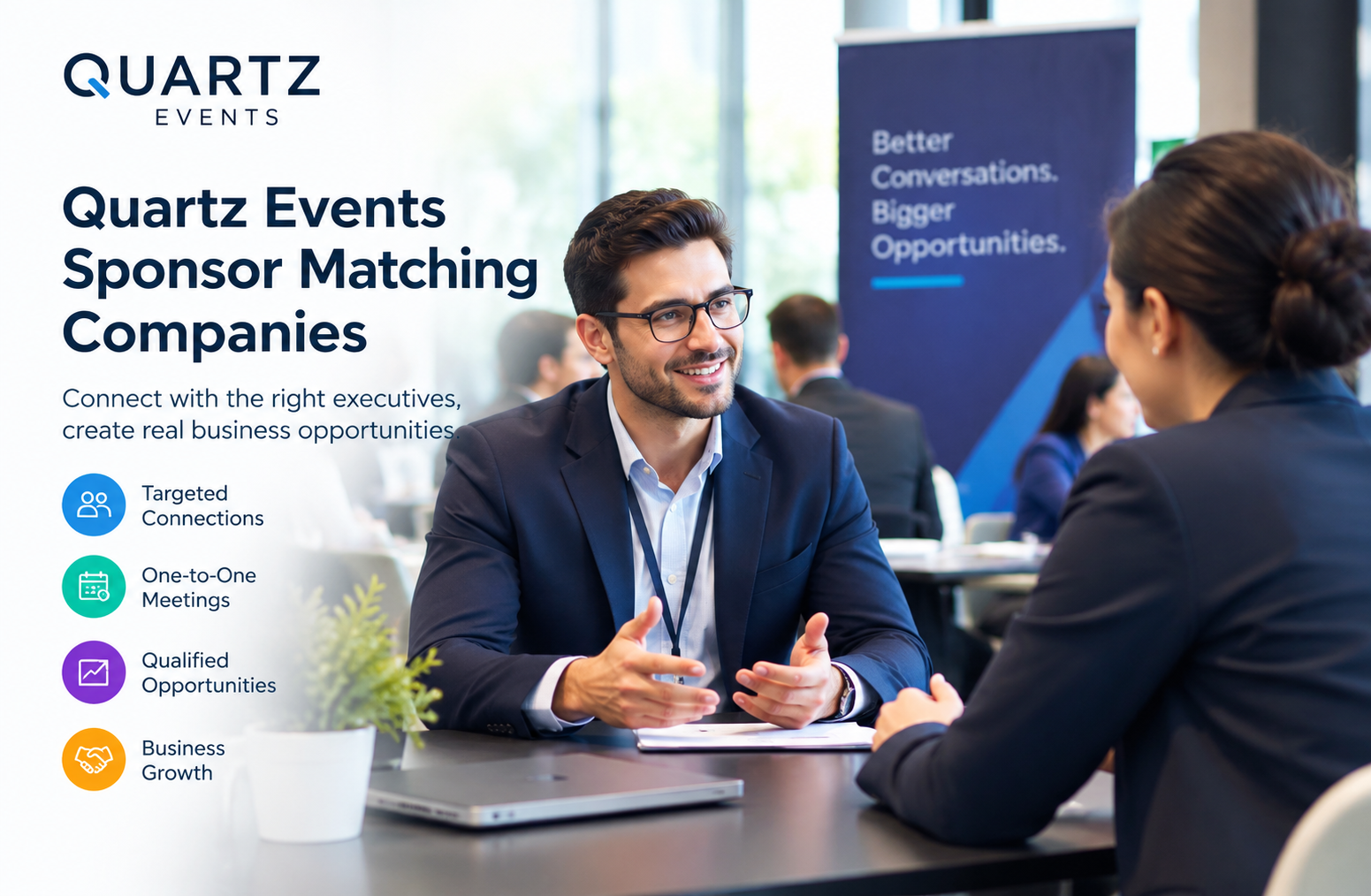
Businesses searching for quartz events sponsor matching companies usually want to understand how Quartz connects business solution providers with relevant executives, what types of companies can participate, and whether this approach to event sponsorship can create valuable business opportunities. Unlike a traditional conference where sponsors often depend on exhibition booths and casual networking, Quartz Network focuses on executive events and structured business meetings designed to connect potential buyers with solution providers.
The most important distinction is that sponsor matching is not simply a directory of companies looking for sponsorship deals. It is a process of identifying relevant business needs and creating opportunities for conversations between organizations that may benefit from working together. For a software provider, consulting firm, technology company, or business services organization, this can offer a more focused way to reach potential customers.
However, the value of this model depends on several factors, including the quality of the attendee audience, the relevance of each introduction, the sponsor’s sales process, and the cost of participation. Understanding these factors helps companies make informed decisions rather than assuming that an event sponsorship automatically produces leads or revenue.
What Are Quartz Events Sponsor Matching Companies?
The phrase quartz events sponsor matching companies generally refers to the businesses that participate in Quartz Network’s event sponsorship and solution-provider ecosystem. These businesses offer products or services that may address challenges faced by senior executives and business decision-makers.
Quartz Events is associated with Quartz Network, an organization that facilitates executive-focused business events. Its approach emphasizes relevant introductions, curated networking, and one-to-one meetings rather than relying entirely on large exhibition floors or unrestricted networking sessions.
A company participating as a sponsor might provide cybersecurity software, enterprise technology, human resources platforms, financial management systems, marketing services, analytics solutions, or supply chain technology. The appropriate audience depends on the company’s offering and the focus of the event.
For example, a business selling enterprise cybersecurity software would have more reason to meet an IT leader responsible for security infrastructure than a marketing executive with no responsibility for technology purchasing. Similarly, a human resources software provider would benefit most from conversations with leaders who oversee recruitment, employee experience, talent management, or workforce operations.
The underlying principle is straightforward: a relevant business conversation is generally more valuable than a large number of unrelated contacts.
This does not mean every meeting will produce a sale. It means that a structured matching process can help businesses focus their time on people whose responsibilities and priorities are more closely connected to their solutions.
How the Quartz Sponsor Matching Process Works
Understanding the process helps explain why this event model differs from conventional sponsorship. Instead of focusing only on brand exposure, the system is designed to create relevant conversations between companies selling business solutions and executives who may need them.
1. Identifying Executive Needs
The process begins with understanding the challenges facing participating executives. These may include reducing operating costs, improving data security, modernizing financial systems, recruiting employees, improving customer retention, or making supply chain operations more efficient.
The event’s focus determines which business priorities are most relevant. A finance leadership event, for instance, may attract executives interested in budgeting, financial planning, compliance, automation, and reporting.
This information helps establish the context for potential meetings. A sponsor can prepare a more useful conversation when it understands the business problem an executive wants to address.
2. Establishing the Sponsor’s Ideal Customer Profile
A solution provider must explain which organizations are most likely to benefit from its products or services.
An ideal customer profile, often shortened to ICP, describes the type of company a provider wants to serve. It may include:
- Industry and business sector.
- Company size and operational complexity.
- Geographic market.
- Relevant executive job titles.
- Technology environment or existing systems.
- Business problems the solution addresses.
- Likely purchasing requirements and project priorities.
For example, a cybersecurity provider targeting large financial institutions will need a different audience from a recruitment platform designed for growing retail businesses.
Clear targeting improves the chances of productive introductions and helps sales teams avoid meetings that have little commercial relevance.
3. Reviewing Potential Matches
Quartz describes giving sponsors advance information about prospective attendees and allowing them to select people they would like to meet. The intention is to build meeting schedules around the sponsor’s target audience and the interests of participating executives.
The quality of the information matters. A job title alone does not prove that someone is a suitable prospect. A vice president may have considerable influence but no responsibility for the particular product being sold.
The stronger match considers both professional responsibility and the business challenge under discussion.
4. Scheduling One-to-One Meetings
After suitable participants have been identified, meetings can be arranged within the event schedule. Quartz promotes sponsorship packages that include guaranteed numbers of qualified meetings, with the advertised quantity depending on the package.
Its official event sponsorship information describes one-to-one meetings, advance prospect information, sponsor-selected attendees, and opportunities to participate in educational sessions and networking activities.
These meetings provide a defined period for discussing a business problem, assessing possible solutions, and determining whether further contact makes sense.
The precise duration, meeting volume, qualification requirements, and package conditions can vary by event. Companies should confirm the applicable details before committing to a sponsorship.
5. Following Up After the Event
A meeting is the beginning of a possible commercial relationship, not the end of the sales process.
After an event, sponsors should record the issues discussed, agreed next steps, expected timelines, and any additional information requested by the prospect.
A useful follow-up process separates contacts into practical categories:
- Immediate opportunities: Prospects with a relevant need and a clear next step.
- Developing opportunities: Companies interested in a solution but still researching options.
- Long-term prospects: Businesses that may need the offering in a later planning or budget cycle.
- Poor-fit contacts: People whose requirements do not align with the sponsor’s product or service.
This classification prevents sales teams from treating every meeting as an equally valuable lead. It also makes performance reporting more accurate.
What Types of Companies Can Benefit From Quartz Events?
There is no single type of business that automatically benefits from executive matchmaking. Suitability depends on the audience, the company’s offering, and whether its sales process requires direct discussions with senior decision-makers.
However, several business categories may be especially relevant.
Enterprise Software and SaaS Companies
Software-as-a-service businesses often sell products that require evaluation, demonstrations, integration planning, and approval from several stakeholders.
Examples include enterprise resource planning systems, customer relationship management platforms, business intelligence tools, workflow automation software, and data management applications.
A structured executive meeting can help a provider discover whether a prospect has a genuine operational challenge, an existing project, and a reason to evaluate new technology.
For these companies, a useful meeting should go beyond a product introduction. It should establish the customer’s current process, the limitations of existing tools, the desired outcome, and the criteria for evaluating alternatives.
Cybersecurity and Information Technology Providers
Technology companies may offer network security, identity management, cloud infrastructure, backup systems, data protection, compliance software, or managed IT services.
Their ideal audience may include chief information officers, chief information security officers, IT directors, infrastructure leaders, and other executives responsible for technology strategy.
A cybersecurity provider, for example, might be most relevant to an organization reviewing access controls, preparing for an audit, consolidating security vendors, or strengthening incident response.
A meeting with someone who has no involvement in these decisions would be less useful, regardless of the person’s seniority.
Marketing Technology and Customer Experience Businesses
Marketing departments use many tools to understand customers, improve campaigns, manage customer data, and measure business performance.
Relevant providers may include companies specializing in marketing automation, customer data platforms, customer relationship management, personalization, analytics, advertising technology, and customer experience software.
Events focused on marketing leadership may help these providers reach decision-makers who oversee marketing budgets and technology investments.
The strongest opportunities arise when a provider can connect its capabilities to a measurable business problem, such as poor campaign attribution, fragmented customer data, weak retention, or inefficient marketing operations.
Human Resources and Workforce Technology Companies
Human resources technology covers recruitment, employee onboarding, workforce planning, learning and development, performance management, employee engagement, and people analytics.
Providers in this category may benefit from conversations with chief human resources officers, talent acquisition leaders, people operations executives, and other professionals responsible for workforce strategy.
A recruitment platform might be relevant to a company struggling to fill specialist roles. A learning platform might be better suited to an organization investing in employee skills or leadership development.
Quartz’s HR-focused programs illustrate how meetings can be organized around specific workforce priorities rather than general interest in technology.
Finance and Financial Technology Providers
Financial leaders are responsible for planning, forecasting, financial reporting, cash flow, risk management, compliance, and business performance.
Companies supplying financial software, payment systems, reporting tools, automation platforms, or advisory services may find finance-focused events relevant to their target markets.
For example, a forecasting platform could be useful to an organization seeking more reliable financial planning across several business units.
A good qualification process should establish whether the executive owns the relevant function, whether a project is under consideration, and what implementation constraints might affect a purchase.
Supply Chain, Procurement, and Manufacturing Businesses
Companies serving supply chain and manufacturing operations may sell logistics software, inventory management systems, procurement platforms, industrial technology, analytics, or process improvement services.
Their target buyers may include chief operating officers, procurement directors, supply chain executives, logistics managers, and manufacturing leaders.
These buyers often evaluate solutions based on operational performance, cost, reliability, integration, and measurable efficiency gains.
A sponsor should therefore be prepared to discuss practical results and implementation requirements rather than relying on broad claims about innovation.
Consulting and Professional Services Firms
Specialist consulting firms may also find value in structured executive meetings. Their services might include digital transformation, organizational change, risk management, operational improvement, strategic planning, or technology implementation.
These businesses often depend on trust and a clear understanding of a client’s situation before proposing a project.
A focused conversation can help establish whether the executive faces a problem that requires outside expertise. However, a sponsor should be able to explain its specific capabilities and experience rather than presenting a general list of services.
The Main Benefits of Quartz Event Sponsorship
The potential benefits extend beyond the number of meetings scheduled. Companies should consider how the format affects prospect quality, sales preparation, market understanding, and the use of their team’s time.
More Focused Access to Decision-Makers
One of the main reasons companies investigate quartz events sponsor matching companies is the opportunity to reach senior business professionals through a structured event.
Traditional exhibitions may attract a broad mix of attendees. Some are potential buyers, while others are students, job seekers, competitors, or professionals who are not involved in purchasing decisions.
An executive-focused event aims to narrow that audience and make the interaction more relevant.
However, seniority alone is not enough. A decision-maker must also have a relevant responsibility, a business need, or an influence on the purchasing process.
Sponsors should therefore evaluate the actual attendee profile rather than relying only on general descriptions of the audience.
Better Preparation Before Meetings
Advance prospect information can help sales representatives prepare targeted questions and avoid spending the entire meeting explaining what their company does.
Before a meeting, a representative might review the prospect’s role, business priorities, current project, and likely requirements.
Preparation should also include a clear objective. One meeting may aim to establish technical fit, while another may focus on understanding a procurement process or arranging a product demonstration.
The benefit is not simply a more polished presentation. It is a better chance of using limited meeting time to discover whether a real opportunity exists.
More Predictable Sales Activity
A defined schedule makes it easier to plan staff time and estimate the amount of prospect interaction available through an event.
Quartz publicly advertises packages with guaranteed qualified meeting volumes. This can give sponsors a clearer starting point for planning than an exhibition model in which conversations depend heavily on booth traffic.
Nevertheless, a guaranteed meeting count should not be confused with guaranteed leads, qualified sales opportunities, contracts, or revenue.
The commercial result depends on the quality of the conversations and what happens afterward.
Opportunities to Learn About Customer Priorities
Meetings can reveal problems that customers are actively trying to solve, as well as the language they use to describe those problems.
Repeated conversations might reveal that prospects are concerned about integration costs rather than software features, or that implementation time matters more than a small difference in subscription price.
These insights can inform product development, sales messaging, and marketing content.
To make the learning useful, teams should record recurring themes in a consistent way. Individual anecdotes can be misleading, but patterns across multiple conversations may identify a genuine market concern.
Relationship Building Beyond the Initial Conversation
Business purchasing decisions can take months. Enterprise solutions may involve finance, legal, IT, procurement, and department leadership before a contract is approved.
An initial meeting may help establish a relationship that develops over time.
A thoughtful follow-up, relevant research, or a useful technical explanation can help maintain the relationship without applying unnecessary pressure.
The long-term value of an event may therefore include future opportunities that do not appear in the immediate post-event sales report.
Potentially More Efficient Use of Sales Resources
Travel, accommodation, event fees, staff time, booth construction, and promotional materials can make traditional conferences expensive.
A meeting-based format changes how companies allocate those resources. Instead of concentrating primarily on attracting passersby, teams can prepare for scheduled discussions with selected prospects.
This can be attractive to companies selling complex products with relatively high contract values.
Even so, the total cost must be evaluated. A smaller number of expensive meetings is not necessarily better than a larger number of lower-cost opportunities. The relevant question is whether the event creates enough qualified pipeline to justify its full cost.
Challenges and Limitations to Consider
A balanced assessment must examine the risks as carefully as the potential advantages. No event format eliminates the uncertainty involved in business development.
A Scheduled Meeting May Not Be a Qualified Opportunity
A prospect may have a relevant job title but no active project, available budget, or authority to purchase.
Another executive may be researching the market without intending to make a decision for several years.
These conversations can still provide useful information, but they should not automatically be counted as sales-qualified opportunities.
Before sponsoring, companies should ask how attendee qualifications are established and what the organizer means by a qualified meeting.
Sponsorship Can Be Expensive
The total investment may include the sponsorship fee, employee time, preparation, travel, follow-up, and the cost of supporting potential customers through the sales process.
Pricing and package terms should be obtained directly from the organizer rather than estimated from another company’s experience.
The business case should account for the full cost, not just the advertised package price.
Some Products Require Longer Sales Cycles
A company selling a relatively simple service may be able to evaluate prospects quickly. A provider selling enterprise infrastructure or complex financial technology may require several months of technical evaluation and internal approval.
This difference affects how event results should be measured.
Judging a complex B2B sponsorship only by contracts signed in the first week could underestimate its value. Conversely, counting every meeting as future revenue would overstate performance.
A suitable evaluation period should reflect the company’s typical sales cycle.
Poor Targeting Can Reduce the Value of Meetings
A broad product description can make it difficult to identify the right audience.
For example, a company that describes itself as a provider of digital transformation services may be relevant to many industries but specific to none. Without a clear target customer and use case, matching becomes less precise.
Sponsors should define their best-fit accounts, target job roles, common business problems, and minimum qualification criteria before an event.
Guaranteed Meetings Do Not Guarantee Revenue
This distinction deserves special attention.
A meeting guarantee is a commitment about the event experience under the applicable agreement. It is not a promise that a prospect will buy, that a contract will be signed, or that a particular return on investment will be achieved.
The sponsor remains responsible for product fit, pricing, sales execution, technical support, and relationship management.
Companies should review the written terms to understand how cancellations, no-shows, rescheduling, and unmet meeting commitments are handled.
Results May Be Difficult to Attribute
A prospect may attend an event, visit a company’s website, speak to its sales team, and later respond to an email campaign before becoming a customer.
Which activity created the opportunity?
Attribution is rarely straightforward. Sponsors should record event interactions in their customer relationship management system and use consistent rules for identifying event-sourced and event-influenced opportunities.
This helps avoid claiming all revenue from a customer simply because an event meeting occurred.
How to Evaluate Whether Quartz Sponsorship Is Worth the Investment
The right way to evaluate event sponsorship is to connect the cost of participation with measurable business outcomes. Meeting volume is a useful starting point, but it is not a complete measure of success.
A company should assess the sponsorship before signing an agreement and continue measuring results after the event.
Step 1: Define the Business Objective
Start by identifying what the company expects to achieve.
Possible objectives include:
- Generating qualified sales opportunities.
- Reaching a specific group of senior executives.
- Entering a new industry or geographic market.
- Introducing a new product to potential buyers.
- Building relationships with enterprise accounts.
- Learning about customer needs and competing solutions.
Choose one primary objective and a small number of supporting goals. This makes it easier to judge the results.
For example, a software company entering the healthcare market may value meetings with hospital technology leaders more than meetings with a larger number of unrelated executives.
Step 2: Calculate the Total Cost
The sponsorship fee is only one part of the investment.
Include the following costs where applicable:
| Cost category | What to include |
| Sponsorship | Package fee and additional participation charges |
| Staff time | Preparation, event attendance, and follow-up |
| Travel | Flights, accommodation, transport, and meals |
| Sales preparation | Prospect research, presentations, and demonstrations |
| Technology | Meeting tools, CRM administration, and supporting systems |
| Follow-up | Sales calls, technical evaluations, and additional demonstrations |
Calculate the total expected cost before comparing sponsorship with other marketing channels.
Step 3: Estimate Cost Per Meeting
Cost per meeting provides a basic measure of efficiency.
The formula is:
Costpermeeting=TotaleventcostCompletedmeetings
Consider a hypothetical company that spends $24,000 on an event and completes 40 meetings.
Its cost per completed meeting would be:
\[ \$24,000 \div 40 = \$600 \]
This is an illustrative calculation, not a published Quartz sponsorship price or a claim about actual event performance.
The result helps the company compare different events, but it does not reveal whether the meetings were commercially useful. A $600 meeting with a qualified enterprise buyer may be more valuable than a $100 meeting with someone who cannot influence a purchase.
Step 4: Track Conversion Rates
Next, measure how many meetings progress to the next stage.
For example, suppose a company completes 40 meetings, identifies 12 qualified opportunities, and eventually closes three customers.
Its meeting-to-opportunity conversion rate is:
\[ \frac{12}{40}\times100 = 30\% \]
Its meeting-to-customer conversion rate is:
\[ \frac{3}{40}\times100 = 7.5\% \]
These are hypothetical figures intended to demonstrate the calculation.
Tracking conversion rates over several events helps a business identify whether it needs better audience targeting, improved sales preparation, stronger follow-up, or a different event format.
Step 5: Measure Pipeline and Revenue
A qualified opportunity should have a defined business need and a realistic possibility of progressing through the sales process.
Sponsors can track:
- Total value of qualified opportunities.
- Number of opportunities reaching a technical evaluation.
- Number of proposals submitted.
- Number of customers acquired.
- Revenue generated from event-sourced opportunities.
- Gross profit and customer acquisition cost.
- Time taken to close a deal.
Pipeline value is not the same as realized revenue. A proposal worth $100,000 does not mean the company has earned $100,000.
For a more complete assessment, use historical conversion rates or clearly documented probability estimates when calculating expected pipeline value. Report actual revenue separately.
Step 6: Compare the Results With Other Channels
Compare sponsorship performance with alternatives such as targeted outbound sales, account-based marketing, industry conferences, webinars, and customer referrals.
The comparison should use similar definitions for a qualified lead, opportunity, and closed customer.
For example, an event may have a higher cost per lead than email marketing but generate a greater proportion of opportunities involving senior decision-makers. The more expensive channel could still be worthwhile if it produces enough profitable business.
The decision should be based on the company’s economics and sales goals rather than the appearance of a large meeting count.
Practical Example: Matching a Software Company With the Right Executives
Consider a fictional company that sells cloud-based supply chain planning software to large manufacturers and distributors.
The company wants to expand into organizations with complex inventory networks and frequent forecasting challenges.
Its target customers have several characteristics:
- Multiple warehouses or distribution centers.
- Complex supplier relationships.
- A need for better inventory visibility.
- Existing enterprise resource planning systems.
- Senior leaders responsible for supply chain performance.
The company could investigate an event focused on supply chain, logistics, or procurement rather than a general business conference.
Identifying the Best-Fit Audience
The ideal attendees might include chief supply chain officers, vice presidents of operations, procurement executives, and supply chain transformation leaders.
However, the company should look beyond job titles. It needs to understand whether these executives oversee the relevant processes and have a reason to investigate new planning software.
An executive who is satisfied with an existing system and has no planned changes may be a lower-priority prospect than a director responsible for replacing an outdated platform.
Preparing for the Meetings
The sales team could prepare questions such as:
- How does your organization currently forecast demand?
- Which parts of the supply chain create the most uncertainty?
- How do you measure inventory accuracy and service levels?
- Are you considering changes to your planning systems?
- What requirements would a new solution need to meet?
These questions help establish whether the product addresses a real problem.
The representative can then explain the relevant capabilities, discuss implementation requirements, and agree on a sensible next step if there is a genuine fit.
Assessing the Outcome
Suppose the company completes 20 meetings. Eight reveal relevant operational problems, four progress to technical demonstrations, and one becomes a customer several months later.
The event may have created value through the new customer, the qualified opportunities still in progress, and the market information gathered from other meetings.
The company should still compare the total investment with the eventual gross profit and the cost of alternative acquisition channels.
This example illustrates the evaluation method. It is not a report of an actual Quartz event or a prediction of what another sponsor will achieve.
How Companies Can Prepare for a Quartz Sponsorship
Preparation influences the quality of the event experience. Businesses that define their objectives early are better positioned to select relevant attendees, prepare useful conversations, and follow up consistently.
Build a Clear Ideal Customer Profile
Write a short description of the organizations most likely to benefit from your offering.
Include the industries you serve, the size of companies you target, the problems you solve, and the roles involved in evaluating your solution.
Avoid trying to target every possible buyer. A focused profile helps the team prioritize the most relevant meetings.
Prepare a Specific Value Proposition
A value proposition should explain three things:
- The business problem your solution addresses.
- How your approach helps solve that problem.
- What evidence supports the expected benefit.
For instance, rather than saying that a platform transforms business operations, explain which process it improves and how customers can evaluate the result.
Use verified customer examples, documented product capabilities, and realistic performance measures. Do not promise results that cannot be supported.
Research the Event Audience
Review the event’s purpose, attendee roles, industry coverage, meeting format, and available qualification information.
Ask the organizer whether sample attendee profiles or anonymized examples can be provided.
Determine whether the audience includes people who can evaluate your offering, influence purchasing decisions, or introduce the relevant internal stakeholders.
This step can reveal a mismatch before money is committed.
Agree on Meeting Expectations in Writing
Before signing, clarify what the sponsorship package includes.
Questions worth asking include:
- How many meetings are included?
- What makes a meeting qualified?
- How are attendee roles and business needs verified?
- Can sponsors select the people they want to meet?
- What happens if a scheduled attendee does not appear?
- Are replacement meetings or other remedies available?
- What information about prospects can sponsors access?
- What are the cancellation, postponement, and refund terms?
Get the answers in writing. Marketing descriptions and contractual obligations are not necessarily identical.
Coordinate Sales and Marketing Teams
Sponsorship should not operate as an isolated marketing activity.
Marketing can define the campaign goals, prepare supporting materials, and manage reporting. Sales can research prospects, lead meetings, qualify opportunities, and own follow-up.
Both teams should agree on what counts as a successful meeting and how outcomes will be recorded.
Without this coordination, an event may generate conversations that never enter the sales pipeline.
Create a Follow-Up Plan Before the Event
Do not wait until the final session to decide how to contact prospects.
Prepare a process for sending relevant information, scheduling demonstrations, answering technical questions, and recording agreed actions.
The follow-up should reflect the conversation. A prospect who requested implementation details should receive those details, not a generic promotional email.
Prompt, relevant communication makes it easier to continue the relationship while the discussion is still fresh.
Quartz Events Compared With Traditional Trade Shows
Both event models can support business development, but they serve somewhat different needs.
| Factor | Quartz-style meeting-based events | Traditional trade shows |
| Main emphasis | Curated executive meetings | Exhibition, visibility, and networking |
| Prospect interaction | Scheduled conversations | Often initiated through booth visits or networking |
| Audience targeting | Focus on relevant executive roles and needs | Varies by show and attendee mix |
| Preparation | Prospect research and meeting planning | Booth preparation, demonstrations, and traffic generation |
| Brand exposure | Depends on the package and event activities | Often a major objective |
| Measurement | Meetings, opportunities, pipeline, and revenue | May include traffic, leads, exposure, and sales |
| Best potential fit | Complex B2B sales and targeted executive access | Broad awareness, product demonstrations, and industry reach |
This comparison is general rather than a claim that every event follows the same format.
A traditional trade show may be a better choice for a company launching a consumer product or seeking wide market exposure. A meeting-based event may suit a business selling specialized enterprise solutions to a relatively small group of decision-makers.
Some companies can benefit from both formats. The right choice depends on the audience, objectives, budget, and sales process.
Important Questions to Ask Before Selecting an Event
Before committing to a sponsorship, companies should examine the event at the level of their own commercial needs.
Is the Audience Relevant to My Product?
Check whether the event attracts people who experience the problems your solution addresses. A prestigious event with a poorly matched audience can be less useful than a smaller event with highly relevant participants.
Can My Team Support the Opportunities?
Generating meetings is not enough if the company lacks the staff or technical resources to respond to interest.
Make sure the sales team can handle demonstrations, security reviews, implementation questions, pricing discussions, and the follow-up workload.
Is the Sponsorship Fee Sustainable?
Calculate the amount the company can reasonably invest to acquire a customer.
If the business needs unusually high conversion rates to recover its costs, the sponsorship may carry too much risk.
What Does the Contract Actually Guarantee?
Read the terms carefully. Verify the meaning of a qualified meeting, the applicable meeting count, and the remedies available if the organizer does not deliver the agreed service.
Do not assume that a promise about meetings also covers lead quality, revenue, or contract value.
How Will Success Be Measured?
Agree on the reporting process before the event. Track completed meetings, qualified opportunities, follow-up actions, pipeline progression, and eventual financial outcomes.
A clear measurement plan makes it easier to compare results across multiple sponsorships and decide whether to participate again.
Frequently Asked Questions
1. What are Quartz Events sponsor matching companies?
The phrase refers to B2B solution providers that participate in Quartz Network’s executive event sponsorship model. These businesses are connected with relevant decision-makers through structured meetings based on business priorities, professional responsibilities, and potential solution fit.
2. How does Quartz match sponsors with potential customers?
Quartz describes a process that uses information about executive needs and solution-provider offerings to facilitate relevant one-to-one meetings. Sponsors can receive advance prospect information and select attendees they want to meet. The exact process and terms may vary by event.
3. Which industries can benefit from Quartz event sponsorship?
Potentially suitable industries include enterprise software, cybersecurity, marketing technology, human resources technology, financial technology, supply chain management, analytics, consulting, and professional services. The best fit depends on whether the event attracts executives who need the sponsor’s products or services.
4. Does Quartz guarantee sales or revenue from sponsorship?
No. Quartz advertises sponsorship packages with guaranteed qualified meetings, but meetings are not the same as sales. Revenue depends on factors such as product suitability, budget, purchasing authority, competition, timing, and the sponsor’s follow-up process.
5. How much does Quartz event sponsorship cost?
The exact price depends on the event, sponsorship package, meeting volume, and applicable terms. Companies should request a current proposal directly from Quartz and calculate the full cost, including staff time, preparation, travel, and follow-up.
6. How can a business determine whether Quartz sponsorship is worthwhile?
A business should compare the total sponsorship cost with the quality of completed meetings, qualified opportunities, customer acquisition costs, pipeline progression, and eventual revenue. Results should be assessed over a period that reflects the company’s normal sales cycle.
Conclusion
Quartz Events sponsor matching companies are best understood within the broader model of executive-focused B2B networking and solution-provider sponsorship. The approach aims to connect businesses offering specialized products and services with executives whose responsibilities and business challenges may make those offerings relevant.
Its main attraction is the opportunity to replace some of the uncertainty of conventional event networking with structured, targeted conversations. Advance prospect information, scheduled meetings, and audience selection can help sales teams prepare more effectively and focus on potential customers who fit their ideal customer profile.
However, successful sponsorship requires more than attending an event or completing a specified number of meetings. Companies need clear targeting, a relevant value proposition, realistic expectations, coordinated sales and marketing teams, and a reliable follow-up process.
The financial case should be based on the total cost of participation and the commercial results that follow. Meeting volume is an important operational measure, but qualified opportunities, customer acquisition costs, gross profit, and long-term revenue provide a more complete picture.
Ultimately, the most useful way to evaluate this sponsorship model is to determine whether the event connects a business with the right people at the right time and creates opportunities that justify the investment. Careful research, written agreement terms, and consistent performance measurement help companies make that decision with greater confidence.