Thesindi Com: What It Is, Features, Benefits, and Safety Guide
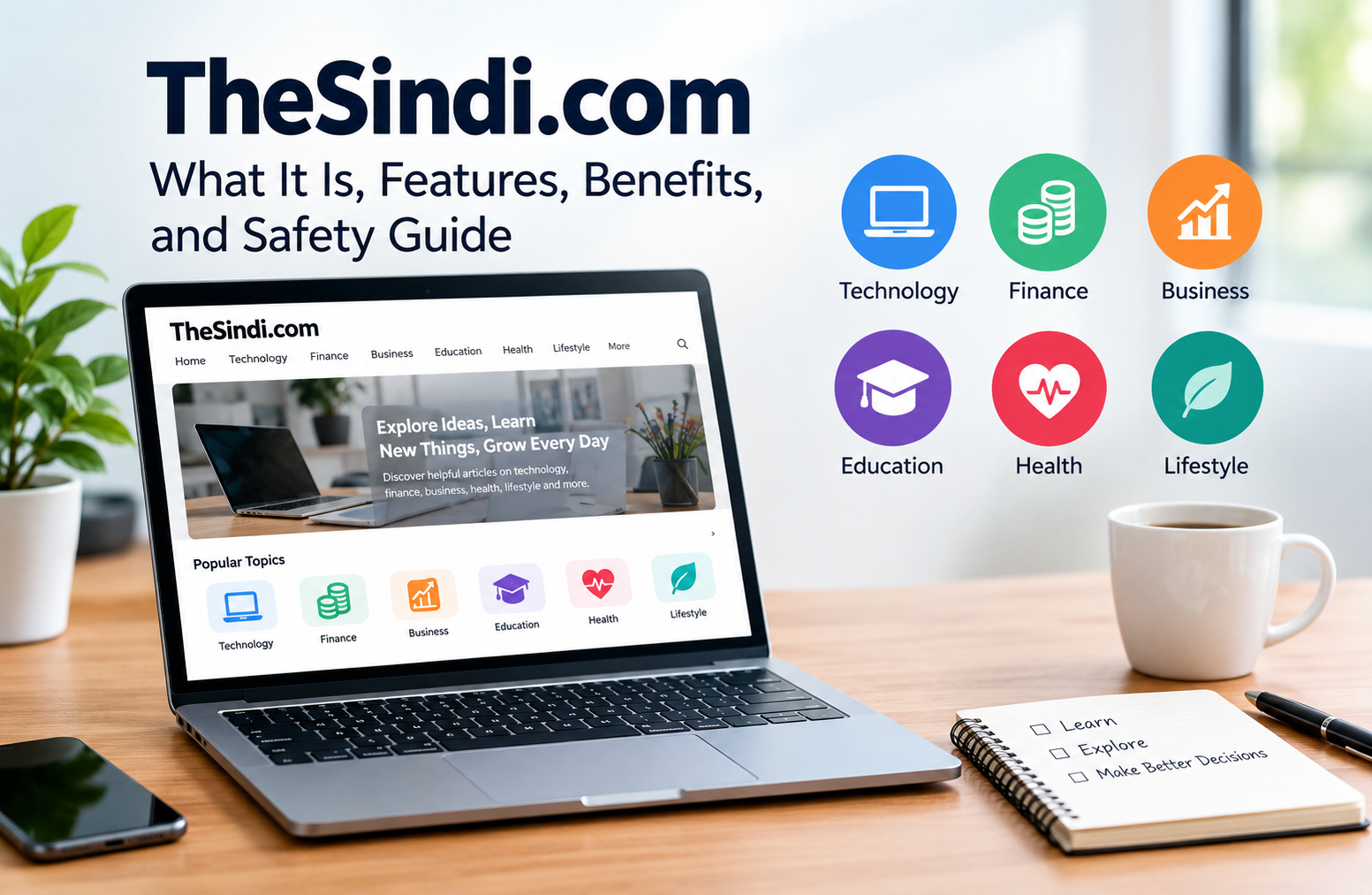
When people search for thesindi com, they are usually looking for information about the website, the topics it covers, the type of content it publishes, and whether it is useful for everyday research. TheSindi.com is an online publishing website associated with informational articles across several subjects, including technology, finance, business, education, health, and lifestyle. Understanding its purpose, content structure, and limitations can help readers decide when to use it and when to consult more specialized sources.
The internet offers countless websites that explain unfamiliar subjects, compare available options, and provide practical advice. However, not every publication serves the same purpose, and a website covering several subjects should not automatically be treated as an expert authority in all of them. Readers benefit most when they understand what a platform offers, how to evaluate its information, and which additional checks are appropriate before acting on an article.
This guide examines the platform from an informational perspective. It explains its general purpose, possible benefits, common limitations, responsible browsing practices, and the factors readers should consider when deciding whether its content meets their needs.
What Is Thesindi Com?
Thesindi.com is a general-interest digital publishing website that publishes articles and informational guides on multiple subjects. Rather than concentrating exclusively on one industry, the site is associated with a broad range of topics designed to answer everyday questions and introduce readers to unfamiliar concepts.
Its general publishing model resembles that of an online magazine or multi-niche blog. Readers can explore articles according to their interests instead of visiting a different website for every basic question.
The distinction between a publishing website and an online service is important. A publishing platform primarily provides information for readers to consume. It is not automatically a shopping service, financial institution, professional consultancy, or specialized software product simply because its articles discuss those subjects.
The exact content, available categories, and website policies can change over time. Readers should therefore check the live website rather than assume that every description of its features remains current.
The Main Purpose of the Website
The primary purpose of a multi-topic information website is to make useful knowledge accessible to a broad audience. Readers may arrive with a specific question, an unfamiliar term, or a need to understand a subject before exploring it in greater depth.
For example, someone researching technology might want a straightforward explanation of a digital tool. Another reader might be looking for introductory information about business planning, personal budgeting, education, or daily routines.
A general-interest publication can provide an initial overview of these subjects. Its value depends on whether the individual article answers the question clearly, uses reliable evidence, explains important limitations, and points readers toward appropriate sources when further verification is necessary.
A website’s stated purpose is only the starting point. The actual quality of its content must be judged article by article.
Is It a Blog, an Online Magazine, or a Digital Service?
The most useful way to understand TheSindi.com is to examine what a reader can actually access.
A blog commonly organizes posts by publication date, author, and category. An online magazine may use a similar structure while presenting a wider range of editorial topics. A digital service, by contrast, usually provides a tool, transaction, account feature, or interactive function beyond reading articles.
TheSindi.com is described in available website information as a general-interest publication. Readers should not confuse articles about a product or service with the product or service itself.
This distinction helps prevent misunderstandings. Reading a guide about online finance, for example, does not mean the publishing website offers banking services. Similarly, an article explaining a technology product does not establish that the website manufactures, owns, or officially represents that product.
Main Topics Covered by TheSindi Com
One of the defining features of a multi-niche publication is its broad subject coverage. Based on available descriptions of the website, its content includes several areas that readers may encounter in daily life.
The following categories explain what readers can generally expect from these subject areas. They should not be interpreted as a guarantee that every category contains the same amount of content or offers the same level of expertise.
1. Technology and Digital Tools
Technology content helps readers understand digital products, online platforms, software, internet services, and changes in the way people use computers and mobile devices.
Articles in this category may explain technical terms, introduce useful tools, or discuss common digital problems. Beginner-friendly explanations can be particularly helpful to readers who want to understand a subject before attempting a more advanced task.
When reading technology guides, consider the following questions:
- Does the article identify the software version or device model being discussed?
- Are the instructions current and easy to follow?
- Does the article explain potential costs, privacy concerns, or compatibility issues?
- Are recommended downloads linked to the developer’s official website?
- Does the guide distinguish between verified features and expected future developments?
These checks matter because software interfaces, subscription plans, and security practices change frequently. A guide that was accurate several months ago may no longer describe the current product.
Technology articles are most useful when they provide practical steps rather than simply listing features. A good guide explains what a tool does, who might benefit from it, and where its limitations become important.
2. Finance and Personal Money Management
Financial education is another subject associated with general-interest websites. Readers may want to understand budgeting, saving, digital payments, investment terminology, or the basic operation of financial products.
Accessible explanations can help readers become familiar with unfamiliar financial language. However, understanding a concept and deciding what to do with personal money are two different tasks.
For example, an introductory article about investing may explain the relationship between risk and potential returns. It cannot determine whether a particular investment suits an individual without considering that person’s financial circumstances, obligations, time horizon, and ability to absorb losses.
When using financial content, readers should:
- Verify interest rates, fees, and eligibility conditions with the relevant institution.
- Check whether an investment claim includes realistic information about risk.
- Look for the date when figures and recommendations were last updated.
- Confirm the identity and regulatory status of any financial provider.
- Avoid sharing banking credentials or sensitive financial information through unfamiliar links.
A responsible reader treats general financial articles as educational material, not personalized investment advice. This is particularly important when an article discusses cryptocurrency, trading platforms, loans, or products that promise unusually high returns.
3. Business and Entrepreneurship
Business information can support people who are exploring self-employment, planning a small venture, learning about marketing, or trying to understand how companies operate.
Readers may benefit from explanations of business models, customer research, online selling, productivity, and basic management practices. Such information can help someone identify the questions they need to investigate before committing time or money to an idea.
A useful business guide should connect its advice to practical circumstances. Instead of promising that a particular strategy will work for every company, it should explain the conditions that may influence the outcome.
For instance, a marketing method that works for a business with an established customer base may not be appropriate for a new company with limited resources. Similarly, an online business model that succeeds in one country may face different taxes, payment options, and regulations elsewhere.
Readers should distinguish between general principles and claims supported by measurable results. Revenue projections, success rates, and customer statistics deserve particular scrutiny when an article does not identify its data source.
4. Education and Learning
Educational content can help readers understand unfamiliar subjects, review basic concepts, and discover ways to improve their learning habits.
Students may use introductory guides to prepare for a more detailed lesson. Professionals may use explainers to become familiar with an industry term or develop a basic understanding of a new skill.
The value of educational information depends on its accuracy and clarity. An explanation should make complex ideas easier to understand without removing important qualifications.
Readers can assess educational articles by checking whether they define key terms, use examples that match the topic, and distinguish established facts from opinion. Where academic work is involved, original research papers, university publications, textbooks, and official educational resources may provide stronger evidence.
A general-interest website can be a convenient starting point, but students should follow their institution’s requirements when selecting sources for assignments or research projects.
5. Health and Wellbeing
Health information requires greater care than many everyday subjects because an inaccurate claim may influence a person’s decisions about symptoms, treatment, nutrition, or medication.
General health articles can introduce basic terminology, explain common wellness concepts, or help readers prepare questions for a healthcare professional. Their usefulness depends on the quality of the evidence and the clarity with which the article explains its limits.
Readers should check whether medical claims are supported by recognized health organizations or relevant research. They should also consider the publication date, particularly when the subject involves medical guidance that may change.
Be cautious of articles that promise guaranteed results, recommend stopping prescribed treatment, or promote a product as a universal solution. Personal testimonials alone cannot establish that a treatment is safe or effective.
The safest approach is to use general health content to build understanding, then consult a qualified healthcare professional for diagnosis or treatment decisions.
6. Lifestyle and Everyday Productivity
Lifestyle content often addresses habits, organization, time management, home routines, personal development, and practical ways to manage daily responsibilities.
This category can be useful because readers may want straightforward ideas they can adapt without extensive technical knowledge. Examples might include planning a weekly schedule, organizing a workspace, or establishing a consistent study routine.
However, lifestyle advice should be treated as a set of possible approaches rather than a universal formula. A routine that suits a student may not work for someone managing irregular shifts or family responsibilities.
The most useful guidance acknowledges these differences and offers realistic options. Readers should look for suggestions that are specific enough to apply while remaining flexible enough to adapt to individual circumstances.
7. Law, Travel, and Other Practical Subjects
General-interest publications may also address legal concepts, travel planning, home improvement, digital marketing, and other everyday questions.
These subjects can be highly dependent on location and circumstances. Laws vary by jurisdiction, travel requirements change, and home improvement work may require permits or qualified professionals.
An article that explains a legal concept in one country should not automatically be applied to another. Likewise, travel guidance should be checked against current government or official transport information before a trip.
The central lesson is simple: broad coverage improves convenience, but subject-specific verification remains essential.
Key Benefits of Using Thesindi Com
A multi-topic information website can offer several practical advantages when its content is relevant, clear, and appropriately supported.
Convenient Access to Different Subjects
The main benefit is the ability to explore different topics through a single publishing platform. Readers do not need to begin every basic research task by finding a specialist publication.
Someone exploring digital tools may also want to understand online business or productivity. A broad website can help that reader build an initial understanding of several connected subjects.
Convenience, however, should not replace careful research. A single platform may provide a useful introduction without being the best source for every question.
Beginner-Friendly Explanations
Technical terminology can make unfamiliar subjects difficult to understand. Clear writing, informative headings, and practical examples reduce this barrier.
A well-structured article helps readers identify the main point quickly, understand the reasoning behind it, and decide which details deserve further investigation.
Good explanations also recognize when a simple answer is insufficient. If a subject involves several exceptions or risks, the article should explain those differences instead of presenting an oversimplified rule.
Flexible Reading Experience
Online articles can be accessed when readers have time to explore a topic. Readers may skim headings first, return to a section later, or follow a relevant reference for additional details.
This flexibility is useful for casual learning and early-stage research. It also allows people to compare explanations across several publications before reaching a conclusion.
The quality of that experience depends on the website’s navigation, accessibility, page performance, and the organization of its content.
A Starting Point for Further Research
One of the strongest uses of a general-interest website is helping readers identify what they need to learn next.
A reader researching a business concept, for example, may discover unfamiliar terminology that can guide a more focused search. Someone exploring a technology product may learn which features matter before comparing official documentation.
This is an important distinction. The best outcome is not simply finishing an article. It is understanding the subject well enough to ask better questions and locate stronger evidence when necessary.
No Need to Assume Every Article Is Equally Reliable
A broad publication can contain articles with different levels of depth, sourcing, and practical usefulness. Readers should assess the specific article rather than assigning automatic credibility to every page because it appears on the same website.
This approach is especially valuable when articles cover subjects as different as personal finance, health, technology, and travel.
A clear explanation can be useful even when it is not a final authority. Its limitations become manageable when readers understand what it can and cannot establish.
How to Use Thesindi Com Effectively
Readers can improve their research experience by following a consistent process. These steps help separate useful introductory information from claims that require additional evidence.
Step 1: Identify the Question You Want Answered
Before browsing, define the information you need.
A broad search such as “business” can lead to many unrelated pages. A focused question such as “What costs should a small online shop calculate before launching?” gives the research a clearer direction.
A specific question also makes it easier to determine whether an article has actually solved the problem.
Step 2: Check the Exact Website Address
Similar domain names can refer to different publications. Spelling differences, extra words, and hyphens may lead to a separate website with different ownership and policies.
If you intend to visit TheSindi.com, check the address carefully and avoid assuming that a similarly named domain belongs to the same organization.
The publication’s reported address is TheSindi.com. This link is useful as a starting point for checking the website’s identity, although visiting a site does not by itself establish the accuracy of its content.
Step 3: Read the Introduction and Relevant Headings
Start by checking whether the article directly addresses your question. The introduction should establish the subject, while the headings should make the rest of the page easy to navigate.
If the article spends several paragraphs discussing unrelated material before reaching its main point, it may not be the most efficient source for your needs.
Look for sections that define terms, explain the process, discuss limitations, and provide evidence. These elements help determine whether the page offers meaningful information or merely repeats general statements.
Step 4: Check the Author and Publication Date
Authorship helps readers understand who is responsible for an article. A relevant professional background may be important when the subject requires specialist knowledge.
The publication date matters because some facts remain stable while others change quickly. A basic explanation of a long-established concept may remain useful for years, while guidance about current software features, regulations, prices, or health recommendations may become outdated.
If the page has been updated, check whether the update addresses the information you need rather than assuming that a recent date guarantees accuracy.
Step 5: Verify Important Claims
Do not rely solely on confident wording. Look for evidence that supports the article’s most important statements.
Depending on the topic, useful evidence may include:
- Government regulations and official public guidance.
- Original research papers and recognized academic publications.
- Official product documentation.
- Published company reports and clearly defined datasets.
- Statements from qualified professionals whose expertise matches the subject.
A claim becomes more useful when readers can trace it to an identifiable source and understand the context in which it applies.
Step 6: Consider Whether the Article Has a Commercial Purpose
Some publishing websites earn revenue through advertisements, affiliate links, sponsored articles, or paid placements. Commercial activity is not automatically evidence of poor quality, but it can influence how products and services are presented.
When an article recommends a product, ask whether the recommendation is supported by independent evidence. Check whether commercial relationships are disclosed and whether the page discusses disadvantages as well as benefits.
A recommendation should be evaluated on its reasoning and evidence, not simply on its placement in an article.
Step 7: Decide Whether More Research Is Necessary
After reading, ask yourself whether the information is sufficient for the task.
For a low-risk question, a clear introductory explanation may be enough. For a financial, legal, medical, or security-related decision, additional verification is usually appropriate.
This final step prevents a common research mistake: treating familiarity with a subject as proof that every important detail has been confirmed.
Is Thesindi Com Safe and Trustworthy?
Safety and trustworthiness are related, but they are not the same thing.
A website may load over a secure connection while still publishing an article that contains outdated, incomplete, or poorly supported information. Similarly, an article may be clearly written without being suitable as the sole basis for a major decision.
Available information about TheSindi.com describes it as a functioning general-interest publication with informational articles and standard website policy pages. An independent review also identifies limitations around transparency, specialist authorship, and the depth of supporting evidence. These observations suggest that readers should assess individual pages rather than assume every article has the same level of reliability.
Website Security and Personal Information
Before interacting with any unfamiliar website, check the browser address bar and confirm that you are visiting the intended domain.
HTTPS encrypts information transmitted between a browser and a website, but it does not guarantee that the website’s claims are accurate or that every linked destination is trustworthy.
For safer browsing:
- Avoid entering banking credentials into an article page.
- Do not install unfamiliar software simply because an article recommends it.
- Review privacy information before submitting personal details.
- Be cautious of unexpected downloads, payment requests, and offers that sound unusually attractive.
- Check the destination of a link before opening it.
These precautions apply to general publishing websites across the internet, not just to one particular domain.
Editorial Transparency
A reader should be able to assess who produced an article and how its claims were established. Author biographies, relevant qualifications, citations, correction procedures, and clear disclosures can all help.
When these details are missing or difficult to verify, readers have less information with which to evaluate the content.
That does not automatically mean an article is false. It means the reader should be more careful about relying on it, especially when the subject has practical consequences.
Can Readers Trust Its Financial and Health Information?
The sensible answer is to treat such articles as introductory material until their important claims have been independently verified.
Financial information should be checked against relevant financial institutions and regulators. Medical claims should be assessed against recognized medical guidance and discussed with a qualified healthcare professional when they affect personal care.
Legal explanations should be checked against the applicable jurisdiction and current law. Software instructions should be confirmed against official documentation when security or data loss is a concern.
The key question is not simply whether the website is legitimate. It is whether the specific information is accurate, current, sufficiently supported, and appropriate for the decision being made.
Common Challenges and Limitations
Although multi-topic websites can make information easier to access, readers should understand several limitations before relying on them.
Broad Coverage Does Not Guarantee Specialist Expertise
A publication that covers many unrelated subjects may be useful for general explanations, but it is difficult to assume that every article has been prepared or reviewed by a specialist in that field.
A technology guide, a legal explanation, and a medical article require different kinds of expertise. The appropriate standard of evidence also varies between subjects.
Readers should look for evidence of relevant knowledge rather than assuming that one publishing brand has equal authority across every category.
Some Information Can Become Outdated
Online content can remain accessible long after its original facts have changed.
Examples include:
- Software instructions that no longer match the current interface.
- Prices that differ from current offers.
- Regulations that have been amended.
- Travel requirements that have changed.
- Health recommendations that have been revised.
A page may still explain the general concept correctly while containing details that are no longer accurate.
Checking the date and confirming time-sensitive information are simple ways to reduce this risk.
Commercial Content May Affect Recommendations
Websites can use commercial relationships to support their publishing activities. These may include advertising, sponsored placements, or affiliate commissions.
The existence of such arrangements does not prove that a recommendation is misleading. However, readers should understand whether a page has a financial incentive to promote a particular option.
Look for disclosures and compare the recommendation against independent information. Be especially careful when an article encourages readers to register for a financial service, purchase an unfamiliar product, or download software from an unknown provider.
General Explanations May Leave Important Questions Unanswered
An introductory article may explain what something is without fully covering its exceptions, risks, or practical requirements.
That is not always a flaw. An overview serves a different purpose from a professional manual or a research paper.
Problems arise when readers expect an introductory explanation to provide a complete answer to a complicated question. Understanding the intended depth of an article helps establish whether further research is needed.
Similar Website Names Can Cause Confusion
The name is another consideration. Several websites use similar variations of the word “Sindi,” but similar branding does not prove common ownership or shared editorial standards.
Readers should confirm the exact domain, review its About and Contact pages, and check whether its policies and identity information are consistent.
This is particularly important when a search result leads to a page that looks familiar but uses a different address.
Who Can Benefit Most From TheSindi Com?
The usefulness of a general-interest publication depends on the reader’s goal.
Students and Lifelong Learners
Students may find introductory explanations helpful when learning unfamiliar terminology or preparing to study a subject in more depth.
The website can serve as a starting point for discovering key concepts and identifying questions for further research. However, students should confirm factual claims with suitable academic sources before citing them in formal assignments.
Everyday Internet Users
People who want straightforward explanations of technology, lifestyle, business, and other general subjects may appreciate an accessible publishing format.
A reader can use an article to understand a topic before comparing alternatives or looking for more detailed guidance.
This works best when the information sought is introductory and the consequences of misunderstanding it are relatively low.
Small Business Owners and Freelancers
Entrepreneurs and freelancers often need to learn about several subjects, including digital tools, marketing, administration, and basic business concepts.
General articles may help them identify useful approaches and recognize issues they need to investigate. However, decisions involving contracts, taxes, regulatory obligations, and significant spending require more specific evidence.
Readers Exploring an Unfamiliar Topic
Someone encountering a new concept for the first time may not know which specialist sources to consult. A clear overview can help establish the vocabulary needed for a more focused search.
This is one of the strongest roles for a broad information website: helping readers move from uncertainty toward informed questions.
Who Should Look Elsewhere?
Readers who need a definitive professional answer should consult the appropriate specialist source.
This includes people making medical treatment decisions, choosing investments, interpreting legal obligations, or performing technical tasks that could expose sensitive information.
A general article may help explain the background, but it should not replace a qualified professional, official documentation, or authoritative evidence where those are necessary.
Practical Ways to Evaluate Any Article
The following checklist can be applied to TheSindi.com and other information websites.
Reader verification checklist
Mark each item as you review an article.
0 of 7
The article answers my actual question.
The author or publisher is identifiable.
The publication date is appropriate for the subject.
Important claims have identifiable supporting evidence.
Recommendations include relevant limitations and risks.
Commercial relationships are disclosed where applicable.
I have checked critical facts with an appropriate independent source.
This checklist is not a certification system. It is a practical method for identifying gaps before relying on online information.
A page that meets most of these criteria may still contain an error, and a short article may omit details that are not relevant to its purpose. The goal is to make a more informed judgment, not to assume that a checklist guarantees accuracy.
How Multi-Niche Websites Fit Into Modern Online Research
People increasingly use search engines to find direct answers instead of browsing entire websites. A query might ask for a definition, a comparison, a process, or a solution to a specific problem.
This makes clear, well-organized articles useful. However, being easy to find does not necessarily mean being accurate or authoritative.
A responsible approach to online research combines accessibility with verification. Readers should understand the original question, locate relevant explanations, check supporting evidence, and compare information where the consequences justify doing so.
The Difference Between Information and Evidence
Information is what an article communicates. Evidence is what supports its claims.
For example, an article may state that a particular software tool improves productivity. To evaluate that statement, readers would need to understand what productivity means in that context, how the result was measured, and whether the claim comes from independent research or promotional material.
The same principle applies to business advice, health information, and financial explanations.
Clear writing makes information easier to understand, but reliable evidence makes it easier to assess.
Why Independent Verification Matters
Independent verification reduces the risk of repeating an error simply because several websites use similar language.
When multiple articles make the same claim, readers should check whether they rely on separate evidence or repeat information from a common source. Several pages repeating an unsupported statement do not automatically make it true.
For important questions, prioritize original documentation, government publications, recognized research, and qualified professionals with relevant expertise.
The Value of Transparent Limitations
Good informational content explains what is known, what remains uncertain, and which circumstances could change the answer.
This approach is more useful than making absolute promises. A recommendation that identifies its assumptions allows readers to decide whether those assumptions match their own situation.
Readers should apply the same standard when assessing articles on general-interest websites. A careful explanation that acknowledges uncertainty can be more useful than a confident claim without adequate support.
Frequently Asked Questions About Thesindi Com
1. What is thesindi com?
Thesindi com refers to TheSindi.com, a general-interest publishing website associated with articles on technology, finance, business, education, health, lifestyle, and other everyday subjects. It is best understood as an information resource rather than a specialist professional service.
2. What type of content does the website publish?
The website is associated with explanatory articles and guides covering multiple subject areas. The exact categories and available articles may change, so readers should check the current website for its latest content.
3. Is thesindi com free to use?
Available descriptions characterize the website as a publication that readers can browse without a paid subscription. Access conditions can change, so check the current site if you encounter a registration request or payment notice.
4. Is thesindi com safe and trustworthy?
It is described as a functioning informational website, but that alone does not guarantee that every article is accurate or that every linked destination is safe. Check the domain, review the content’s sources, and avoid sharing sensitive information unnecessarily.
5. Can I rely on its financial or medical articles?
Use such articles for general background rather than as the sole basis for important decisions. Verify financial claims with appropriate institutions and regulators, and consult qualified healthcare professionals about personal medical questions.
6. How can I tell whether I am visiting the correct website?
Check the complete domain name in your browser and compare it with the address provided by the intended publication. Do not assume that websites with similar names have the same owners, policies, or content standards.
Conclusion
Thesindi com is best approached as a general-interest information resource for readers who want to explore different subjects in accessible language. Its broad coverage can help people discover unfamiliar concepts, learn basic terminology, and identify questions that deserve further research.
The platform’s potential value lies in convenience and accessibility. Readers can explore subjects ranging from technology and business to lifestyle and personal finance without treating every topic as a separate research project. However, broad coverage also makes it important to evaluate each article according to its subject, evidence, and intended purpose.
Trust should be based on more than a website’s appearance or confident writing. Publication dates, author information, supporting references, commercial disclosures, and independent verification all contribute to a more informed assessment. These checks are especially important for health, legal, financial, and cybersecurity topics, where inaccurate information may have meaningful consequences.
Ultimately, thesindi com can serve as an initial source of information, provided readers understand its limitations. The most responsible way to use any general-interest publication is to combine accessible explanations with reliable evidence and appropriate specialist guidance. This approach makes online research more useful while reducing the risk of relying on incomplete or outdated claims.