Charfen.co.uk: Website Guide, Features, and Trust Review
Charfen.co.uk is an online publishing website that readers may discover while searching for business advice, technology updates, lifestyle information, travel ideas, and other practical topics. Understanding what the website offers, how its content is organized, and how to assess the information it publishes can help readers decide whether it meets their needs.
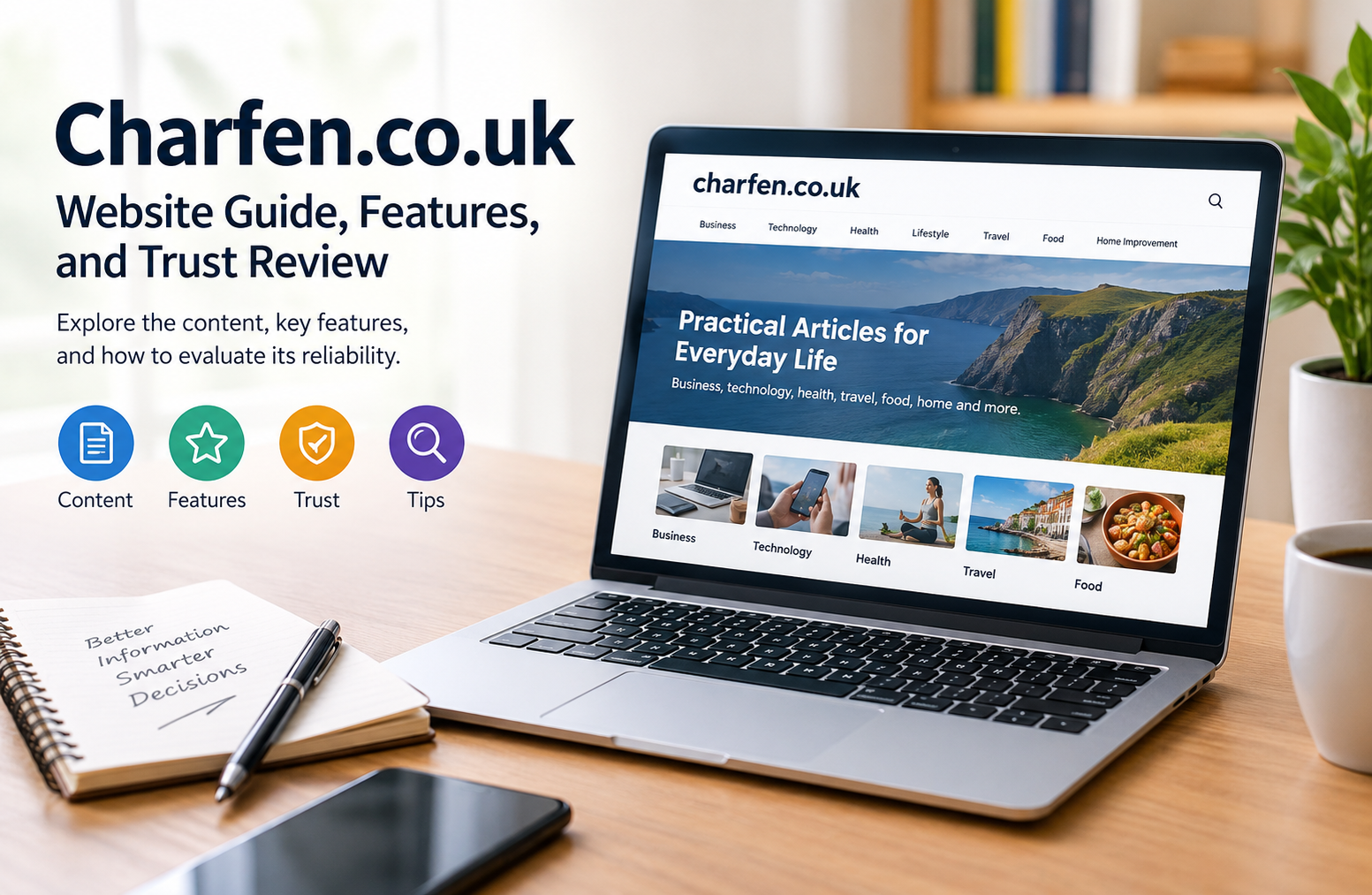
The name may initially suggest a website focused entirely on entrepreneurship or professional development. However, its current public-facing content covers a much broader range of subjects. These include business, technology, health, food, home improvement, travel, lifestyle, and general-interest articles. This makes it important to look beyond the domain name and examine the actual content available to visitors.
For readers researching Charfen.co.uk, the central questions are straightforward. What kind of website is it? What can visitors expect to find? Is its information useful and trustworthy? Does the name indicate a connection to a particular business or entrepreneur? Answering these questions requires a careful distinction between publicly visible facts and claims that cannot be independently confirmed.
This guide examines the website’s purpose, content categories, potential benefits, limitations, credibility signals, and practical uses. It also explains how readers can evaluate individual articles before relying on their advice, particularly when the subject involves health, money, technology, or business decisions.
What Is Charfen.co.uk?
Charfen.co.uk is a multi-topic online publication that provides articles and informational content across several subject areas. Rather than functioning exclusively as a specialist business website, it presents material intended for readers with different interests and information needs.
Its homepage and blog sections display content covering subjects such as entrepreneurship, technology, personal lifestyle, home improvement, travel, food, and health. The range of topics means that visitors may encounter both professional guidance and everyday informational articles during the same browsing session.
The website’s public About page emphasizes entrepreneurial knowledge, business growth, practical strategies, and professional development. At the same time, the broader collection of published material gives the site a general-interest publishing identity.
This distinction matters because a website’s stated mission and its actual content are not always identical in scope. Readers should consider both when deciding whether a publication is relevant to a particular question.
A General Publishing Platform
An online publishing platform organizes written material into articles, categories, and other navigational sections. Its primary purpose is to make information accessible to readers through a website.
A multi-topic publication can serve several audiences at once. For example:
- Entrepreneurs may look for business planning and management information.
- Professionals may explore technology developments and productivity ideas.
- Homeowners may search for maintenance guidance and improvement projects.
- Travellers may research destinations, accommodation, and practical travel decisions.
- General readers may want explanations of unfamiliar terms, products, or everyday issues.
A broad content model can be useful when the articles are accurate, well organized, and clearly written. However, covering many subjects also creates an editorial challenge: expertise in one field does not automatically establish expertise in another.
For that reason, visitors should evaluate the quality of individual articles rather than assuming that every page has the same level of authority.
What the Website’s Name Tells Readers
A domain name can help people recognize a website, but it does not independently prove who owns the site, where its editorial team operates, or whether it represents a particular company.
The .co.uk extension is associated with the United Kingdom’s internet domain namespace. Nevertheless, the extension alone does not prove that a website is a registered UK company, employs a UK-based editorial team, or has a physical office in Britain.
These details require separate evidence. Readers who need to verify ownership or business identity should look for clear company information, named representatives, relevant registration records, and consistent disclosures.
This is especially important when a domain name resembles an established brand or a well-known person’s name. Similarity can explain why visitors make a connection, but it is not sufficient evidence of a formal relationship.
What Content Can Readers Find on Charfen.co.uk?
The website covers several broad content areas. Understanding these categories helps visitors determine whether it is a suitable starting point for their research.
1. Business and Entrepreneurship
Business-related content is an important part of the site’s stated identity. Its About page describes an interest in entrepreneurship, leadership, business growth, and practical strategies for professional development.
Articles in this general area may be relevant to readers who want to understand topics such as planning, management, productivity, and business operations.
For example, a small business owner researching operational efficiency might benefit from an article that explains how to document routine tasks, monitor performance, or identify avoidable delays.
The usefulness of such material depends on the quality of its evidence. Strong business guidance explains the problem, identifies the conditions under which a strategy may work, and acknowledges its limitations. It should not present a universal solution as suitable for every company.
Readers should also distinguish general educational content from professional advice. A business article can help someone prepare questions or compare options, but decisions involving contracts, tax obligations, employment law, or major investments may require a qualified professional.
2. Technology and Digital Tools
Technology is another visible subject area. Content in this category may address software, digital products, artificial intelligence, online services, and changes in the way people work.
Technology articles are useful when they explain unfamiliar concepts in accessible language. A good guide should help readers understand what a tool does, what problem it solves, what limitations it has, and what practical considerations matter before using it.
For instance, an article about workplace automation should explain which tasks can be automated, which require human judgment, and how mistakes can be detected. Simply claiming that automation saves time does not tell a reader whether a particular tool is suitable for their needs.
Technology information can also become outdated quickly. Software interfaces change, pricing structures are revised, and security weaknesses emerge. Visitors should therefore check publication dates and compare important claims with current product documentation.
When a technology article discusses privacy or cybersecurity, readers should look for clear explanations of data collection, permissions, access controls, and potential risks.
3. Health and Everyday Well-Being
Health-related information can help readers become familiar with common terms, everyday wellness topics, and questions they may wish to discuss with a qualified professional.
However, health content requires greater care than many general-interest subjects. A clearly written article is not necessarily medically reliable, and an explanation of a treatment does not establish that the treatment is appropriate for a particular person.
Readers should pay attention to whether an article identifies credible medical evidence, distinguishes established findings from uncertain claims, and explains when professional assessment is necessary.
Advice involving medication, diagnosis, pregnancy, children, chronic conditions, or potentially serious symptoms should not be followed solely because it appears in a general online article.
A responsible approach is to use broad health information as a starting point for understanding a topic, then verify important claims through appropriate medical sources.
4. Lifestyle and Personal Interests
Lifestyle articles can cover everyday routines, personal interests, consumer choices, and practical ways to approach common tasks.
Their value often comes from making information easier to apply. A useful article does more than describe a trend. It explains who may benefit, what limitations exist, and how readers can decide whether the idea suits their circumstances.
For example, a guide about changing a daily routine should account for differences in schedules, budgets, personal preferences, and available resources. Advice that ignores these factors may sound appealing but prove difficult to use.
Readers should also distinguish personal opinion from evidence-based guidance. An article can offer a reasonable perspective without proving that its recommendations will work for everyone.
5. Home Improvement and Practical Projects
Home improvement is another subject that appears in the wider publishing mix. Articles in this area may help readers understand maintenance tasks, renovation decisions, household products, or the process of selecting a service provider.
Practical guidance is most valuable when it includes clear steps, realistic limitations, and information about safety.
A strong article about a household repair, for example, should distinguish tasks suitable for a competent homeowner from work that requires a licensed or qualified professional. Electrical installations, structural changes, and certain plumbing tasks may involve legal requirements or safety risks that general advice cannot resolve.
Readers should also consider the location of a project. Building rules, materials, labour costs, and product availability differ between regions. A guide written for one country may not apply directly to a property in another.
6. Travel, Food, and General Information
Travel and food content can serve readers looking for inspiration, explanations, planning ideas, and practical information.
For travel, useful details include location, transport options, seasonal conditions, accessibility, likely expenses, and the date on which information was checked. Opening hours and travel requirements should be verified before a trip.
For food-related content, readers may need ingredient details, preparation instructions, storage guidance, or information about dietary restrictions. Recipes should provide clear quantities and cooking steps rather than relying on vague descriptions.
General-interest articles can also explain concepts that readers encounter in daily life. Their quality depends on how clearly they define the topic, separate verified facts from opinion, and provide enough context for readers to understand the subject.
Key Features and Potential Benefits
The main potential benefit of a multi-topic publication is convenience. Readers can explore several areas of interest without moving between many separate websites.
However, convenience alone does not establish quality. The following features are useful ways to assess what a reader can gain from the site.
A Range of Subject Categories
Organized categories help visitors narrow their search. Someone looking for technology information can focus on that section instead of browsing every article.
Clear categories also make it easier to recognize the website’s editorial range. If a publication covers both specialist and everyday subjects, visitors can decide which sections are most relevant to their needs.
Category labels should be treated as navigational aids, not guarantees of specialist expertise.
Accessible Explanations
Readers often benefit from articles that explain complex topics in straightforward language. Good writing reduces the effort needed to understand an unfamiliar subject without removing important details.
An accessible explanation should define key terms, provide relevant examples, and avoid making a subject appear simpler than it really is.
For instance, a business article about cash flow should distinguish money entering and leaving a company from accounting profit. That difference is important because a profitable business can still experience cash shortages.
The same principle applies to technology, health, and other subjects: clear language should improve understanding rather than replace accuracy.
Opportunities for Further Research
A general article can help readers identify the next questions they need to answer.
Someone researching a software product may discover that pricing, compatibility, security, or support matters more than expected. A person considering a business strategy may realize that the decision depends on team size, available capital, or customer demand.
This makes introductory content useful as a research tool. Its role is to help readers develop a better understanding of the problem, not necessarily to provide the final answer to every complex question.
Flexible Reading Across Topics
The broad subject range may appeal to readers whose interests extend beyond one field. A small business owner, for example, might also need information about software, home office equipment, travel, or general consumer decisions.
The practical benefit depends on whether the articles are well organized and sufficiently accurate. A large volume of material is not automatically more useful than a smaller collection of carefully researched articles.
Support for Initial Decision-Making
Informational articles can help readers compare choices before committing time or money.
A useful comparison identifies meaningful differences, explains the relevant trade-offs, and makes its assumptions clear. It should not hide limitations or present a recommendation as universally correct.
Readers can use this approach to evaluate business tools, household services, travel options, and other everyday decisions.
How to Use Charfen.co.uk Effectively
Visitors can get more value from an online publication by approaching it with a specific question and a clear method for evaluating the answer.
Step 1: Define the Question You Need to Answer
Before browsing, identify the problem you are trying to solve.
Instead of searching broadly for business advice, decide whether you need information about pricing, customer retention, employee management, or another specific issue.
A focused question makes it easier to recognize whether an article is relevant. It also reduces the risk of spending time on content that is interesting but does not address the actual problem.
Step 2: Choose the Most Relevant Category
Use the website’s visible navigation and subject categories to locate material related to your question.
Read the title and introductory paragraphs to determine the article’s scope. A page may mention your topic without examining the specific issue you need to understand.
If the article addresses a different question, treat it as background reading rather than a complete answer.
Step 3: Check the Publication Date
The date matters because information changes at different rates.
Basic explanations of established concepts may remain useful for years. Software instructions, travel restrictions, product specifications, market information, and regulatory guidance may need frequent updates.
When an article concerns a changing subject, check whether its details still match current official information.
If the publication date is missing or the article appears outdated, avoid relying on it for decisions where accuracy is important.
Step 4: Identify the Author and Evidence
Look for the author’s name, relevant qualifications, and evidence supporting the article’s main claims.
An author biography can help establish background, but it should not replace evidence. Likewise, a confident writing style is not proof of expertise.
Stronger articles explain where important facts come from and make it possible to distinguish research findings from personal interpretations.
If the article makes a surprising claim without showing how it was established, look for independent confirmation before accepting it.
Step 5: Compare Important Claims With Primary Sources
Primary sources are especially valuable when information has practical consequences.
Examples include government guidance for legal or regulatory requirements, official documentation for software features, and recognized medical organizations for health information.
Comparing claims with the original source can reveal whether an article has simplified the issue too much, omitted an important qualification, or relied on outdated details.
This step is particularly important when an article recommends spending money, changing a business process, using a health product, or taking a safety-related action.
Step 6: Separate General Advice From Individual Needs
An article may describe a useful approach without establishing that it is right for every reader.
A small company with three employees will not necessarily need the same management systems as an international organization. A household renovation project may face different constraints from a commercial construction project.
Consider your budget, experience, location, available resources, and the consequences of getting the decision wrong.
Use general advice to identify possible options, then assess those options against your own requirements.
Step 7: Record the Most Useful Findings
When researching a complicated issue, keep a brief record of the points that matter.
This might include a definition, a practical step, a limitation, a source to verify, and a question that remains unanswered.
Such notes reduce repeated browsing and make it easier to compare information from different publications.
For business research, a simple table of options, estimated costs, benefits, and risks can be especially helpful. For everyday research, a short checklist may be enough.
Step 8: Reassess Before Acting
Before making a significant decision, review the evidence rather than relying on the overall impression created by an article.
Ask yourself:
- Does the information directly answer my question?
- Is the source appropriate for the subject?
- Are the important claims supported by evidence?
- Is the information recent enough?
- Are there risks or exceptions that the article does not address?
- Do I need specialist advice before proceeding?
This process helps turn online reading into informed decision-making.
Is Charfen.co.uk Trustworthy?
Trustworthiness should be evaluated through observable evidence rather than a simple label. A website can be active and accessible while still varying in accuracy, editorial quality, and subject expertise.
The appropriate question is not only whether the website exists, but whether a particular article is reliable enough for the purpose for which it will be used.
Review the Website’s Transparency
A credible publication should make it reasonably clear who operates it, how readers can contact the publisher, and how editorial responsibility is handled.
Useful signals include:
- A clear About page describing the publication’s purpose.
- Contact information that provides a practical way to reach the publisher.
- Named authors and meaningful author biographies.
- Editorial standards or information about how articles are reviewed.
- Privacy information explaining how visitor data is handled.
- Clear distinctions between editorial content, advertising, and sponsored material.
These signals do not guarantee accuracy, but they help readers understand who is responsible for the information.
Public-facing information about Charfen.co.uk includes an About page and contact pages. However, readers should independently assess whether the available disclosures provide enough detail for their particular needs.
Do Not Treat Every Article as Equally Authoritative
A publication that covers many subjects may have articles with different levels of research and depth.
An introductory lifestyle article has different evidence requirements from an article about a medical treatment or a legal obligation. The latter subjects require more careful sourcing and often specialist knowledge.
Readers should therefore assess the author, sources, date, reasoning, and level of uncertainty for each article.
It is not reasonable to assume that every article is unreliable simply because the site covers multiple topics. It is equally unreasonable to assume that every article is authoritative because the website presents itself professionally.
A balanced evaluation considers the evidence available on the page.
Understand the Difference Between an Active Site and a Verified Business
A functioning website is not, by itself, proof of a company’s registration, financial stability, professional credentials, or commercial track record.
This distinction matters if a reader is considering paying for a service, sharing sensitive information, entering a partnership, or accepting business advice from a publisher.
Before making a commitment, look for independently verifiable business details, clear terms, identifiable representatives, and evidence that the offered service matches the claims being made.
Avoid treating a domain extension, professional-looking design, or positive language as substitutes for verification.
Consider Security and Privacy
Basic browsing safety remains important regardless of the website’s subject matter.
Check that the address is correct, avoid entering unnecessary personal information, and review privacy terms before submitting details through a form or subscribing to a mailing list.
A secure connection helps protect data in transit, but it does not prove that the website’s content is accurate or that every business practice is trustworthy.
Never provide passwords, financial credentials, or other sensitive information simply because an article or contact form requests it. Verify the reason for any request before proceeding.
Is Charfen.co.uk Connected to Alex Charfen?
The name may lead some readers to associate the UK domain with Alex Charfen, an entrepreneur known for business coaching and entrepreneurship-related work.
However, similar names and domain extensions do not establish common ownership.
The public-facing information reviewed for this guide does not provide sufficient evidence to confirm that Charfen.co.uk is officially operated by Alex Charfen or is the UK branch of his business.
Readers should therefore keep the two identities separate unless a direct, verifiable statement establishes a formal connection.
This is a general principle for evaluating websites. A domain can resemble a recognized brand without being owned by that brand, and an article mentioning a person or business does not automatically indicate endorsement or partnership.
If your goal is to research Alex Charfen’s professional work, use independently verified information from his established professional channels. If your goal is to understand the UK domain, assess the content and disclosures of that particular website.
This distinction protects readers from accidentally attributing one organization’s credentials, products, or reputation to another.
Challenges and Limitations of a Multi-Topic Website
A broad publishing model offers flexibility, but it also creates limitations that readers should understand.
Broad Coverage Can Reduce Subject Depth
A publication covering business, health, technology, travel, and lifestyle must address very different research requirements.
Some questions can be answered with a straightforward explanation. Others require technical documentation, specialist experience, current data, or a review of competing evidence.
Readers should examine whether an article provides the depth needed for the question at hand. A brief overview may be suitable for learning basic terminology but insufficient for a complex decision.
Information Can Become Outdated
Online articles remain accessible even after their details stop being accurate.
A guide may continue appearing in search results after a product changes, a regulation is revised, or a service is discontinued.
The presence of an article on an active website does not guarantee that the content has been reviewed recently. Publication and update dates should therefore be considered alongside the subject’s rate of change.
Ownership and Editorial Responsibility May Need Further Verification
Readers may find that public pages do not answer every question about a publisher’s ownership, editorial process, or specialist qualifications.
That lack of detail does not prove wrongdoing. It does, however, limit the conclusions that can reasonably be drawn about the organization.
When identity or accountability is central to a decision, seek verifiable information instead of filling gaps with assumptions.
Search Visibility Does Not Equal Expertise
A page may appear prominently in search results because it matches a query, uses clear headings, or addresses a popular topic.
Search visibility is not a guarantee that its claims have been independently verified or that the author has relevant professional experience.
Readers should judge content by its accuracy, relevance, transparency, and usefulness rather than its position in search results alone.
Recommendations May Not Suit Every Reader
General advice often assumes a typical situation. Real circumstances can differ substantially.
Business size, location, budget, technical knowledge, health needs, and available resources may all affect whether a recommendation is appropriate.
A strong article makes these limits clear. Readers should be cautious when content presents one method as the best choice for everyone without explaining the conditions behind that recommendation.
Real-World Applications: When the Website May Be Useful
The usefulness of an online publication becomes clearer when its information is connected to a specific task.
For Small Business Owners
A business owner may use introductory articles to explore ways to organize work, understand common management terms, or compare broad operational approaches.
For example, a company experiencing missed deadlines could research task ownership, workflow documentation, and progress tracking. The owner could then compare those ideas with the company’s actual process and measure whether changes improve delivery times.
The important step is to test recommendations against evidence from the business itself. A strategy that sounds effective in an article should still be evaluated through costs, results, and practical limitations.
For Students and Independent Learners
Readers learning about a new subject can use general articles to build vocabulary and identify major concepts.
A beginner exploring artificial intelligence, for instance, may first need to understand the difference between a model, an application, and an automated workflow.
After establishing that foundation, the learner can move to technical documentation, academic publications, or other primary sources for deeper study.
This layered approach makes unfamiliar subjects easier to navigate without treating introductory content as the final authority.
For Consumers Comparing Options
A consumer may use an article to identify features worth comparing before purchasing a product or hiring a service.
Useful comparison factors can include total cost, reliability, warranty terms, compatibility, maintenance, and the availability of support.
Readers should verify prices and specifications through current sources before making a purchase. They should also distinguish paid promotion from independent evaluation where that distinction is relevant.
For People Researching Everyday Questions
General-interest articles can provide a convenient first explanation of an unfamiliar topic.
A reader may want to understand a home maintenance issue, prepare for a trip, or learn how a digital service works. A well-structured article can help identify the main considerations and the questions that need further research.
The benefit is greatest when the article explains its limits and directs readers toward reliable evidence for details that require confirmation.
For Professionals Exploring New Tools
Professionals may use technology content to identify tools or methods that could improve their work.
Before adopting a tool, they should check its compatibility, pricing, privacy policy, support arrangements, and integration requirements.
A small trial can help determine whether the tool solves a genuine problem. This is usually more informative than adopting a product solely because an article describes it positively.
How Charfen.co.uk Fits Into a Responsible Research Routine
No single publication needs to answer every question. A more reliable approach is to use different types of sources for different purposes.
Start with an accessible article to understand the subject. Identify the main claims and the questions that remain unanswered. Then consult a primary or specialist source for any details that affect a significant decision.
For a software question, that may mean checking official product documentation. For a legal question, it may mean consulting government guidance. For a health question, it may require recognized medical information or a qualified clinician.
Keep track of dates when information may change. If two sources disagree, examine their evidence, definitions, and publication dates instead of automatically accepting the more confident explanation.
This approach allows readers to benefit from broad informational websites without depending on any one publisher for every kind of expertise.
It also makes the research process more efficient. Instead of collecting a large number of loosely related articles, readers can focus on sources that answer a specific question and support the answer with appropriate evidence.
Frequently Asked Questions
1. What is Charfen.co.uk?
Charfen.co.uk is a multi-topic online publishing website. Its public content covers subjects such as business, technology, lifestyle, health, travel, food, and home improvement.
2. Is Charfen.co.uk only about business?
No. Although its About page emphasizes entrepreneurship and business growth, the wider website also publishes general-interest articles across several other categories.
3. Is Charfen.co.uk officially connected to Alex Charfen?
A formal connection has not been established by the public-facing information reviewed for this article. Similar names alone do not prove common ownership or official affiliation.
4. Can readers trust information published on the website?
Reliability should be assessed article by article. Check the author, publication date, supporting evidence, transparency, and whether important claims agree with suitable independent sources.
5. Is Charfen.co.uk a UK-registered company?
The .co.uk domain extension alone does not establish company registration in the United Kingdom. Readers who need to verify legal status should consult appropriate official records and look for independently verifiable business details.
6. How should readers use Charfen.co.uk for research?
Use relevant articles to understand a topic and identify useful questions. Verify important facts through primary or specialist sources, particularly before making health, financial, legal, security, or business decisions.
Conclusion
Charfen.co.uk is best understood as a broad online publishing website rather than a source devoted exclusively to one specialist subject. Its range of topics may help readers explore business, technology, lifestyle, travel, health, and other areas of everyday interest.
Its potential value depends on the relevance and quality of the individual article being read. Clear explanations can help people understand unfamiliar subjects, compare options, and identify areas that need further research. However, readers should not confuse accessible writing, a functioning website, or search visibility with proof of expertise.
A careful assessment considers the author’s background, the publication date, the evidence behind important claims, and the transparency of the publisher. It also recognizes that a website’s domain name does not establish a formal connection with another person or business.
Used thoughtfully, the site can serve as one starting point for general research. For decisions with significant consequences, readers should verify key information through appropriate primary sources or qualified professionals. This balanced approach makes it easier to benefit from online information while avoiding unsupported assumptions.