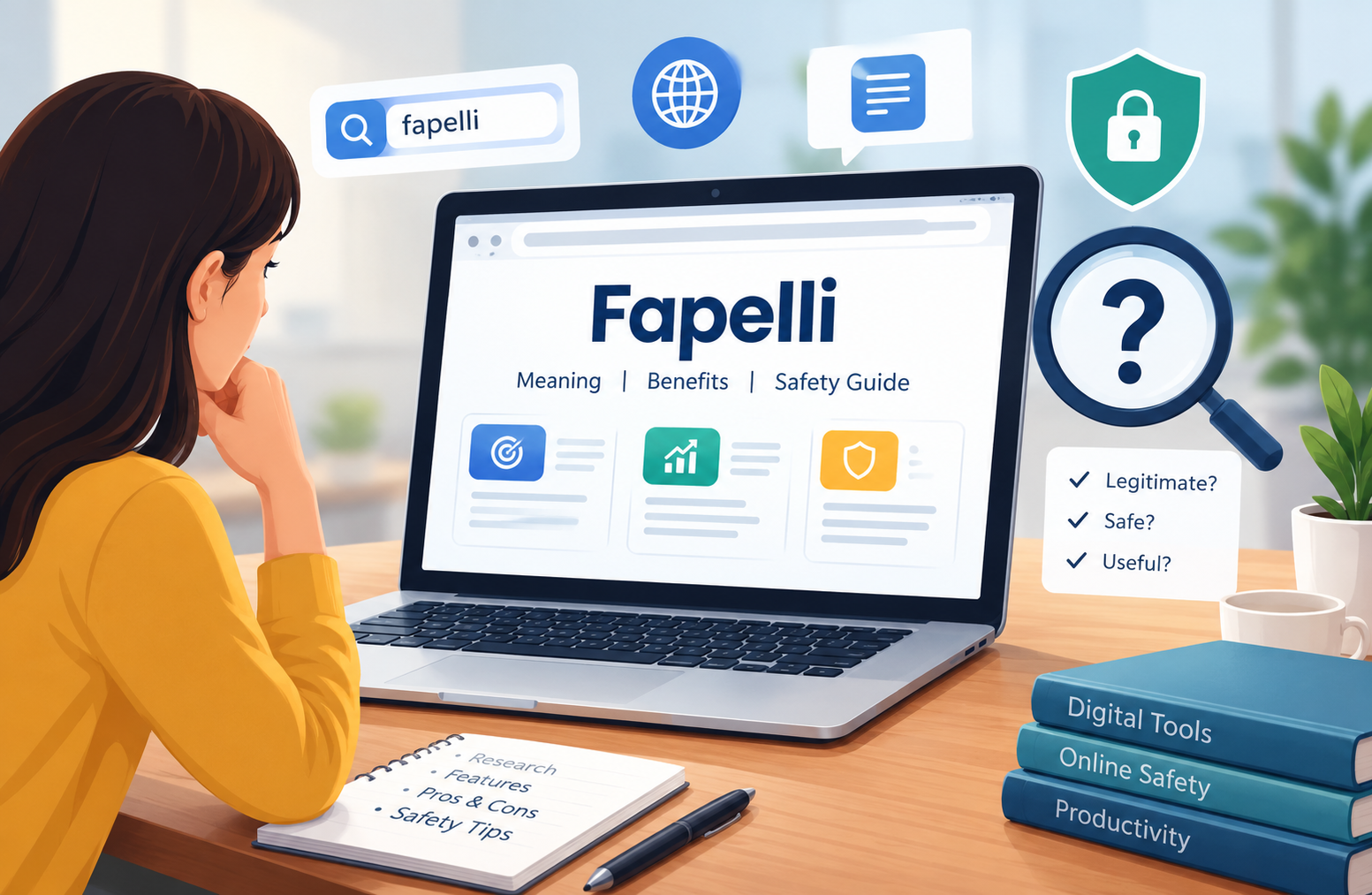
Fapelli: Meaning, Online Presence, Benefits, and Safety Guide
Fapelli is a name that has attracted attention online, but understanding what it represents requires looking beyond the word itself. People searching for Fapelli may want to know whether it is a digital platform, a business, a website, a brand, or a term associated with a particular online service. The challenge is that different websites use the same name to describe different ideas, making it important to separate verifiable information from assumptions.
In today’s digital environment, unfamiliar names can spread quickly through search engines, websites, social media, and online discussions. A name may become recognizable before the organization behind it has established a clear identity. This creates questions about its purpose, potential benefits, reliability, and practical uses. Readers need more than a simple definition. They need a method for understanding what a website actually offers and deciding whether it deserves their attention.
Fapelli is particularly interesting because its online descriptions are not completely consistent. Some websites associate the name with digital services and productivity tools, while others discuss it as a broader technology concept or a modern brand identity. These descriptions should not automatically be treated as proof that every service or feature mentioned is available through one verified organization.
This guide examines the meaning of the term, its online presence, its possible applications, the advantages it may offer when used in a clearly defined digital context, and the questions worth asking before engaging with a website using the name. It also explains how to evaluate online claims, protect personal information, and make informed decisions when information is limited.
The central principle is straightforward: understanding a digital name begins with identifying the exact website or service behind it. Once that distinction is clear, it becomes easier to judge its usefulness, credibility, and relevance to your needs.
What Is Fapelli?
Fapelli is an online name associated with several different descriptions rather than one universally established definition. Some web pages present it as a digital services platform intended to help individuals and businesses. Others use the name in discussions about productivity, technology, lifestyle, or branding.
One website using the Fapelli name, fapelli.net, describes its purpose in terms of digital services, practical tools, resources, and guidance for individuals and businesses. This provides an indication of how that particular website presents itself. However, a website’s own description does not independently establish the size of its business, the quality of its services, or the availability of every feature it mentions.
That distinction matters because the same name can appear on unrelated websites. Two sites may share a name without having the same owner, operating team, products, or policies. A blog post discussing a digital platform may also describe proposed features that are not confirmed by the platform itself.
For that reason, it is more accurate to understand Fapelli as a name with multiple online interpretations than to assume it refers to one fully documented product.
Is Fapelli a Brand or a Digital Platform?
It may be presented as either, depending on the specific website being discussed.
A brand is an identity used to distinguish a business, product, service, or organization. A digital platform, by comparison, is a website or software environment that provides functions to its users. A single organization can operate a brand and a digital platform at the same time, but the two concepts are not interchangeable.
When a website describes Fapelli as a digital platform, useful questions include:
- What specific service does the website provide?
- Who is the intended audience?
- Are the tools accessible and demonstrably functional?
- Is there clear documentation explaining how the service works?
- Does the website identify its operator and provide reliable contact information?
- Are its claims supported by examples, product documentation, or independent evidence?
These questions help distinguish a functioning service from a broad description of a potential business idea.
A professional-looking website can communicate a polished brand identity, but visual presentation alone does not establish legitimacy or usefulness. Reliable evaluation depends on the information available about the actual service.
Does the Name Have an Established Meaning?
There is no sufficiently established definition in the available evidence to assign Fapelli one universal meaning. It may function as a distinctive name chosen for branding or online identification.
It is also important not to invent a linguistic origin, historical background, or cultural meaning without credible supporting evidence. A name can sound memorable or sophisticated without having a documented etymology.
When researching an unfamiliar term, the safest approach is to examine how it is used in context. An official company page, a software listing, a product description, and an independent review can each provide different kinds of information. Their claims should be compared rather than combined into one assumed definition.
Why Is Fapelli Appearing in Online Searches?
Searches for unfamiliar names often reflect a practical need. People may have encountered a term in a search result, received a link from someone else, seen it mentioned in an article, or come across it while researching a service.
Fapelli can prompt similar questions because its online identity is not immediately clear from the name alone.
Curiosity About an Unfamiliar Name
A distinctive name naturally encourages people to investigate it. Users may want a quick explanation before deciding whether to visit a website or learn more about the organization behind it.
However, search visibility should not be confused with proven popularity. A name appearing in several articles does not automatically mean that it has a large customer base, widespread adoption, or a strong reputation.
To understand its significance, readers should look for meaningful evidence, such as independently documented use, credible company information, genuine customer experiences, and clear explanations of the service.
Interest in Digital Services
Some descriptions connect Fapelli with digital tools and services. This may attract individuals who are looking for ways to organize work, simplify repetitive tasks, or find useful online resources.
These are common needs across the digital marketplace. Nevertheless, the general usefulness of productivity software does not establish that a particular website provides those benefits.
Before relying on any service, identify the exact functions it offers and determine whether they solve a real problem. A clear product demonstration or accessible documentation is more useful than a broad promise of innovation.
Questions About Website Reliability
Another possible reason for searching a website name is the need to check its credibility. Users may want to know who operates it, whether it protects their information, and whether it is appropriate for business or personal use.
This is a sensible step. A website should be evaluated according to its actual behavior, transparency, and purpose, not simply its name or appearance.
The same principle applies to Fapelli. If you have a particular domain in mind, investigate that domain directly rather than assuming that information about another website with a similar name applies to it.
How to Evaluate Fapelli Before Using It
The most useful way to investigate an unfamiliar online service is to follow a consistent evaluation process. This reduces the risk of relying on unsupported claims and helps you determine whether the service meets your needs.
Step 1: Identify the Exact Website
Start by checking the complete domain name in the browser’s address bar. Small differences in spelling can lead to entirely different websites.
For example, a site ending in .net may be operated independently of a similarly named site ending in .org or .co.uk. A shared name does not prove that the sites are connected.
Check the spelling carefully, particularly if you reached the page through an advertisement, a shortened link, or an unexpected redirect.
If several websites use the name, keep your research about each domain separate until you find reliable evidence connecting them.
Step 2: Read the About Page
An About page should explain what the organization does, whom it serves, and what users can expect.
Look for specific information rather than broad claims. A useful description might explain the service’s main functions, its intended users, and the problems it aims to solve.
Be more cautious when a website relies heavily on general phrases such as advanced technology, complete solutions, or improved productivity without explaining how those outcomes are achieved.
Broad language is not proof of misconduct, but it makes independent verification more important.
Step 3: Review Contact Information
Reliable organizations generally provide a practical way for users to contact them. Depending on the business, this may include a support email address, contact form, business address, or clearly identified customer service channel.
Check whether the contact information is consistent across the website and whether the organization explains how questions, complaints, or account issues are handled.
A contact address alone does not prove that a business is legitimate. However, missing or contradictory information can make it harder to establish accountability.
Step 4: Examine the Privacy Policy
A privacy policy should explain what information the website collects, why it collects that information, how the information is used, and whether it is shared with other organizations.
If the service requires an account, consider whether the requested information is reasonable for its stated purpose.
For example, a basic information website normally has less reason to request extensive personal details than a service that must verify a user’s identity to perform a specific function.
Do not submit sensitive information simply because a registration form requests it. First, establish why the information is necessary and whether the service provides adequate explanations.
Step 5: Look for Independent Evidence
A website’s own claims are useful for understanding its stated purpose, but they are not the same as independent verification.
Search for reviews from identifiable users, credible reporting, software documentation, or other sources that have a clear basis for their conclusions.
Evaluate reviews carefully. A detailed account that explains a specific experience is generally more informative than a short statement declaring a service excellent or terrible without supporting details.
Also consider the date of a review. A report about an old version of a website may not describe its current operation.
Step 6: Test Basic Functionality
If the website appears relevant and does not raise immediate security concerns, assess its publicly available functions before committing to it.
Determine whether navigation works, descriptions match the available features, and important pages are accessible. If a demonstration is offered, check whether it provides enough information to understand the service.
Avoid downloading unknown files or granting unnecessary browser permissions during this process.
The purpose of testing is to establish whether the service works as described, not to assume that every advertised capability has been proven.
Potential Benefits of a Clearly Defined Digital Service
The benefits associated with a digital platform depend on what it actually does. Because online descriptions of Fapelli vary, it would be inaccurate to promise that every benefit below is a confirmed feature of a specific Fapelli website.
Instead, these are the potential advantages users should look for when evaluating a service presented as a digital productivity or business platform.
Greater Convenience
A useful digital service can make a task easier to complete by bringing relevant information or functions into one accessible place.
For example, a business tool might help users manage documents, review tasks, or find information without repeatedly switching between unrelated applications.
The value comes from reducing unnecessary effort. If a platform introduces more steps than it removes, its convenience may be limited.
When assessing a service associated with Fapelli, identify the task you want to improve and determine whether the available functions genuinely make that task easier.
Improved Organization
Digital tools can help organize information that would otherwise be scattered across documents, messages, and spreadsheets.
A well-designed system may make it easier to locate records, track progress, and understand which tasks require attention.
However, organization depends on more than the availability of software. Users still need consistent processes, accurate information, and a clear understanding of how the system should be maintained.
If a platform claims to improve organization, look for practical examples of its workflow rather than relying only on marketing language.
Support for Routine Work
Some digital services automate repetitive actions. Depending on their actual design, these may include generating reports, sending reminders, sorting information, or transferring data between approved systems.
Automation can reduce manual work, but it also introduces risks when rules are poorly configured or outputs are not checked.
A useful service should explain what it automates, what permissions it needs, and when human review remains necessary.
It is particularly important to verify automated actions before allowing them to affect customer communications, payments, business records, or other important processes.
Better Access to Information
A centralized information service may help users find relevant material more quickly.
This can be useful when the service offers accurate documentation, well-organized resources, and clear explanations. Poorly maintained information, by contrast, can create confusion and lead to mistakes.
Readers should therefore assess not only how much information a website provides, but also how clearly it identifies sources, dates, limitations, and the intended use of its content.
Potential Business Efficiency
Businesses often evaluate digital tools according to the time, effort, and money required to complete important tasks.
A suitable service may improve efficiency if it reduces duplicated work, makes information easier to access, or supports a reliable process.
These benefits should be measured rather than assumed. Compare the existing workflow with the proposed alternative, including setup time, subscription costs, training, maintenance, and possible errors.
For Fapelli or any comparable service, a clear explanation of its functions and a practical trial would provide more useful evidence than general claims about business transformation.
Possible Applications and Real-World Use Cases
Understanding how a digital service might be used is easier when its possible applications are connected to specific problems. The following examples describe common needs that a clearly documented digital platform could address. They should not be interpreted as confirmation that every function is available on a particular Fapelli website.
Individual Productivity
An individual may want a better way to organize tasks, keep track of deadlines, or manage personal projects.
A suitable tool can provide a central place for information and help users maintain consistent routines. Its value depends on whether the interface is understandable and the available features match the user’s needs.
Before adopting a new platform, compare it with tools you already use. A new service is worthwhile only if it offers a meaningful advantage, such as a better workflow, greater accessibility, or a feature that your current tools lack.
Small Business Operations
Small businesses often work with limited staff and resources. Owners may need to manage documents, customer inquiries, project deadlines, and routine administration.
A digital platform can be useful when it supports a clearly defined part of this process. For example, a documented task-management system may help a team see responsibilities and deadlines in one place.
The decision should account for the business’s size and complexity. A small operation may not need an expensive system with extensive features, especially if those features create additional training or maintenance work.
Team Collaboration
Teams need reliable ways to share information, coordinate responsibilities, and keep track of changes.
A suitable collaboration service may make these tasks easier by providing shared records, permission controls, and clear communication channels.
Before selecting such a tool, check whether team members can control access appropriately, export their information, and recover important records if something goes wrong.
It is also important to understand whether the service supports the devices and software the team already uses.
Research and Information Management
Researchers, students, writers, and professionals often need to organize information from multiple sources.
A digital resource platform may help if it offers searchable material, clear categorization, or reliable documentation. Users should still verify important claims against original sources.
The presence of a statement in an online article does not make it authoritative. For factual research, the source’s expertise, evidence, and publication context remain important.
Customer Service and Administration
Some businesses use digital systems to organize customer requests and routine administrative work.
A suitable system might help track unresolved questions, assign responsibilities, or maintain a record of previous interactions.
However, customer information requires careful handling. Before adopting a service for this purpose, establish what data it stores, who can access it, how long records are retained, and how information can be exported or deleted.
These safeguards matter regardless of the platform’s name.
Challenges and Limitations to Consider
A balanced evaluation must consider limitations as well as possible advantages. New or poorly documented services can create uncertainty even when their stated goals appear useful.
Unclear Identity
The main challenge with researching Fapelli is that the name does not consistently identify one clearly documented entity across the available online material.
This makes it difficult to transfer information from one website to another. A description of a platform on one domain may not apply to a similarly named website elsewhere.
The practical solution is to identify the exact domain and assess its information independently.
Limited Independent Documentation
A service may describe its goals without providing enough evidence to verify its operations, customer base, technical capabilities, or long-term reliability.
This does not automatically mean the service is unreliable. New organizations can have limited public histories, and small businesses may not receive extensive independent coverage.
Nevertheless, limited evidence should lead to measured expectations. Avoid treating unverified statements as established facts.
Uncertain Costs
A website may not make its full pricing structure immediately clear. Some services use free access, paid plans, usage-based charges, or additional fees for particular functions.
Before entering payment details, identify the total cost and the conditions attached to it.
Check whether a trial automatically becomes a paid subscription, whether cancellation is straightforward, and whether refunds are available under clearly stated terms.
If pricing information is missing or contradictory, request clarification before making a financial commitment.
Privacy and Security Questions
A digital service may handle personal details, business records, uploaded documents, or account credentials.
Users should understand the service’s security practices before allowing it to store sensitive information. Important questions include whether secure connections are used, how accounts are protected, and what happens if a user wants to close an account.
A padlock icon in a browser indicates an encrypted connection to the website, but it does not independently prove that the organization is trustworthy.
Security decisions should consider the complete picture rather than relying on one technical indicator.
Dependence on a Third-Party Service
Using an online platform can create dependence on its availability, policies, and continued operation.
If a business stores important information in a service, it should understand how to export its records and whether it can continue operating if access is interrupted.
A sensible approach is to keep appropriate backups and avoid placing critical processes in a system without a recovery plan.
Overestimating Automation
Automation can save time, but it is not a substitute for sound judgment.
If a digital platform claims to use artificial intelligence or automated decision-making, users should understand the limits of its outputs. Results may require verification, especially when they affect money, customer relationships, compliance, or important business decisions.
A reliable workflow includes checks for accuracy, clear responsibility for decisions, and a way to correct mistakes.
Is Fapelli Safe to Use?
There is no responsible way to give a universal safety verdict based on the name alone. Safety depends on the exact website, the activities it supports, and the information it requests.
A public information page presents different risks from a service that requires payment details, access to business files, or permission to connect other accounts.
The most useful approach is to assess the risk of the specific activity you plan to perform.
Check for Clear Ownership
Look for a consistent organization name, working contact details, transparent terms, and a privacy policy that explains the service’s practices.
Where appropriate, verify business details through relevant public registries or independent sources.
If a website makes major claims but provides no practical way to identify its operator, avoid making assumptions about its accountability.
Protect Your Login Information
Never reuse an important password on an unfamiliar website. If you decide to register, use a unique password and enable multifactor authentication when available.
Do not share account credentials with a website simply because it claims to improve convenience or connect multiple services.
If a platform requests access to another account, review the permissions carefully. Grant only the access necessary for the task.
Avoid Unnecessary Downloads
Do not install unknown software, browser extensions, or files just to explore an unfamiliar website.
If a service requires an installation, verify the source and review the permissions it requests. Be particularly cautious when a download is unexpected or when the website pressures you to install something immediately.
Review Payment Terms
Before paying, verify the seller’s identity, the exact service being purchased, the total price, and the cancellation process.
Be cautious of pressure tactics, unexplained fees, or payment requests that do not match the stated purpose of the service.
For additional guidance on recognizing and avoiding online fraud, consult the Federal Trade Commission’s consumer advice.
Respond Carefully to Unexpected Redirects
If the name appears without you intentionally searching for it, consider what happened immediately beforehand.
An unexpected page may result from a redirect, an advertisement, a notification permission, or another browser-related issue. The name itself is not enough to establish the cause.
Close suspicious tabs, avoid interacting with unfamiliar prompts, and review browser notification permissions if unwanted pages continue appearing. If the problem persists, check installed extensions and use reputable security software.
These steps help address the underlying behavior without assuming that a particular name is responsible.
How Fapelli Compares With Established Digital Tools
Comparisons are useful only when the products being compared are clearly identified. Because Fapelli has multiple online descriptions and limited independently established product information, it would be misleading to assign it a definitive ranking against established software without verified feature and pricing data.
Instead, compare the actual service with the tools you currently use.
Features and Practical Value
Begin with a list of tasks the tool must perform. Separate essential functions from optional extras.
For instance, if your main need is task tracking, prioritize clear assignments, deadlines, search, and dependable notifications. A service with many additional features is not necessarily better if its basic workflow is difficult to use.
Ease of Use
Consider how much time it takes to learn the system and whether the interface supports your normal working habits.
A tool that saves a few minutes each day but requires extensive training may not be worthwhile for a small team. Conversely, a well-designed system can provide value when it reduces repeated manual work.
Whenever possible, test the service with a realistic task before making a long-term commitment.
Costs and Flexibility
Compare total costs rather than looking only at the advertised starting price.
Include subscriptions, setup fees, training, data migration, storage limits, and any charges for additional users or functions.
Also consider how easily you can leave the service. Data export, account closure, and the ability to transfer work to another system can be important factors.
Transparency and Support
Established tools often provide extensive documentation, clear service terms, and identifiable support channels, although the quality varies by provider.
When evaluating Fapelli, look for the same practical evidence. Can users find clear instructions? Are limitations explained? Is there a reliable way to resolve account problems?
The best choice is the one that meets your needs with acceptable costs and manageable risks, not necessarily the one with the most impressive description.
A Practical Decision Framework for Beginners
If you are encountering the name for the first time, it helps to use a simple decision process rather than making an immediate judgment.
Define Your Purpose
Write down why you are interested in the service. You may be researching its meaning, considering a digital tool, checking a website’s credibility, or trying to understand an unexpected browser redirect.
These situations require different responses. A person researching a name may only need reliable information, while someone considering a paid service needs a more detailed assessment.
Identify the Evidence You Need
Decide what information would be sufficient for your purpose.
For a general overview, a clear explanation of the website’s stated purpose may be enough. For a business decision, you may also need verified ownership, pricing, technical documentation, privacy information, and evidence that the service works as described.
Check the Claims Individually
Avoid accepting a complete marketing message as one indivisible claim.
A website may accurately describe its general purpose while making other statements that are difficult to verify. Evaluate each important claim separately.
For example, a claim that a tool supports task management should be checked against its available functions. A claim that it saves time requires evidence about the workflow or measurable results.
Test Before Committing
If the website passes your initial checks, begin with a low-risk activity. Avoid uploading confidential documents, connecting important accounts, or purchasing a long-term plan before you understand the service.
Record any limitations you encounter. This makes it easier to compare the tool with alternatives and determine whether it provides real value.
Reassess Over Time
A website’s ownership, services, pricing, and security practices can change.
Check important information again before renewing a subscription or expanding the service’s role in your work. A decision that made sense during a limited trial may need to be reconsidered if the terms or available features change.
Frequently Asked Questions About Fapelli
1. What is Fapelli?
Fapelli is an online name used in different contexts, including descriptions of digital services and platforms. Its meaning depends on the specific website or reference, so the name alone does not establish one universal definition.
2. Is Fapelli a legitimate company?
The name alone is insufficient to establish the legitimacy of a particular business. Check the exact domain, operator details, contact information, policies, and independent evidence before relying on a service.
3. Is Fapelli a digital platform?
Some websites using the name present it as a digital platform or service provider. However, the features and purpose described by one website should not automatically be attributed to every website using the same name.
4. Is Fapelli safe to use?
Safety depends on the specific website and the activity involved. Review its privacy policy, ownership information, security practices, and payment terms before sharing personal information or making a purchase.
5. What are the benefits of Fapelli?
Potential benefits depend on the actual service. If a particular platform provides useful digital tools, it may help with organization, convenience, or routine tasks. These benefits should be verified rather than assumed from promotional descriptions.
6. How can I find reliable information about Fapelli?
Start with the exact website, read its official documentation, and compare important claims with independent sources. Check dates, ownership details, pricing, privacy policies, and evidence of actual functionality before making a decision.
Conclusion
Fapelli is an example of why unfamiliar digital names deserve careful investigation. Although some websites present it as a provider of digital tools or services, its online identity is not consistently defined across all available sources. That makes it important to distinguish the claims of a particular website from independently verified facts.
For readers, the most valuable approach is to identify the exact domain, understand what it offers, and examine the evidence behind its claims. Clear ownership details, transparent policies, practical documentation, reasonable pricing, and reliable security practices all contribute to a more informed assessment.
Potential benefits such as convenience, better organization, and improved productivity depend on the actual functions available. They should not be treated as guaranteed results simply because a website uses the language of innovation or efficiency.
The same careful approach applies to safety. Avoid sharing sensitive information, granting unnecessary permissions, downloading unfamiliar files, or making payments before understanding the service. When important information is missing, uncertainty should be acknowledged rather than replaced with assumptions.
Ultimately, understanding Fapelli requires more than knowing the name. It requires examining the specific website, checking its claims, and deciding whether its actual services meet a clearly defined need. This evidence-based approach offers a practical way to navigate unfamiliar online platforms while protecting personal information and making better digital decisions.