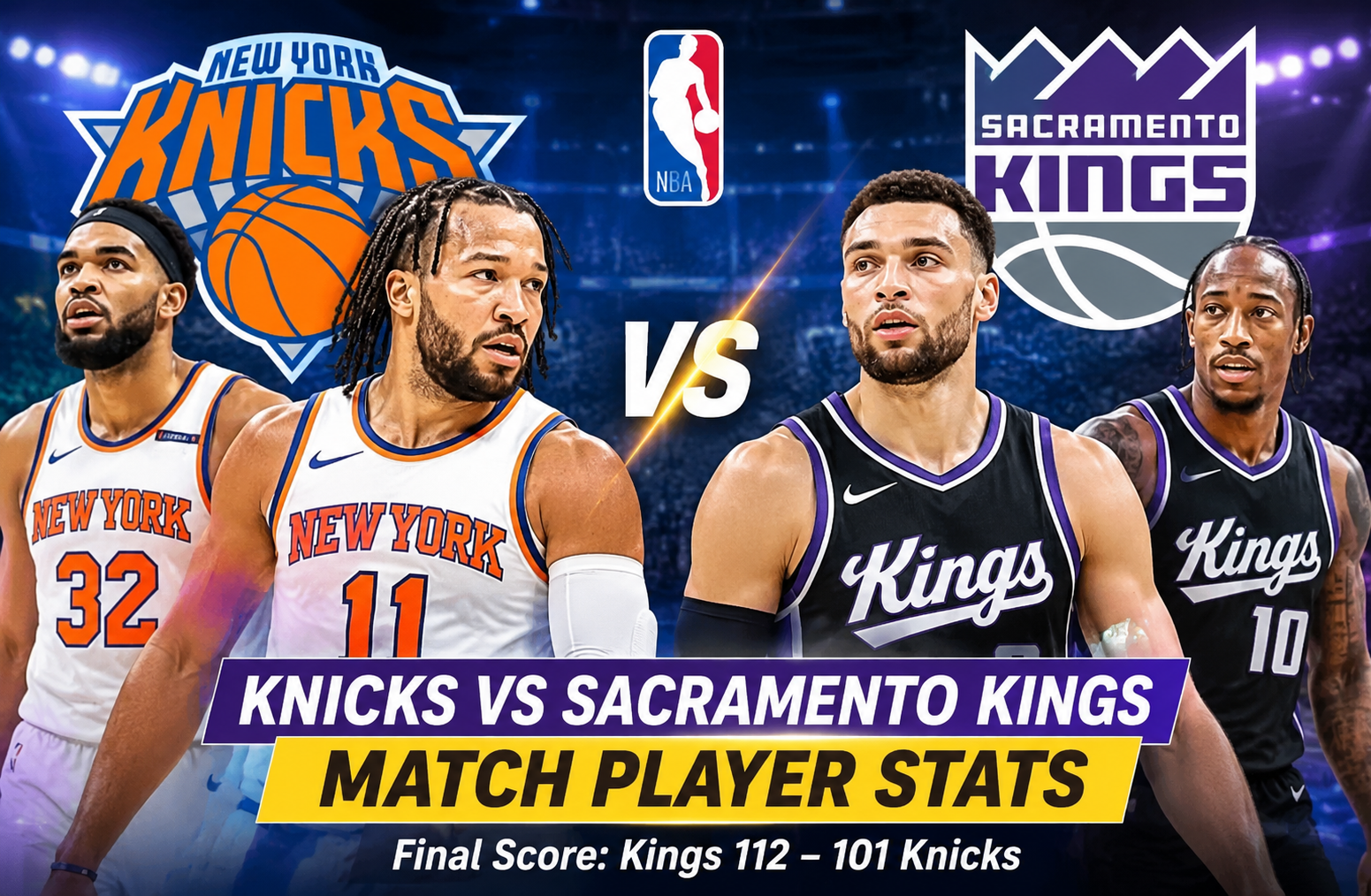
Knicks vs Sacramento Kings Match Player Stats
The knicks vs sacramento kings match player stats from January 14, 2026, reveal how Sacramento used efficient shooting, strong interior play, and balanced scoring to defeat the New York Knicks 112-101 at Golden 1 Center. The Kings established control in the opening quarter, received outstanding performances from DeMar DeRozan, Zach LaVine, Russell Westbrook, and Precious Achiuwa, and maintained enough offensive pressure to withstand New York’s third-quarter response. Although the Knicks improved their scoring after a difficult start, their shooting struggles and early injury setback made a comeback difficult.
This matchup offered an interesting contrast between Sacramento’s offensive efficiency and New York’s difficulty converting scoring opportunities. The Kings finished with a 47.3% field-goal percentage, while the Knicks managed just 39%. Sacramento also made 10 three-pointers compared with New York’s eight, despite attempting significantly fewer shots from beyond the arc.
DeRozan led all players with 27 points, while LaVine contributed 25. Achiuwa delivered an impressive double-double with 20 points and 14 rebounds, and Westbrook finished with 19 points and 11 assists. For New York, Mikal Bridges led the team with 19 points, followed by OG Anunoby with 15 and Karl-Anthony Towns with 13.
The final score tells the basic story, but the individual performances, shooting percentages, rebounding numbers, and quarter-by-quarter scoring explain why Sacramento deserved the victory. Looking beyond the headline numbers also reveals where New York struggled and how the Kings created an advantage that lasted throughout most of the contest.
Game Overview: Sacramento Kings vs New York Knicks
The Sacramento Kings hosted the New York Knicks at Golden 1 Center on January 14, 2026. Sacramento entered the matchup looking to continue its positive momentum, while New York aimed to secure an important road victory.
The Kings ultimately won by 11 points, finishing with 112 points against the Knicks’ 101. Their strongest advantage came early, when they established a 15-point lead in the first quarter.
Sacramento’s offense operated with greater efficiency. The team converted 35 of 74 field-goal attempts, including 10 of 27 three-point attempts. New York attempted 100 shots but made only 39. That difference in shot selection and conversion played a major role in determining the outcome.
Match Details
| Game Information | Details |
| Matchup | New York Knicks vs Sacramento Kings |
| Date | January 14, 2026 |
| Venue | Golden 1 Center |
| Location | Sacramento, California |
| Final Score | Kings 112, Knicks 101 |
| Winning Team | Sacramento Kings |
| Winning Margin | 11 points |
| Attendance | 15,095 |
| Knicks’ Points | 101 |
| Kings’ Points | 112 |
The attendance of 15,095 reflected the support behind Sacramento on its home floor. The Golden 1 Center crowd witnessed a game in which the home team controlled the early stages and responded effectively whenever New York threatened to reduce the deficit.
Quarter-by-Quarter Score
| Team | Q1 | Q2 | Q3 | Q4 | Total |
| New York Knicks | 17 | 25 | 34 | 25 | 101 |
| Sacramento Kings | 32 | 24 | 40 | 16 | 112 |
The first quarter was particularly important. Sacramento scored 32 points, while New York managed only 17. That opening difference created a difficult situation for the visitors.
The Knicks responded in the second quarter, scoring 25 points and limiting Sacramento to 24. However, the Kings produced another strong offensive performance in the third, adding 40 points to extend their advantage.
New York scored 25 points in the final period, while Sacramento managed 16. Although the Knicks finished the game with a better final-quarter scoring total, the earlier deficit proved too large to overcome.
Knicks vs Sacramento Kings Match Player Stats: Complete Analysis
Individual statistics explain how the Kings built their advantage and why New York struggled to keep pace. Sacramento received significant contributions from several starters rather than relying on one player to carry the entire offense.
DeRozan was the leading scorer, LaVine supplied efficient perimeter shooting, Achiuwa controlled important possessions around the basket, and Westbrook created opportunities for teammates.
The Knicks also had several productive individual performances, but their combined shooting efficiency was not enough to match Sacramento.
Sacramento Kings Player Statistics
| Player | Points | Rebounds | Assists | FG |
| DeMar DeRozan | 27 | 6 | 5 | 7/16 |
| Zach LaVine | 25 | 5 | 1 | 8/14 |
| Precious Achiuwa | 20 | 14 | 2 | 7/14 |
| Russell Westbrook | 19 | 6 | 11 | 6/13 |
| Maxime Raynaud | 10 | 4 | 0 | 4/6 |
| Malik Monk | 9 | 3 | 3 | 2/7 |
| Dylan Cardwell | 2 | 6 | 1 | 1/2 |
| Nique Clifford | 0 | 4 | 0 | 0/1 |
Sacramento’s starting group provided the foundation for the victory. Four players reached at least 19 points, creating multiple scoring options for the team.
New York Knicks Player Statistics
| Player | Points | Rebounds | Assists | FG |
| Mikal Bridges | 19 | 3 | 1 | 6/20 |
| OG Anunoby | 15 | 3 | 4 | 5/13 |
| Karl-Anthony Towns | 13 | 4 | 1 | 5/14 |
| Josh Hart | 10 | 5 | 5 | 4/7 |
| Jordan Clarkson | 11 | 3 | 1 | 5/11 |
| Miles McBride | 10 | 6 | 6 | 4/14 |
| Mitchell Robinson | 8 | 11 | 0 | 3/3 |
| Tyler Kolek | 7 | 5 | 5 | 3/9 |
| Jalen Brunson | 4 | 0 | 0 | 2/3 |
| Guerschon Yabusele | 2 | 3 | 0 | 1/5 |
| Ariel Hukporti | 2 | 0 | 0 | 1/1 |
The Knicks received useful contributions from their supporting players, especially Robinson, who collected 11 rebounds, and McBride, who recorded six assists. However, the team struggled to generate consistent scoring efficiency across its main rotation.
DeMar DeRozan Leads Sacramento With 27 Points
DeMar DeRozan delivered the leading scoring performance of the night. He finished with 27 points, six rebounds, and five assists, giving Sacramento a dependable offensive option throughout the contest.
His shooting numbers were particularly important. DeRozan made seven of his 16 field-goal attempts and converted 12 of 13 free throws. Although he did not rely heavily on three-point shooting, his ability to attack the basket and earn trips to the free-throw line helped maintain Sacramento’s scoring pressure.
DeRozan also demonstrated why an experienced scoring forward can be valuable in a game that requires more than perimeter shooting. He created opportunities through controlled movement, midrange attempts, and trips into the paint.
His performance was not limited to scoring. Five assists showed that he also contributed to the team’s offensive organization, while six rebounds helped Sacramento finish defensive possessions.
Why His Free-Throw Shooting Mattered
DeRozan’s 12 successful free throws represented an important part of his 27-point performance.
Free throws can become especially valuable when a team faces defensive pressure or struggles to create clean perimeter opportunities. By consistently reaching the line and converting his attempts, DeRozan gave Sacramento points without requiring another field-goal attempt.
He also helped prevent the Knicks from building momentum through defensive stops. Every successful trip to the line added to New York’s challenge of reducing the deficit.
Zach LaVine Adds 25 Points With Efficient Shooting
Zach LaVine provided another major scoring contribution for Sacramento, finishing with 25 points, five rebounds, and one assist.
His shooting efficiency made his performance particularly impressive. LaVine converted eight of 14 field-goal attempts and made five of his nine three-point attempts.
That placed his field-goal percentage at approximately 57.1%, while his three-point percentage reached 55.6%.
LaVine’s outside shooting gave the Kings an important scoring dimension. When opponents focus their defensive attention on a player who can attack the basket, an accurate perimeter shooter can punish defensive adjustments.
His five successful three-pointers also helped Sacramento create separation without needing to dominate every possession inside the paint.
LaVine’s Offensive Value
There are several reasons his performance stood out:
- He scored 25 points on only 14 field-goal attempts.
- He made five three-pointers.
- He converted all four free-throw attempts.
- He collected five rebounds.
- He finished with a team-best plus-minus of +16 among Sacramento’s leading scorers.
LaVine’s numbers illustrate the importance of shooting efficiency. A player does not necessarily need 20 or more attempts to produce a major scoring performance.
His ability to convert open opportunities allowed Sacramento to maintain offensive balance alongside DeRozan’s inside and midrange scoring.
Precious Achiuwa Controls the Interior
Precious Achiuwa produced one of the most complete performances of the game. He recorded 20 points and 14 rebounds, earning a double-double while providing Sacramento with an important presence near the basket.
His shooting performance was also efficient. Achiuwa made seven of 14 field-goal attempts and converted two of four three-point attempts.
The 14 rebounds were especially valuable because they helped Sacramento control possessions at both ends of the floor. Six of those rebounds came on the offensive glass, giving the Kings additional opportunities to score.
Achiuwa also recorded two assists, two steals, and two blocks. Those contributions demonstrate that his impact extended beyond the scoring column.
The Importance of His Rebounding
Rebounding can influence a game without always receiving the same attention as points or assists.
Achiuwa’s performance helped Sacramento:
- Secure defensive rebounds and limit second chances.
- Create additional possessions through offensive rebounds.
- Maintain a physical presence near the basket.
- Protect the interior against New York’s frontcourt players.
- Support the team’s transition from defense to offense.
His double-double was one of the strongest individual contributions in the matchup.
Russell Westbrook Delivers 19 Points and 11 Assists
Russell Westbrook played an important role in organizing Sacramento’s offense. He finished with 19 points, six rebounds, and 11 assists, recording a double-double through his scoring and playmaking.
His 11 assists were particularly important because Sacramento did not depend exclusively on individual scoring. Westbrook helped distribute the ball and create opportunities for teammates.
He made six of 13 field-goal attempts, including two of six from three-point range. He also converted five of seven free throws.
The assist total demonstrated his ability to influence the game even when he was not taking every important shot himself.
How Westbrook Helped Sacramento’s Offense
Westbrook’s performance provided several benefits:
- Ball distribution: His 11 assists helped teammates receive scoring opportunities.
- Offensive pressure: His ability to attack created defensive decisions for New York.
- Rebounding support: Six rebounds helped Sacramento compete for possession.
- Scoring contribution: His 19 points gave the Kings another dependable offensive option.
- Pace management: His playmaking helped Sacramento move the ball and create different offensive looks.
The Kings benefited from having a player who could combine scoring with passing. His contribution also reduced the responsibility placed on DeRozan and LaVine to create every opportunity.
Mikal Bridges Leads the Knicks With 19 Points
Mikal Bridges was New York’s leading scorer, finishing with 19 points, three rebounds, and one assist.
Although he produced the highest point total for the Knicks, his shooting efficiency was a concern. Bridges made six of 20 field-goal attempts and two of nine three-point attempts.
His overall field-goal percentage was 30%, which made it difficult for New York to match Sacramento’s scoring efficiency.
Bridges converted all five of his free-throw attempts and contributed two steals and one block. His defensive activity remained useful, but the Knicks needed greater offensive production from their leading perimeter players.
Understanding Bridges’ Shooting Performance
Bridges attempted 20 field goals, the highest total among the Knicks’ main scorers.
However, he converted only six. That difference highlights a broader issue in New York’s offense.
Taking a high number of shots is not automatically a problem. Teams sometimes need their primary scorers to create difficult opportunities. The concern arises when a large number of attempts produce relatively few points.
Against Sacramento, Bridges could not consistently convert his opportunities, allowing the Kings to maintain their advantage.
OG Anunoby and Karl-Anthony Towns Provide Additional Scoring
OG Anunoby finished with 15 points, three rebounds, and four assists. He made five of 13 field-goal attempts and converted five of eight free throws.
Anunoby also recorded two blocks, showing his defensive value. However, he struggled from long range, missing all six of his three-point attempts.
Karl-Anthony Towns recorded 13 points, four rebounds, and one assist. He made five of 14 field-goal attempts and converted three of four free throws.
Towns also recorded five steals, an impressive defensive contribution for a frontcourt player. However, his offensive production remained below the level New York needed in this matchup.
Why Their Contributions Were Not Enough
Anunoby and Towns both contributed in different areas, but their combined offensive production did not close the gap.
The Knicks needed more consistent scoring from their primary rotation players. Sacramento’s ability to spread production across four leading scorers made it difficult for New York to focus on a single offensive threat.
New York’s 20% three-point shooting also reduced the value of its attempts to create space for interior scoring.
Jalen Brunson’s Early Exit Changes the Game
One of the most significant developments was the early exit of Jalen Brunson.
Brunson played approximately five minutes before suffering a right ankle injury. He finished with four points after making two of three field-goal attempts.
His absence affected New York’s offensive structure because he normally provides an important combination of ball handling, scoring, and playmaking.
Losing a primary guard early in a road game can force teammates into unfamiliar offensive responsibilities. Other players may need to handle the ball more frequently, create shots under greater defensive pressure, or adjust their positioning.
The Knicks still managed to score 101 points, but the loss of Brunson reduced their available offensive options.
It is important not to attribute the entire defeat to his injury. New York’s shooting percentages, the early scoring deficit, and Sacramento’s balanced performance also played significant roles.
However, his absence was clearly an important factor when evaluating the team’s overall offensive performance.
Team Statistics: Where Sacramento Gained Its Advantage
The team statistics reveal why Sacramento won despite New York attempting more field goals.
| Statistical Category | Knicks | Kings |
| Total Points | 101 | 112 |
| Field Goals Made | 39 | 35 |
| Field Goals Attempted | 100 | 74 |
| Field-Goal Percentage | 39% | 47.3% |
| Three-Pointers Made | 8 | 10 |
| Three-Pointers Attempted | 41 | 27 |
| Three-Point Percentage | 19.5% | 37% |
| Free Throws Made | 15 | 32 |
| Free Throws Attempted | 23 | 38 |
| Free-Throw Percentage | 65.2% | 84.2% |
| Total Rebounds | 45 | 48 |
| Assists | 23 | 23 |
| Turnovers | 9 | 15 |
The most important difference was shooting efficiency.
New York made more field goals in total, but Sacramento converted a significantly higher percentage of its attempts. The Kings also generated 32 points from free throws, compared with 15 for the Knicks.
That 17-point difference from the free-throw line was especially important in an 11-point game.
Field-Goal Efficiency
Sacramento converted 35 of 74 field-goal attempts, producing a 47.3% shooting percentage.
New York made 39 of 100 attempts, resulting in a 39% percentage.
The Knicks made four more field goals, but they needed 26 additional attempts to do so.
This is a useful reminder that field-goal totals should never be evaluated without considering attempts and shooting percentage.
A team can make more shots while still being less efficient overall.
Three-Point Shooting
Sacramento made 10 of 27 three-point attempts, compared with New York’s eight of 41.
The Kings converted approximately 37% of their attempts from beyond the arc. The Knicks finished at approximately 19.5%.
That difference meant Sacramento received more points from three-point shooting despite taking 14 fewer attempts.
LaVine’s five three-pointers were especially influential. His perimeter efficiency gave Sacramento a reliable scoring option when the defense had to account for DeRozan and Achiuwa.
Free-Throw Shooting
The free-throw numbers provide another important explanation for the result.
Sacramento made 32 of 38 attempts, while New York converted 15 of 23.
The Kings therefore scored 17 more points from the free-throw line.
DeRozan was a major contributor, making 12 of his 13 attempts. His ability to convert free throws helped Sacramento maintain its scoring advantage.
Rebounding
Sacramento won the rebounding battle 48-45.
The difference was not enormous, but it supported the Kings’ overall performance.
Achiuwa led Sacramento with 14 rebounds, while Mitchell Robinson collected 11 for New York.
Sacramento’s offensive rebounding also created additional opportunities. The Kings finished with nine offensive rebounds, compared with 16 for the Knicks, so New York actually had the advantage in that specific category.
This distinction matters. Sacramento did not win every statistical category. Instead, its shooting and free-throw efficiency outweighed New York’s advantages in certain possession-related numbers.
Assists and Ball Movement
Both teams finished with 23 assists.
This suggests that the final result was not simply a matter of one team passing the ball more effectively overall.
The difference was what happened after those offensive opportunities were created.
Westbrook recorded 11 assists for Sacramento, providing a major individual playmaking contribution. New York distributed its assists across several players, including Josh Hart, Miles McBride, and Tyler Kolek.
Sacramento converted its opportunities more effectively, which made its offensive possessions more productive.
How Sacramento Built Its Early Lead
The first quarter established the direction of the game.
Sacramento scored 32 points while limiting New York to 17. That 15-point advantage placed the Knicks under immediate pressure.
DeRozan and Achiuwa were especially productive during the opening period, each scoring 10 points.
LaVine also contributed 10 points in the first quarter, giving Sacramento three players who could create scoring opportunities.
This early production demonstrated the value of having different offensive options.
DeRozan could attack through controlled scoring opportunities, Achiuwa provided interior production, and LaVine created perimeter threats.
New York struggled to match that combination.
The Second Quarter: A More Competitive Contest
The Knicks improved their performance in the second quarter.
They scored 25 points, compared with Sacramento’s 24, preventing the deficit from growing significantly during that period.
However, matching Sacramento’s scoring for one quarter was not enough to erase the opening disadvantage.
The Kings entered halftime with a 56-42 lead.
New York needed a major offensive improvement after the break, particularly from its perimeter players.
The Third Quarter: Sacramento Extends Its Advantage
The third quarter was another major scoring period for Sacramento.
The Kings scored 40 points, their highest total in any quarter.
New York also produced its strongest offensive quarter, scoring 34 points. Despite that improvement, the Knicks lost the period by six points.
The result was a larger challenge heading into the final quarter.
Sacramento’s offense continued to generate productive opportunities, and its ability to score from several positions prevented New York from building sustained momentum.
The Fourth Quarter: New York Reduces the Damage
The Knicks scored 25 points in the fourth quarter, while Sacramento managed 16.
This was New York’s best relative period of the game.
The Kings’ offensive production slowed, giving the visitors an opportunity to finish more competitively.
However, Sacramento’s earlier scoring advantage remained sufficient to secure the 112-101 victory.
The final quarter showed that New York could compete more effectively, but the first three periods had already created too large a gap.
Why the Knicks Struggled to Complete a Comeback
New York’s defeat involved several connected issues rather than one isolated weakness.
The team attempted 100 field goals but converted only 39. Its three-point percentage remained below 20%, and its free-throw production was also significantly lower than Sacramento’s.
These numbers created a difficult situation.
The Knicks needed more possessions to produce the same scoring output as Sacramento. They also struggled to convert opportunities from outside the arc, making it harder to create offensive space.
1. Poor Perimeter Efficiency
The Knicks attempted 41 three-pointers and made only eight.
This 19.5% conversion rate limited their ability to reduce Sacramento’s lead quickly.
When a team trails by double digits, successful three-point shooting can help close the gap. New York did not receive enough perimeter production to make that strategy effective.
2. Inconsistent Scoring From Key Players
Bridges, Anunoby, and Towns combined for 47 points.
Their contributions were useful, but the team needed more efficient shooting from its leading offensive players.
Bridges attempted 20 shots and made six, while Anunoby missed all six of his three-point attempts.
Towns also struggled to convert consistently.
3. The Absence of Brunson
Brunson’s early exit reduced New York’s available offensive leadership.
His ability to create shots and organize possessions was particularly valuable in a matchup where the Knicks needed to recover from an early deficit.
His injury forced other players to take on additional responsibilities.
4. Sacramento’s Multiple Scoring Threats
The Kings had four players score at least 19 points.
That distribution made defensive adjustments more difficult for New York.
Limiting one player would not necessarily stop the others from scoring.
Sacramento’s balanced offense was one of the strongest reasons it maintained control.
What the Matchup Reveals About Both Teams
The result offers several useful observations about the strengths and weaknesses displayed by both teams.
For Sacramento, the victory demonstrated the importance of offensive balance. Four leading scorers produced between 19 and 27 points, while the team’s shooting efficiency remained strong.
For New York, the game highlighted the importance of converting high-volume shooting opportunities. The Knicks created enough attempts to remain competitive statistically in some categories, but their low conversion rate prevented them from matching Sacramento’s production.
Sacramento’s Strengths
The Kings displayed several positive characteristics:
- Multiple players capable of scoring 20 or more points.
- Efficient shooting from the field.
- Strong three-point conversion.
- Effective free-throw shooting.
- A double-double from Achiuwa.
- Significant playmaking from Westbrook.
- Productive scoring from the opening quarter.
These factors combined to create an offensive performance that was difficult for New York to match.
New York’s Areas for Improvement
The Knicks had several areas that required attention:
- Improving three-point accuracy.
- Converting more field-goal attempts.
- Finding reliable offensive production when Brunson is unavailable.
- Maintaining defensive consistency from the opening quarter.
- Getting more efficient scoring from key perimeter players.
The team still showed some positive signs, particularly its fourth-quarter response and Mitchell Robinson’s rebounding contribution.
However, the statistical gap in shooting efficiency remained too significant.
Key Statistical Takeaways From the Game
Several numbers deserve special attention when reviewing this matchup.
- Sacramento’s 112 points: The Kings reached 112 through efficient shooting and balanced scoring.
- DeRozan’s 27 points: He was the leading scorer and made 12 of 13 free throws.
- LaVine’s five three-pointers: His perimeter shooting gave Sacramento an important offensive advantage.
- Achiuwa’s 20-point, 14-rebound double-double: His interior contribution helped the Kings control important possessions.
- Westbrook’s 11 assists: His playmaking helped distribute scoring opportunities.
- New York’s 39% field-goal percentage: The Knicks struggled to convert their attempts.
- Sacramento’s 84.2% free-throw percentage: The Kings capitalized on opportunities from the line.
- The 32-17 first quarter: Sacramento’s opening performance created the foundation for its victory.
- The 40-point third quarter: The Kings extended their advantage at an important stage.
- The 15-point difference in the opening quarter: This early gap remained a major obstacle for New York throughout the game.
How to Read Basketball Player Statistics More Effectively
A box score contains a large amount of information, but understanding what the numbers mean is more important than simply reading them.
The game between Sacramento and New York provides a useful example of how different statistical categories work together.
Points
Points measure a player’s direct scoring contribution.
DeRozan led the game with 27, followed by LaVine with 25 and Achiuwa with 20.
However, points alone do not explain how efficiently those players scored.
Field-Goal Percentage
Field-goal percentage measures the proportion of successful shots.
It can help readers distinguish between high-volume scoring and efficient scoring.
For example, LaVine scored 25 points on 14 field-goal attempts. Bridges scored 19 points but needed 20 attempts.
Their point totals were relatively close, but their shooting efficiency was very different.
Rebounds
Rebounds show how many missed shots a player recovers.
They are divided into offensive and defensive rebounds.
Achiuwa’s 14 rebounds demonstrated his importance around the basket, while Robinson’s 11 rebounds represented an important contribution for New York.
Assists
Assists measure passes that directly lead to successful field goals.
Westbrook’s 11 assists were a major part of Sacramento’s offensive production.
A high assist total can indicate that a player is creating opportunities for teammates rather than focusing only on personal scoring.
Turnovers
Turnovers represent possessions lost through mistakes or other unsuccessful actions.
Sacramento recorded 15 turnovers, compared with New York’s nine.
This was one category in which the Knicks performed better.
It also illustrates why a complete statistical evaluation is necessary. Sacramento won despite committing more turnovers because its shooting efficiency and free-throw production provided a larger advantage.
Plus-Minus
Plus-minus measures the team’s scoring difference while a player is on the court.
LaVine finished at +16, while Achiuwa also recorded +16.
Bridges finished at -11, and Anunoby recorded -16.
These figures can help describe how the scoreboard changed during a player’s minutes, but they should not be treated as a complete measurement of individual ability. Teammates, opponents, substitutions, and game situations all influence the number.
The Importance of Official Box Scores and Reliable Data
Accurate player statistics are essential when reviewing an NBA game.
A reliable box score helps readers understand scoring contributions, shooting efficiency, rebounds, assists, turnovers, and other important categories.
For this matchup, the official NBA game record provides the primary reference for the final result and player statistics.
Readers can consult the official NBA box score to review the individual performances and team totals.
When comparing different statistical sources, it is also important to recognize that game dates can appear differently depending on the time zone. The contest took place on January 14 in Sacramento, while some international listings associate it with January 15.
Another important consideration is the difference between a player’s total production and efficiency. A player scoring 20 points on 12 attempts has produced a different offensive result from someone scoring 20 points on 25 attempts.
For a meaningful comparison, readers should consider points, field-goal percentage, three-point percentage, free throws, rebounds, assists, and turnovers together.
This approach creates a more complete picture of how a player influenced the game.
Frequently Asked Questions
1. Who won the Knicks vs Sacramento Kings game on January 14, 2026?
The Sacramento Kings defeated the New York Knicks 112-101 at Golden 1 Center in Sacramento. The Kings established an early advantage and maintained their lead throughout the game.
2. Who scored the most points in the Knicks vs Kings matchup?
DeMar DeRozan was the leading scorer with 27 points. He also recorded six rebounds and five assists while converting 12 of 13 free throws.
3. How many points did Zach LaVine score against the Knicks?
Zach LaVine scored 25 points for Sacramento. He made eight of 14 field-goal attempts, including five of nine three-point attempts.
4. What were Precious Achiuwa’s stats against New York?
Precious Achiuwa recorded 20 points, 14 rebounds, and two assists. He also contributed two steals and two blocks, finishing with a double-double.
5. How did Russell Westbrook perform against the Knicks?
Russell Westbrook finished with 19 points, six rebounds, and 11 assists. His playmaking helped Sacramento create scoring opportunities throughout the matchup.
6. Why did the New York Knicks lose to Sacramento?
New York struggled with shooting efficiency, converting only 39% of its field-goal attempts and approximately 19.5% of its three-pointers. Sacramento also built a 15-point first-quarter advantage and benefited from strong performances by several leading players. Jalen Brunson’s early ankle injury was another important factor.
Conclusion
The Sacramento Kings’ 112-101 victory over the New York Knicks was built on efficient scoring, balanced offensive production, and a dominant opening quarter. DeMar DeRozan led the way with 27 points, while Zach LaVine added 25 through excellent shooting from the field and beyond the three-point line. Precious Achiuwa contributed a 20-point, 14-rebound double-double, and Russell Westbrook recorded 19 points and 11 assists.
New York received 19 points from Mikal Bridges, 15 from OG Anunoby, and 13 from Karl-Anthony Towns. However, the Knicks struggled to convert their shooting opportunities and could not recover from Sacramento’s early advantage.
The statistical comparison makes the outcome understandable. Sacramento shot 47.3% from the field and 84.2% from the free-throw line, while New York finished at 39% and 65.2%, respectively. Both teams recorded 23 assists, but the Kings made better use of their scoring opportunities.
Ultimately, this matchup demonstrated how offensive efficiency, multiple scoring threats, and strong individual contributions can determine an NBA result. The final numbers provide a clear record of Sacramento’s victory and explain why the Kings were able to protect their home court.