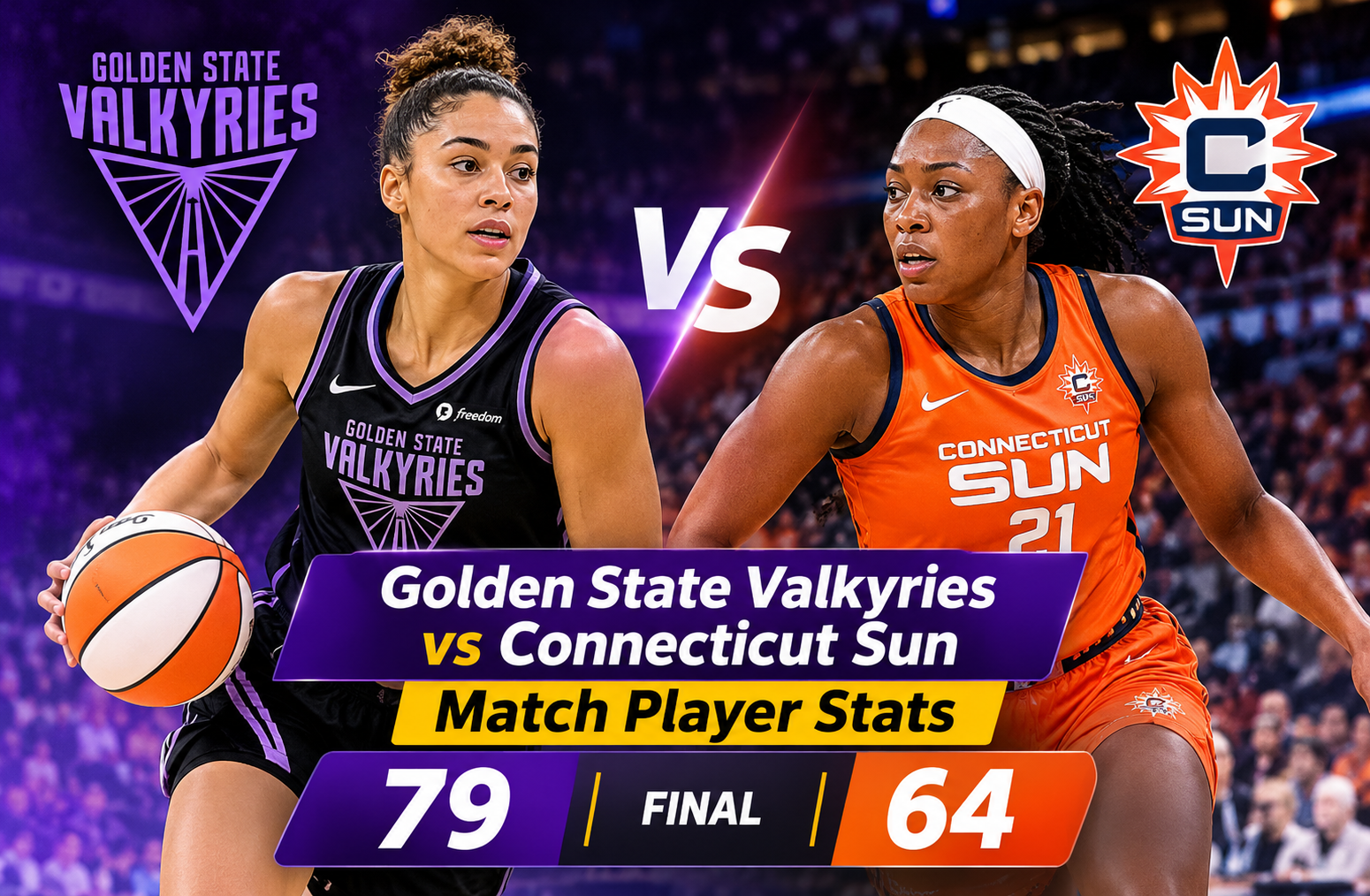
Golden State Valkyries vs Connecticut Sun Match Player Stats
The golden state valkyries vs connecticut sun match player stats reveal how efficient shooting, defensive pressure, and a powerful second-half performance helped Golden State secure a convincing 79-64 victory over Connecticut on July 10, 2026, at Mohegan Sun Arena in Uncasville. Veronica Burton led the Valkyries with 17 points and 6 assists, while Janelle Salaün delivered an outstanding performance off the bench with 16 points and 7 rebounds. On the Connecticut side, Diamond Miller finished with 14 points, and Olivia Nelson-Ododa contributed 12 points and 8 rebounds. Although the Sun started strongly, Golden State gradually took control through better shot selection, improved defensive execution, and fewer costly turnovers.
The result was important for both teams. Golden State extended its winning streak to seven games, while Connecticut struggled to maintain its early momentum. The 15-point difference reflected more than just scoring ability. It demonstrated how consistent execution across several areas of basketball can determine the outcome of a competitive WNBA matchup.
This article examines the complete available player statistics, team shooting numbers, individual contributions, scoring progression, and tactical factors that shaped the contest. It also explains what the numbers reveal about the performances of both teams.
Game Overview: Golden State Valkyries vs Connecticut Sun
The matchup brought together two teams with different levels of momentum. Golden State entered the contest playing confident basketball, while Connecticut was looking for a stronger performance against one of the league’s improving teams.
The Valkyries eventually found their rhythm and produced their best basketball after halftime.
Match Information
| Match Detail | Information |
| Competition | WNBA Regular Season |
| Matchup | Golden State Valkyries vs Connecticut Sun |
| Game Date | July 10, 2026 |
| Venue | Mohegan Sun Arena |
| Location | Uncasville, Connecticut |
| Final Score | Golden State 79, Connecticut 64 |
| Winning Team | Golden State Valkyries |
| Winning Margin | 15 points |
| Attendance | 8,546 |
| Series Result | Golden State won 3-0 |
Golden State finished with 79 points, while Connecticut managed 64. The Valkyries also completed a three-game sweep of their season series against the Sun.
One of the most important details was Golden State’s ability to increase its scoring production in the second half. The team scored 49 points after halftime, compared with only 30 points in the first half.
That improvement changed the direction of the game.
Golden State Valkyries vs Connecticut Sun Match Player Stats
Individual performances provide a clearer understanding of how Golden State secured the victory. Several players contributed valuable minutes, but Veronica Burton and Janelle Salaün were particularly important.
Burton controlled the offense and created scoring opportunities, while Salaün provided an important scoring boost from the bench.
Golden State Valkyries Player Statistics
| Player | Points | Rebounds | Assists |
| Veronica Burton | 17 | 3 | 6 |
| Janelle Salaün | 16 | 7 | 1 |
| Kaila Charles | 9 | 5 | 1 |
| Tiffany Hayes | 9 | 0 | 5 |
| Kaitlyn Chen | 8 | 1 | 1 |
| Laeticia Amihere | 6 | 5 | 3 |
| Kiah Stokes | 5 | 4 | 2 |
| Cecilia Zandalasini | 4 | 1 | 0 |
| Nadia Fingall | 3 | 0 | 0 |
| Kayla Thornton | 2 | 4 | 0 |
| Juste Jocyte | 0 | 0 | 0 |
Player statistics are presented using the available game box-score data.
Veronica Burton Leads Golden State With 17 Points
Veronica Burton was the leading scorer for the Valkyries. She finished with 17 points, 6 assists, and 3 rebounds.
Her performance was especially important because Golden State was without Gabby Williams, who missed the game because of a back contusion.
Burton took on additional offensive responsibility and delivered an effective performance.
She made 7 of her 12 field-goal attempts, showing good efficiency throughout the contest. She also recorded 2 blocks, adding defensive value to her offensive contribution.
Her six assists demonstrated her ability to create opportunities for teammates rather than relying entirely on individual scoring.
Three aspects of Burton’s performance deserve attention:
- Scoring: Her 17 points made her the leading scorer in the game.
- Playmaking: Six assists helped Golden State maintain offensive movement.
- Defense: Two blocks added another dimension to her contribution.
Burton’s performance demonstrated why reliable guard play is important when a team is missing one of its major contributors.
She did not simply replace Williams’ scoring. She helped maintain the team’s offensive organization and provided consistent leadership throughout the game.
Janelle Salaün Delivers an Excellent Bench Performance
Janelle Salaün was another major reason for Golden State’s success.
She finished with 16 points and 7 rebounds in 27 minutes. Her contribution was particularly valuable because she provided scoring without requiring the team to depend entirely on its starting lineup.
Salaün converted 5 of her 11 field-goal attempts and made 4 of 7 attempts from three-point range. She also made both of her free throws.
Her four successful three-pointers were important because they helped stretch Connecticut’s defense.
When an opposing defense must cover players beyond the three-point line, more space becomes available for drives, cuts, and interior opportunities.
Salaün also contributed three steals and one block, demonstrating that her impact extended beyond scoring.
Her plus-minus rating of +18 was the best among the players listed in the game statistics.
This number indicates that Golden State outscored Connecticut by 18 points during her time on the court. It should not be treated as an individual measure of overall ability, but it does highlight how effective the team was during her minutes.
Kaila Charles Provides Efficient Scoring
Kaila Charles contributed 9 points and 5 rebounds.
She made 3 of her 5 field-goal attempts and converted her only three-point attempt. She also made both free throws.
Her shooting efficiency helped Golden State avoid unnecessary offensive possessions.
Charles did not need a large number of attempts to contribute. Instead, she converted available opportunities and helped maintain balance across the lineup.
Her five rebounds were also useful in controlling possession and limiting Connecticut’s opportunities for second-chance points.
Tiffany Hayes Adds Valuable Playmaking
Tiffany Hayes finished with 9 points and 5 assists.
Her shooting performance was particularly efficient. She made all three of her field-goal attempts and added three successful free throws.
Although Hayes did not record a rebound, her offensive contribution was significant.
Five assists showed that she helped create scoring opportunities for other players. Her passing was especially valuable when Golden State needed to maintain offensive pressure against Connecticut’s defense.
Hayes demonstrated that a player can have an important influence without dominating the scoring statistics.
Kaitlyn Chen Supports the Offense
Kaitlyn Chen recorded 8 points, 1 rebound, and 1 assist.
She converted 4 of her 7 field-goal attempts. Although her three-point shooting did not produce a made basket, her ability to score inside the arc helped the Valkyries maintain offensive balance.
Chen also recorded two steals.
Her defensive activity and scoring contribution helped Golden State receive useful production from multiple positions.
Laeticia Amihere Makes an Impact Defensively
Laeticia Amihere finished with 6 points, 5 rebounds, and 3 assists.
Her defensive contribution was particularly impressive.
She recorded three blocks, the highest total among all players in the game. She also added a steal.
Amihere’s ability to protect the basket helped Golden State challenge Connecticut’s interior scoring attempts.
Her performance demonstrates why defensive statistics should be considered alongside points and rebounds when evaluating a player’s overall contribution.
Kiah Stokes Contributes Inside
Kiah Stokes recorded 5 points, 4 rebounds, and 2 assists.
She made 2 of 4 field-goal attempts and converted one three-pointer.
Stokes provided useful interior support and helped Golden State maintain its rebounding presence.
Her contribution was not the largest on the scoreboard, but she played a supporting role in a balanced team performance.
Connecticut Sun Player Statistics
Connecticut had several players who produced respectable individual numbers, but the team’s offensive efficiency was not strong enough to compete with Golden State over four quarters.
Diamond Miller was the leading scorer for the Sun, while Olivia Nelson-Ododa provided an important contribution in the paint.
Connecticut Sun Player Statistics
| Player | Points | Rebounds | Assists |
| Diamond Miller | 14 | 3 | 0 |
| Olivia Nelson-Ododa | 12 | 8 | 4 |
| Charlisse Leger-Walker | 12 | Not specified | Not specified |
| Aaliyah Edwards | 11 | Not specified | Not specified |
| Leila Lacan | 8 | 3 | 6 |
The table includes the individual statistics available from the reported game data. Unspecified figures have not been estimated.
Diamond Miller Leads Connecticut With 14 Points
Diamond Miller was Connecticut’s leading scorer with 14 points.
She made 4 of 8 field-goal attempts and converted all five of her free throws. She also made one three-pointer.
Her shooting efficiency was one of the positive aspects of Connecticut’s offensive performance.
Miller showed an ability to create scoring opportunities and attack the basket. However, her production was not enough to overcome Golden State’s balanced offensive attack.
She finished with 3 rebounds.
Her contribution highlighted the difference between individual scoring success and overall team performance. A player can shoot efficiently and still be on the losing side when the team struggles in other areas.
Olivia Nelson-Ododa Records 12 Points and 8 Rebounds
Olivia Nelson-Ododa delivered an important interior performance.
She finished with 12 points, 8 rebounds, and 4 assists.
Her eight rebounds were particularly valuable because they gave Connecticut a presence around the basket.
Nelson-Ododa also made 5 of her 13 field-goal attempts.
Her four assists demonstrated that she was involved in creating opportunities for teammates, not simply finishing possessions near the basket.
Despite her individual contribution, Connecticut struggled to generate enough efficient scoring opportunities to challenge Golden State.
Charlisse Leger-Walker Adds 12 Points
Charlisse Leger-Walker also finished with 12 points.
Her scoring helped Connecticut remain competitive during several stretches of the game.
However, the Sun needed more consistent production across the lineup, particularly after halftime.
The problem was not simply a lack of scoring from one player. Connecticut struggled to maintain offensive efficiency as Golden State increased its defensive pressure.
Aaliyah Edwards Contributes 11 Points
Aaliyah Edwards scored 11 points for Connecticut.
Her contribution provided additional support to Miller and Nelson-Ododa.
However, Golden State’s defensive organization limited the Sun’s ability to build a sustained scoring run.
Edwards’ performance was a positive individual contribution, but the overall offensive numbers show why Connecticut found it difficult to close the gap.
Leila Lacan Supports Connecticut’s Ball Movement
Leila Lacan recorded 8 points, 3 rebounds, and 6 assists.
Her six assists were an important part of Connecticut’s offensive organization.
She matched Veronica Burton’s assist total, showing that Connecticut had players capable of creating opportunities for teammates.
However, assists alone do not guarantee efficient offense. The quality of the resulting shots and the ability to convert them are equally important.
Connecticut struggled in that area, particularly from beyond the three-point line.
First-Half Performance: Connecticut Starts Strong
The first quarter suggested that Connecticut might be able to challenge Golden State throughout the game.
The Sun opened with more offensive confidence and finished the first period with a 19-17 advantage.
Golden State scored 17 points.
Connecticut’s early lead demonstrated that the Valkyries did not control the game from the opening minutes.
The difference came from how both teams responded to the developing contest.
Golden State gradually improved its offensive execution, while Connecticut experienced difficulties maintaining its scoring pace.
First Quarter Score
| Team | Points |
| Golden State Valkyries | 17 |
| Connecticut Sun | 19 |
Connecticut’s two-point advantage was relatively small, but it gave the home team an encouraging start.
Golden State needed to improve its shooting rhythm and find more consistent ways to attack the defense.
Second Quarter: Golden State Changes the Momentum
The second quarter became one of the most important periods of the game.
Golden State scored 13 points, while Connecticut managed only 6.
The Sun’s offensive production dropped significantly.
Connecticut struggled to convert its attempts and experienced a prolonged scoring drought. The team made only 3 of 15 field-goal attempts during the quarter.
Golden State took advantage of the situation by improving its defensive pressure and limiting Connecticut’s comfortable scoring opportunities.
The Valkyries entered halftime with a 30-25 lead.
First-Half Score
| Team | Q1 | Q2 | First-Half Total |
| Golden State | 17 | 13 | 30 |
| Connecticut | 19 | 6 | 25 |
The five-point difference at halftime showed that Golden State had already started taking control.
However, the game was far from decided.
Connecticut still had enough time to respond, and the third quarter would determine whether the Sun could regain momentum.
Second-Half Performance: Golden State Takes Complete Control
The most impressive part of Golden State’s performance came after halftime.
The Valkyries scored 49 points in the final two quarters.
This represented a significant improvement compared with their first-half production.
Connecticut scored 39 points during the same period.
Although the Sun improved its scoring after the second quarter, it could not match Golden State’s offensive efficiency.
Third Quarter: Valkyries Build Their Advantage
Golden State scored 24 points in the third quarter, compared with 19 from Connecticut.
The Valkyries continued to create better scoring opportunities and increased their advantage.
A major highlight was Golden State’s 11-0 second-half run, which helped establish a more comfortable lead.
Burton became the first Valkyries player to reach double-digit scoring during the game. She converted an important three-point play late in the quarter and added a driving layup before the buzzer.
Golden State entered the final period with a 54-44 advantage.
That ten-point lead gave the visitors a stronger position heading into the fourth quarter.
Fourth Quarter: Golden State Protects Its Lead
Golden State continued its strong performance in the final quarter.
The Valkyries scored 25 points, while Connecticut added 20.
Golden State opened the period with a 6-0 run, increasing the lead to 16 points.
Burton contributed another important three-pointer during this stretch.
Salaün also continued to provide scoring support, making it difficult for Connecticut to reduce the deficit.
The Valkyries eventually finished the game with a 79-64 victory.
Complete Quarter-by-Quarter Score
| Quarter | Golden State | Connecticut |
| First Quarter | 17 | 19 |
| Second Quarter | 13 | 6 |
| Third Quarter | 24 | 19 |
| Fourth Quarter | 25 | 20 |
| Final Score | 79 | 64 |
The scoring progression makes the result easier to understand.
Connecticut had the better opening quarter, but Golden State won each of the remaining three quarters.
The second quarter was especially important because it allowed the Valkyries to take the lead before producing an even stronger offensive performance after halftime.
Team Statistics Comparison
The team statistics provide a deeper explanation of why Golden State won.
Both teams recorded 19 assists, showing that they created a similar number of assisted scoring opportunities.
However, Golden State had advantages in shooting percentage, three-point accuracy, rebounds, blocks, and turnovers.
Golden State Valkyries vs Connecticut Sun Team Stats
| Statistical Category | Golden State | Connecticut |
| Total Points | 79 | 64 |
| Field Goals Made | 31 | 24 |
| Field Goals Attempted | 60 | 58 |
| Field-Goal Percentage | 51.7% | 41.4% |
| Three-Pointers Made | 8 | 4 |
| Three-Point Attempts | 18 | 16 |
| Three-Point Percentage | 44.4% | 25.0% |
| Free Throws Made | 9 | 12 |
| Free-Throw Attempts | 13 | 17 |
| Rebounds | 30 | 23 |
| Assists | 19 | 19 |
| Steals | 11 | 10 |
| Blocks | 6 | 3 |
| Turnovers | 15 | 20 |
These numbers reveal several important differences.
Field-Goal Efficiency Favors Golden State
Golden State made 31 of its 60 field-goal attempts.
That resulted in a shooting percentage of approximately 51.7%.
Connecticut converted 24 of 58 attempts, finishing at approximately 41.4%.
The difference was more than ten percentage points.
This was a major advantage for Golden State because efficient shooting allows a team to generate more points without needing a significantly higher number of possessions.
The Valkyries also demonstrated better shot selection.
Their ability to convert opportunities consistently helped them maintain offensive pressure.
Three-Point Shooting Creates Additional Separation
Three-point shooting was another major factor.
Golden State made 8 of 18 attempts from beyond the arc, producing a 44.4% shooting percentage.
Connecticut made only 4 of 16 attempts, finishing at 25%.
Golden State therefore made twice as many three-pointers.
That difference produced a 12-point advantage in three-point scoring.
Salaün was especially important in this area because she made four three-pointers by herself.
When a team has multiple reliable scoring options from the perimeter, defenders must cover more space.
This can create additional opportunities for players attacking the basket.
Golden State benefited from that offensive flexibility.
Rebounding Advantage Helps Golden State
Golden State collected 30 rebounds, compared with 23 for Connecticut.
The seven-rebound advantage helped the Valkyries maintain possession and reduce some of the Sun’s opportunities.
Salaün led Golden State with 7 rebounds.
Nelson-Ododa recorded 8 for Connecticut.
Although Nelson-Ododa had the highest individual rebound total among the highlighted players, Golden State received more combined production across its lineup.
This is an important distinction.
Team rebounding is not determined by one player alone. Guards, forwards, and centers all contribute to controlling the ball after missed shots.
Turnovers Give the Valkyries More Control
Golden State committed 15 turnovers, while Connecticut committed 20.
This five-turnover difference was another important factor.
Turnovers can be especially damaging in a game where the shooting percentages are already different.
Every lost possession represents a scoring opportunity that a team cannot complete.
Connecticut’s 20 turnovers made it more difficult to establish offensive consistency.
Golden State did a better job of protecting possession and converting its opportunities.
Assists Show Similar Passing Production
Both teams recorded 19 assists.
This means Golden State did not win simply because it recorded more assists.
Instead, the difference came from what happened after those scoring opportunities were created.
Golden State converted a higher percentage of its shots.
This distinction is important when evaluating offensive performance.
A team can move the ball effectively and still struggle if its players cannot consistently convert open or contested attempts.
Why Golden State Valkyries Won the Game
The 79-64 result was produced by several connected factors rather than one individual performance.
Golden State executed better in important statistical areas and maintained its defensive intensity.
1. Better Shooting Accuracy
The biggest difference was Golden State’s shooting efficiency.
A field-goal percentage of 51.7% gave the Valkyries a significant advantage over Connecticut’s 41.4%.
The additional accuracy meant Golden State could generate more points from a similar number of attempts.
The difference became even more noticeable from three-point range.
2. Strong Bench Contributions
Salaün’s 16 points were extremely valuable.
Her scoring helped Golden State maintain offensive production beyond its starting lineup.
Tiffany Hayes also provided 9 points and 5 assists.
This type of contribution is important during a long WNBA season because teams cannot rely exclusively on their starting five.
A productive bench helps maintain intensity when starters need rest.
3. Improved Defensive Execution
Golden State limited Connecticut to only 6 points in the second quarter.
That was arguably the most important defensive stretch of the game.
The Valkyries challenged shots, disrupted offensive rhythm, and forced the Sun to work harder for scoring opportunities.
Amihere’s three blocks and Salaün’s three steals were important individual examples of that defensive effort.
4. Better Ball Security
Connecticut committed five more turnovers than Golden State.
The Valkyries were more careful with possession and reduced unnecessary mistakes.
In a game with a 15-point final difference, protecting possessions helped maintain Golden State’s advantage.
5. Consistent Second-Half Scoring
Golden State scored 49 second-half points.
The team did not simply build a lead and attempt to defend it.
Instead, it continued to score effectively in both the third and fourth quarters.
That approach prevented Connecticut from making a serious comeback.
Connecticut Sun’s Biggest Problems
Connecticut had some positive individual performances, but several team-level issues made the contest difficult.
Inconsistent Offensive Production
The six-point second quarter was a major problem.
Connecticut scored only 30 points in the first half.
Although the Sun improved after halftime, the early offensive struggles had already placed the team in a difficult position.
Poor Three-Point Accuracy
Connecticut made only 25% of its three-point attempts.
That limited the team’s ability to stretch Golden State’s defense.
The Valkyries could focus more attention on defending drives and interior scoring because Connecticut was not consistently punishing them from outside.
Too Many Turnovers
Twenty turnovers placed unnecessary pressure on Connecticut’s offense.
The Sun needed more completed possessions and better decision-making to compete with Golden State’s shooting efficiency.
Reducing turnovers would have helped the team maintain a stronger offensive rhythm.
Defensive Difficulties Against the Bench
Golden State received significant scoring from its reserves.
Salaün’s 16 points were particularly damaging because she provided another offensive threat that Connecticut had to contain.
The Sun needed more consistent defensive coverage against Golden State’s perimeter players.
Head-to-Head Performance and Season Series
The July matchup completed a 3-0 season series sweep for Golden State against Connecticut.
Winning all three meetings was an important achievement for the Valkyries.
It demonstrated that their performances against the Sun were not limited to one successful night.
A season series sweep also provides a useful opportunity to examine how teams respond to familiar opponents.
Coaches can identify which offensive actions create problems, which defensive adjustments work, and where additional improvements are needed.
For Golden State, the final meeting reinforced the team’s strong form.
The Valkyries entered the contest with significant momentum and extended their winning streak to seven games.
For Connecticut, the result highlighted the need for improved offensive consistency and stronger possession management.
The three-game result should not be viewed as proof that every future meeting would produce the same outcome. Basketball performances depend on player availability, match conditions, tactical decisions, and shooting form.
However, Golden State clearly had the upper hand in this particular season series.
What the Player Statistics Reveal About Golden State’s Playing Style
The individual and team numbers offer useful information about how Golden State approached the matchup.
Three characteristics stand out.
Balanced Offensive Contributions
Burton led the scoring, but Golden State did not depend on one player.
Salaün added 16 points, while Charles and Hayes contributed 9 each.
Chen provided another 8 points.
This distribution made the offense more difficult to defend.
If Connecticut concentrated too much defensive attention on Burton, other players could take advantage of the additional space.
Perimeter Shooting Creates Space
Golden State’s 44.4% three-point percentage helped stretch the defense.
Salaün’s four successful attempts were particularly important.
Perimeter scoring creates more than direct points. It also changes the positioning of defenders.
When opponents must respect outside shooters, driving lanes can become more available.
This relationship between perimeter shooting and interior opportunities was an important feature of the Valkyries’ offensive performance.
Defensive Contributions Come From Multiple Players
Amihere’s three blocks, Salaün’s three steals, and Burton’s two blocks demonstrate how several players contributed defensively.
The team also collected more rebounds than Connecticut.
This suggests that Golden State’s success was not based entirely on offensive execution.
The Valkyries were effective at both ends of the court.
How to Read Basketball Player Statistics Correctly
For readers interested in understanding WNBA box scores, it is useful to look beyond the points column.
Individual numbers become more meaningful when they are considered together.
Points
Points show how much scoring a player contributed.
However, the total does not explain how efficiently those points were produced.
For example, Burton scored 17 points on 7-of-12 field-goal shooting.
Looking at both numbers gives a better understanding of her offensive performance.
Rebounds
Rebounds measure how many missed shots a player recovered.
They are divided into offensive and defensive rebounds.
Offensive rebounds can create additional scoring opportunities, while defensive rebounds help a team complete its defensive possession.
Nelson-Ododa’s 8 rebounds were an important contribution for Connecticut.
Assists
Assists measure passes that directly lead to made baskets.
They provide information about playmaking and offensive teamwork.
Burton and Lacan both recorded 6 assists.
This shows that both teams had players capable of creating opportunities for teammates.
Steals
Steals measure how often a player takes possession away from the opposition.
They are an important defensive statistic.
Salaün recorded 3 steals, demonstrating her activity away from the scoring area.
Blocks
Blocks measure defensive actions that stop or alter an opponent’s shot.
Amihere recorded 3 blocks for Golden State.
Her performance demonstrates how defensive contributions can influence a game without appearing prominently in the scoring column.
Field-Goal Percentage
Field-goal percentage measures successful shots divided by total field-goal attempts.
A higher percentage generally indicates better shooting efficiency.
Golden State’s 51.7% was considerably higher than Connecticut’s 41.4%.
Plus-Minus
Plus-minus measures the difference between a team’s scoring and its opponent’s scoring while a particular player is on the court.
Salaün finished at +18.
This indicates that Golden State outscored Connecticut by 18 points during her playing time.
However, plus-minus should always be interpreted carefully because it reflects the performance of the entire lineup during those minutes.
It does not measure an individual player’s contribution in isolation.
What This Result Means for Both Teams
The result provided different lessons for Golden State and Connecticut.
Golden State Valkyries: Confidence and Momentum
Golden State continued its impressive run with a seventh consecutive victory.
The team’s balanced scoring was encouraging, especially with Gabby Williams unavailable.
Burton demonstrated that she could take on greater offensive responsibility.
Salaün showed the value of bench production.
The team’s shooting efficiency and defensive pressure also provided evidence of its growing consistency.
The most important positive was that Golden State found ways to win through different contributors.
Connecticut Sun: Areas Requiring Improvement
Connecticut needed better offensive consistency.
The six-point second quarter was difficult to overcome, especially against a team shooting above 50% from the field.
The Sun also needed to reduce turnovers and improve their perimeter shooting.
Their individual contributors showed potential, but the team needed a more consistent collective performance.
Nelson-Ododa’s rebounding, Miller’s scoring, and Lacan’s playmaking were positive elements.
Building around those contributions while improving team execution would be important for future performances.
Frequently Asked Questions
1. Who won the Golden State Valkyries vs Connecticut Sun game?
The Golden State Valkyries defeated the Connecticut Sun 79-64 on July 10, 2026, at Mohegan Sun Arena in Uncasville, Connecticut.
2. Who was the top scorer in the game?
Veronica Burton was the leading scorer with 17 points for Golden State. Diamond Miller led Connecticut with 14 points.
3. How many points did Janelle Salaün score?
Janelle Salaün scored 16 points and collected 7 rebounds. She also made four three-pointers and recorded three steals.
4. How many rebounds did Olivia Nelson-Ododa record?
Olivia Nelson-Ododa recorded 8 rebounds, along with 12 points and 4 assists for Connecticut.
5. What was the biggest statistical difference between the teams?
Shooting efficiency was one of the biggest differences. Golden State shot 51.7% from the field and 44.4% from three-point range, while Connecticut shot 41.4% overall and 25% from three-point range.
6. What was the final head-to-head season series result?
Golden State completed a 3-0 season series sweep against Connecticut in their 2026 regular-season meetings.
Conclusion
The Golden State Valkyries secured an impressive 79-64 victory over the Connecticut Sun through efficient shooting, balanced scoring, and strong second-half execution. Veronica Burton led the winning team with 17 points and 6 assists, while Janelle Salaün delivered one of the most valuable bench performances with 16 points, 7 rebounds, and four successful three-pointers.
Connecticut received important contributions from Diamond Miller, Olivia Nelson-Ododa, Charlisse Leger-Walker, and Aaliyah Edwards. However, its offensive inconsistency, lower shooting percentage, and 20 turnovers made it difficult to compete with Golden State.
The team statistics explain the result clearly. Golden State shot better from the field, converted more three-pointers, collected more rebounds, and committed fewer turnovers. Both teams recorded 19 assists, but the Valkyries were more effective at turning their offensive opportunities into points.
The golden state valkyries vs connecticut sun match player stats ultimately demonstrate the importance of teamwork, shooting efficiency, defensive discipline, and bench contributions. Golden State’s 15-point victory also completed a 3-0 season series sweep and extended its winning streak to seven games.