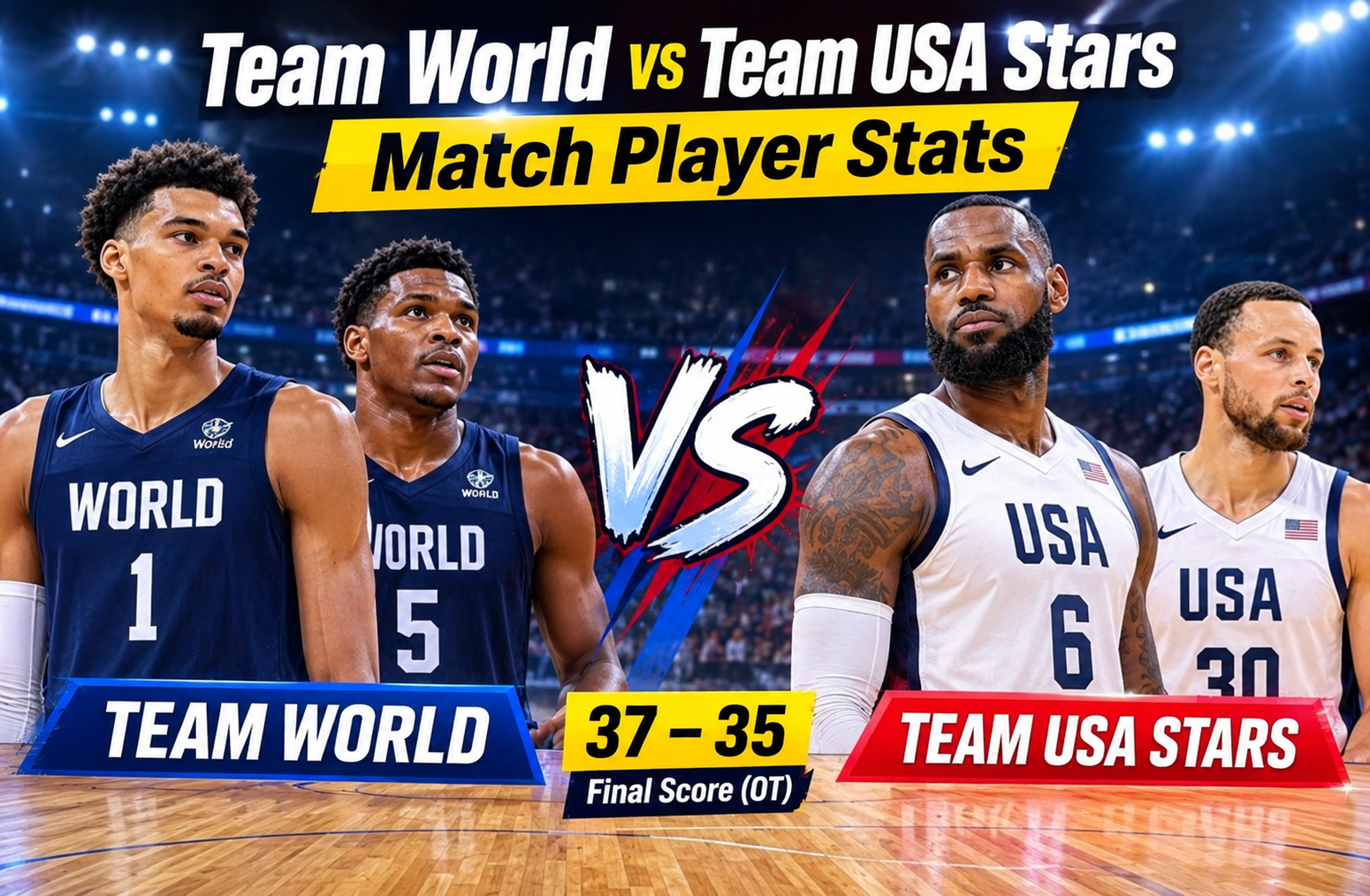
Team World Basketball vs Team USA Stars Match Player Stats
The team world basketball vs team usa stars match player stats tell the story of a dramatic NBA All-Star 2026 opening game that finished with a 37-35 overtime victory for USA Stars. Played at Intuit Dome in Inglewood, California, on February 15, 2026, the contest brought together leading international basketball talent and American NBA stars. Victor Wembanyama led Team World with 14 points, while Anthony Edwards scored 13 points for USA Stars. The game remained tied at 32-32 after regulation before Scottie Barnes hit the decisive three-pointer in overtime.
Game Overview: Team World vs Team USA Stars
The opening game of the 2026 NBA All-Star competition delivered a close contest between two talented groups. Team World featured international players from different basketball backgrounds, while USA Stars represented American NBA talent.
Unlike a traditional NBA regular-season matchup, this game used a shorter format. The limited playing time made every possession important and left little room for teams to recover from missed opportunities.
Here are the essential game details:
| Game Detail | Information |
| Competition | 2026 NBA All-Star Game |
| Matchup | Team World vs USA Stars |
| Date | February 15, 2026 |
| Venue | Intuit Dome |
| Location | Inglewood, California |
| Final Score | USA Stars 37-35 Team World |
| Result | USA Stars won in overtime |
| Regulation Score | 32-32 |
| Attendance | 15,973 |
| Broadcast | NBC and Peacock |
Important date clarification: The NBA’s official records list this game as February 15, 2026, in Inglewood. February 16 may appear in some international time zones or publication timestamps. The official game record is the most reliable reference for the match date and statistics.
Team World Basketball vs Team USA Stars Match Player Stats
The following breakdown uses the NBA’s official box score rather than estimated figures. It includes individual scoring, shooting percentages, rebounds, assists, blocks, and other important contributions.
One important distinction is that the supplied information contains a few statistical inaccuracies. The official record confirms that Team World shot 41.4% from the field and 35.7% from three-point range. It also confirms that USA Stars recorded 13 assists, compared with 12 for World.
Final Score and Overtime Results
37
USA Stars
Winner
35
FINAL / OT
35
Team World
Runner-up
| Scoring Period | USA Stars | Team World |
| Regulation | 32 | 32 |
| Overtime | 5 | 3 |
| Final | 37 | 35 |
Both teams produced 32 points during regulation. Neither side managed to establish a winning advantage before the end of the initial period.
The additional period created another opportunity for the players to demonstrate their scoring ability. USA Stars managed five points, while Team World scored three. Scottie Barnes delivered the winning three-pointer to finish the contest.
The final difference was only two points, making this an especially close opening game of the All-Star competition.
Complete Team World Player Statistics
Team World entered the game with several internationally recognized NBA players. The lineup included Victor Wembanyama, Nikola Jokic, Luka Doncic, Jamal Murray, Karl-Anthony Towns, Pascal Siakam, and other established professionals.
Although the international team lost, its players produced several impressive individual performances.
Team World Full Box Score
| Player | MIN | PTS | REB | AST | BLK |
| Victor Wembanyama | 9:47 | 14 | 6 | 0 | 3 |
| Karl-Anthony Towns | 7:54 | 10 | 1 | 0 | 0 |
| Deni Avdija | 8:28 | 5 | 0 | 2 | 0 |
| Pascal Siakam | 7:54 | 4 | 1 | 1 | 0 |
| Luka Doncic | 5:05 | 2 | 0 | 2 | 0 |
| Nikola Jokic | 5:05 | 0 | 2 | 0 | 0 |
| Jamal Murray | 10:35 | 0 | 2 | 4 | 0 |
| Norman Powell | 6:55 | 0 | 0 | 1 | 0 |
| Alperen Sengun | 3:12 | 0 | 4 | 2 | 0 |
| Team Total | 64:55 | 35 | 16 | 12 | 3 |
MIN represents playing time. REB represents rebounds, AST represents assists, and BLK represents blocks.
The most important statistical observation is the difference between Wembanyama’s scoring production and the contributions of the other players. He recorded 14 points, accounting for 40% of his team’s total scoring.
Towns also made a significant contribution with 10 points. Together, these two players scored 24 of the team’s 35 points.
Victor Wembanyama Leads Team World With 14 Points
Wembanyama teaches Spurs’ Popovich to change one dribble at a time
Victor Wembanyama
Team World top scorer
14 points
6 rebounds | 3 blocks | 80% field goals
Victor Wembanyama was the most productive scorer for Team World. He finished with 14 points, six rebounds, and three blocked shots in 9 minutes and 47 seconds of playing time.
His shooting efficiency was particularly impressive.
- Field goals: 4-of-5
- Field-goal percentage: 80%
- Three-pointers: 2-of-2
- Three-point percentage: 100%
- Free throws: 4-of-4
- Rebounds: 6
- Blocks: 3
- Total points: 14
These numbers show that Wembanyama made excellent use of his limited minutes. He converted every three-point attempt and every free throw.
His three blocks were also important because they demonstrated his defensive influence around the basket. Even in a short All-Star contest, his height, reach, and ability to challenge shots created problems for opposing players.
Wembanyama’s performance was a major reason Team World remained competitive. His scoring provided the foundation for the international team’s offense, while his defensive contributions helped limit opportunities near the basket.
However, individual production was not enough to secure the victory. Team World needed more consistent scoring from its supporting players during the closing moments.
Karl-Anthony Towns Adds 10 Points
Houston Rockets v Minnesota Timberwolves
Karl-Anthony Towns
10 points
1 rebound | 2 three-pointers
Karl-Anthony Towns delivered the second-highest scoring performance for Team World.
He recorded 10 points in 7 minutes and 54 seconds. His shooting statistics included:
- Field goals: 3-of-4
- Field-goal percentage: 75%
- Three-pointers: 2-of-3
- Three-point percentage: 66.7%
- Free throws: 2-of-2
- Rebounds: 1
Towns demonstrated his ability to score from different areas of the court. His outside shooting was particularly useful because it forced the opposing defense to respect his range.
His two successful three-pointers helped Team World maintain offensive pressure. However, his contribution was not enough to overcome the scoring gap created by the other players’ limited production.
The combination of Towns and Wembanyama gave Team World 24 points. The remaining players combined for just 11 points, showing how heavily the team’s offense depended on its two leading scorers.
Deni Avdija Contributes 5 Points
Deni Avdija finished with five points, two assists, and one turnover.
His shooting performance was efficient:
- Field goals: 2-of-3
- Three-pointers: 1-of-2
- Points: 5
- Assists: 2
Avdija provided useful offensive support and helped move the ball between teammates. His ability to contribute without requiring a large number of shots was valuable in a short game.
Although he did not produce a major scoring total, his two assists helped Team World create additional scoring opportunities.
Pascal Siakam Records 4 Points
Pascal Siakam finished with four points, one rebound, and one assist.
He converted two of his four field-goal attempts and did not make a three-pointer.
Siakam’s contribution was relatively modest, but his experience and versatility gave Team World another option on offense.
His performance also illustrates an important aspect of the matchup. Having several experienced players does not automatically guarantee offensive balance. A team still needs its players to convert opportunities consistently.
Luka Doncic’s Performance
Luka Doncic recorded two points and two assists in 5 minutes and five seconds.
His official shooting numbers were:
- Field goals: 1-of-3
- Three-pointers: 0-of-2
- Points: 2
- Assists: 2
Doncic did not have a major scoring impact, but he contributed to the team’s ball movement.
His limited playing time is an important consideration when evaluating his numbers. A short appearance provides fewer opportunities to influence the overall result than a full-length NBA game.
Nikola Jokic Finishes Without Scoring
Nikola Jokic finished the game with zero points and two rebounds.
He attempted one field goal but did not convert it. He played 5 minutes and five seconds.
His absence from the scoring column does not mean he had no contribution. His two rebounds provided additional possessions and helped Team World compete on the boards.
Jamal Murray Leads Team World in Assists
Jamal Murray recorded four assists, the highest total for either team in the game.
However, he did not score a point after missing all six field-goal attempts.
His complete shooting record included:
- Field goals: 0-of-6
- Three-pointers: 0-of-1
- Points: 0
- Rebounds: 2
- Assists: 4
- Steals: 1
Murray’s passing was one of the positive elements of the international team’s performance. Four assists demonstrated his ability to create opportunities for teammates even when his own shooting was unsuccessful.
His six missed field goals also show how difficult it can be for a team to win when an important offensive contributor cannot find his shooting rhythm.
Other Team World Contributions
The remaining players also had smaller but useful roles.
- Alperen Sengun: Recorded four rebounds and two assists in just over three minutes.
- Norman Powell: Added one assist but did not score.
- Pascal Siakam: Contributed four points and one assist.
- Luka Doncic: Added two points and two assists.
Giannis Antetokounmpo and Shai Gilgeous-Alexander were listed as inactive because of injury or illness. Their absence is relevant when assessing the available international roster.
Overall, Team World had individual talent and efficient shooting from its leading players. However, its limited scoring depth became a major issue during the closing stage.
Complete Team USA Stars Player Statistics
USA Stars entered the contest with an impressive collection of American NBA talent. The team featured Anthony Edwards, Devin Booker, Cade Cunningham, Tyrese Maxey, Jalen Duren, Scottie Barnes, Jalen Johnson, and Chet Holmgren.
The group produced a balanced offensive performance, with several players contributing to the victory in different ways.
USA Stars Full Box Score
| Player | MIN | PTS | REB | AST | BLK |
| Anthony Edwards | 9:04 | 13 | 2 | 0 | 0 |
| Devin Booker | 10:17 | 5 | 1 | 4 | 0 |
| Cade Cunningham | 10:17 | 4 | 3 | 1 | 0 |
| Tyrese Maxey | 7:29 | 4 | 3 | 2 | 0 |
| Jalen Johnson | 6:37 | 4 | 0 | 1 | 0 |
| Scottie Barnes | 8:12 | 3 | 5 | 2 | 1 |
| Jalen Duren | 8:28 | 2 | 4 | 3 | 0 |
| Chet Holmgren | 4:31 | 2 | 1 | 0 | 0 |
| Team Total | 64:55 | 37 | 19 | 13 | 1 |
USA Stars had a more distributed scoring performance than their opponents. Although Anthony Edwards led the team with 13 points, six other players also contributed to the scoreboard.
This distribution helped the team avoid depending entirely on one player.
Anthony Edwards Leads USA Stars With 13 Points
Anthony Edwards was the leading scorer for USA Stars and one of the most influential offensive players in the contest.
He recorded 13 points in 9 minutes and four seconds. His scoring efficiency was a major factor in keeping the American team competitive throughout regulation.
His official statistics included:
- Minutes played: 9:04
- Points: 13
- Field goals: 5-of-9
- Field-goal percentage: 55.6%
- Three-pointers: 3-of-7
- Three-point percentage: 42.9%
- Rebounds: 2
- Assists: 0
Edwards demonstrated his ability to create scoring opportunities through both perimeter shooting and regular field-goal attempts.
His three successful shots from beyond the arc were especially valuable. In a short competition, outside shooting can quickly change the scoreboard and put pressure on the opposing defense.
He was also responsible for several important scoring moments late in regulation. His three-pointer helped USA Stars reach 32 points and tie the game before overtime.
Edwards’ performance showed why he was such an important part of the American lineup. His scoring ability gave the team an offensive advantage, while his confidence allowed him to take important shots when the contest became tight.
Although he was not the player who scored the final basket, his contribution established the foundation for the victory.
Devin Booker Records 5 Points and 4 Assists
Devin Booker played an important role as a scorer and playmaker.
He finished with five points, four assists, and one rebound in 10 minutes and 17 seconds.
His shooting numbers were:
- Field goals: 2-of-5
- Field-goal percentage: 40%
- Three-pointers: 1-of-3
- Three-point percentage: 33.3%
- Points: 5
- Assists: 4
- Rebounds: 1
Booker’s four assists were particularly valuable because they helped USA Stars create scoring opportunities for multiple players.
An assist may not appear as important as a basket in a quick box-score review, but it often reflects good decision-making, passing accuracy, and awareness of defensive positioning.
His contribution also helped maintain the team’s offensive rhythm. Instead of forcing every possession into an individual scoring attempt, Booker distributed the ball and allowed other players to participate.
This was an important difference between the two teams. USA Stars recorded 13 assists, compared with 12 for Team World, while also receiving useful contributions from several players.
Scottie Barnes Hits the Game-Winning Three-Pointer
Scottie Barnes delivered the decisive moment of the contest.
He finished with three points, five rebounds, two assists, one steal, and one blocked shot.
His shooting statistics were:
- Field goals: 1-of-1
- Three-pointers: 1-of-1
- Field-goal percentage: 100%
- Three-point percentage: 100%
- Rebounds: 5
- Assists: 2
- Steals: 1
- Blocks: 1
His scoring total was smaller than Edwards’ contribution, but the timing of his points made them extremely important.
During overtime, the score reached 34-35 in favor of Team World after Wembanyama converted a three-point shot.
USA Stars needed another successful possession to take the lead. Barnes answered by making a three-pointer that moved the score to 37-35.
That basket ended the contest and secured the victory for the American team.
His five rebounds were also the highest total recorded by any player in the game. This demonstrates that his influence extended beyond the final shot.
Barnes combined rebounding, passing, defensive activity, and efficient shooting to make a valuable contribution in limited minutes.
Cade Cunningham Provides Balanced Support
Cade Cunningham recorded four points, three rebounds, one assist, and three steals.
He played 10 minutes and 17 seconds, making him one of the players with the longest appearances for USA Stars.
His shooting numbers were:
- Field goals: 2-of-6
- Field-goal percentage: 33.3%
- Three-pointers: 0-of-1
- Rebounds: 3
- Assists: 1
- Steals: 3
- Points: 4
Cunningham’s three steals were an important defensive contribution.
While his shooting percentage was lower than that of Edwards or Barnes, his defensive activity helped USA Stars create additional opportunities.
His three steals were also the highest individual total in the contest.
This is a useful example of why player performance should not be judged through points alone. Defensive statistics can reveal contributions that are less obvious when someone looks only at the scoring column.
Tyrese Maxey Adds Four Points
Tyrese Maxey contributed four points, three rebounds, and two assists.
He played 7 minutes and 29 seconds and converted two of his five field-goal attempts.
His three-point shooting was unsuccessful, but he provided additional offensive support through his movement and passing.
Maxey’s two assists helped the team maintain offensive balance and provided another option for creating scoring opportunities.
Jalen Johnson’s Offensive Contribution
Jalen Johnson finished with four points and one assist.
He made two of his three field-goal attempts, producing a field-goal percentage of 66.7%.
His contribution was efficient despite limited playing time.
Johnson did not need a large number of attempts to help his team. His ability to convert available opportunities added useful scoring support behind Edwards and Booker.
Jalen Duren Helps Control the Rebounds
Jalen Duren recorded two points, four rebounds, and three assists.
His four rebounds were an important contribution to USA Stars’ advantage on the boards.
He also provided three assists, matching the number of rebounds he recorded as a useful all-around contributor.
Duren’s passing was particularly noteworthy for a player operating in a frontcourt role. His involvement helped the team create opportunities through different positions rather than relying exclusively on perimeter players.
Chet Holmgren Adds Two Points
Chet Holmgren played 4 minutes and 31 seconds and recorded two points and one rebound.
He converted one of his three field-goal attempts.
Although his playing time was limited, his contribution gave USA Stars another frontcourt option.
His presence also added defensive size and versatility to the lineup.
Team World Basketball vs Team USA Stars Match Player Stats: Team Comparison
Individual performances explain much of the contest, but the team statistics provide a broader understanding of why USA Stars won.
The official numbers show that both teams had strengths in different areas.
Complete Statistical Comparison
| Statistical Category | USA Stars | Team World |
| Final Score | 37 | 35 |
| Field Goals | 16/36 | 12/29 |
| Field-Goal Percentage | 44.4% | 41.4% |
| Three-Pointers | 5/16 | 5/14 |
| Three-Point Percentage | 31.2% | 35.7% |
| Free Throws | 0/0 | 6/6 |
| Rebounds | 19 | 16 |
| Assists | 13 | 12 |
| Steals | 4 | 1 |
| Blocks | 4 | 3 |
| Turnovers | 3 | 4 |
| Points in the Paint | 20 | 12 |
| Second-Chance Points | 7 | 0 |
| Fast-Break Points | 6 | 7 |
Team steals and blocks are taken from the official box score. The team comparison highlights the categories that influenced the result.
Field-Goal Percentage
USA Stars finished with a 44.4% field-goal percentage, while Team World recorded 41.4%.
The American team made 16 of its 36 attempts. Team World converted 12 of 29 attempts.
Although the difference in shooting percentage was relatively small, USA Stars made four more field goals.
In a contest decided by two points, those additional successful attempts were significant.
The numbers also demonstrate that Team World did not struggle with every aspect of its offense. Its players created opportunities, but the American team converted a greater number of shots.
Three-Point Shooting
Both teams made five three-pointers.
However, Team World had the better percentage from beyond the arc.
USA Stars converted five of 16 attempts for 31.2%, while Team World made five of 14 attempts for 35.7%.
This difference indicates that Team World was slightly more efficient from long range.
Nevertheless, the higher percentage did not translate into a victory.
USA Stars compensated through stronger overall field-goal production, better rebounding, and additional points inside the paint.
This is an important lesson when analyzing basketball statistics. A team can perform better in one shooting category without necessarily winning the game.
Rebounding Advantage
USA Stars collected 19 total rebounds, compared with 16 for Team World.
Scottie Barnes led all players with five rebounds, while Jalen Duren contributed four.
On the international side, Wembanyama collected six rebounds, the highest individual total in the contest.
Alperen Sengun added four rebounds despite playing only 3 minutes and 12 seconds.
The overall advantage of three rebounds helped USA Stars maintain possession and create additional scoring opportunities.
Rebounding was particularly important because the game had a short format. Each additional possession created another chance to score, while losing the ball reduced the number of available opportunities.
Assists and Ball Movement
USA Stars recorded 13 assists, while Team World finished with 12.
The difference was only one assist, but the numbers reflect the offensive contributions of the two groups.
Booker led the American team with four assists. Duren added three, while Barnes and Maxey recorded two each.
Jamal Murray led Team World with four assists. Doncic and Sengun contributed two apiece.
Both teams showed an ability to create scoring opportunities through passing.
However, USA Stars had slightly better overall shooting production, allowing more of those opportunities to become successful field goals.
Turnovers and Ball Security
Team World recorded four turnovers, while USA Stars committed three.
The difference was relatively small, but limiting mistakes was important in a close contest.
Every possession carried additional value because the game had limited playing time.
A turnover can remove an opportunity to score while giving the opposing team a chance to increase its lead.
USA Stars managed to protect the ball slightly better, helping the team avoid unnecessary lost possessions.
Points in the Paint
One of the most important differences appeared in points scored near the basket.
USA Stars recorded 20 points in the paint, compared with 12 for Team World.
This eight-point advantage was substantial in a game that ended with only a two-point difference.
The American team was more successful at generating scoring opportunities closer to the basket.
This gave USA Stars another offensive option when perimeter shooting became difficult.
Team World, meanwhile, depended more heavily on its leading scorers and outside shooting.
The difference in inside scoring was one of the clearest statistical explanations for the final result.
Second-Chance Points
USA Stars recorded seven second-chance points, while Team World finished without any.
Second-chance scoring happens when an offensive team collects an offensive rebound and converts another scoring opportunity.
USA Stars recorded three successful baskets from five second-chance attempts.
Team World’s inability to generate points in this category limited its offensive output.
This statistic also connects directly to the rebounding advantage. The American team collected more rebounds and was more successful at turning additional possessions into points.
How the Game Developed: Regulation to Overtime
The contest was competitive from the beginning, with both teams demonstrating different offensive strengths.
Team World relied heavily on Wembanyama and Towns, while USA Stars received contributions from Edwards, Booker, Barnes, and other players.
Regulation Ends in a 32-32 Tie
The regulation period finished with both teams scoring 32 points.
This result demonstrated how closely matched the two sides were.
Team World had a strong inside presence through Wembanyama and Towns. Its players also created opportunities from outside, making five three-pointers during the game.
USA Stars responded through more balanced scoring and stronger production around the basket.
Edwards’ perimeter shooting was especially important in keeping the American team level.
Neither side managed to establish a decisive advantage before the end of regulation.
Overtime Changes the Outcome
Overtime provided the deciding opportunity.
USA Stars scored five points, while Team World managed three.
The sequence of scoring was crucial:
- Anthony Edwards scored to give USA Stars a 34-32 advantage.
- Victor Wembanyama answered with a three-pointer, moving Team World ahead 35-34.
- Scottie Barnes converted a three-point shot to give USA Stars a 37-35 victory.
This short sequence demonstrates how quickly the result changed.
Team World briefly took the lead through Wembanyama, but Barnes delivered the final basket.
The American team’s ability to respond immediately was the defining moment of the game.
Scottie Barnes Delivers Under Pressure
Barnes’ winning shot deserves special attention because of its timing.
He did not lead his team in scoring, but he made the most important basket of the contest.
His shot also reflected the value of teamwork. Jalen Duren recorded the assist on the decisive three-pointer.
The final play involved successful passing, positioning, and shooting rather than an individual scoring attempt without support.
It was an excellent example of how a player with a relatively small point total can become central to a game’s outcome.
Why USA Stars Won Against Team World
The final score was close, but several statistical differences explain the American team’s success.
1. Better Overall Field-Goal Efficiency
USA Stars shot 44.4% from the field, compared with 41.4% for Team World.
Although the difference was not enormous, the American side converted more attempts.
2. Stronger Scoring Distribution
Edwards led the team with 13 points, but other players also contributed.
Booker, Cunningham, Maxey, Johnson, Barnes, Duren, and Holmgren all scored.
This prevented Team World from concentrating its defensive attention on one player.
3. Better Rebounding Numbers
USA Stars finished with 19 rebounds.
Team World recorded 16.
The extra rebounds helped the American team maintain possession and create additional scoring opportunities.
4. More Points Inside the Paint
USA Stars scored 20 points in the paint, while Team World managed 12.
This was one of the largest differences between the teams.
The American side found ways to score closer to the basket, even when perimeter shooting was inconsistent.
5. Better Defensive Activity
USA Stars recorded four steals and four blocks in the official team statistics.
Team World finished with one steal and three blocks.
The American team created more defensive disruptions, which helped limit the international team’s offensive opportunities.
6. Successful Execution in Overtime
The final two points came from Barnes’ winning three-pointer.
USA Stars scored five points in overtime and limited Team World to three.
The ability to convert the final opportunity was ultimately more important than having the highest three-point percentage during the game.
What the Statistics Reveal About Individual Player Value
A detailed review of this matchup provides several useful lessons about basketball performance.
Scoring Is Important, but Efficiency Matters Too
Wembanyama scored 14 points, making him the leading scorer.
However, Barnes made his only field-goal attempt, including the decisive three-pointer.
Both players made important contributions, but their roles were different.
Wembanyama provided sustained scoring throughout his appearance, while Barnes delivered the final winning basket.
This shows why player analysis should consider both total production and the circumstances surrounding individual plays.
Rebounds Can Change the Direction of a Game
Barnes recorded five rebounds, while Wembanyama collected six.
These numbers were among the most important individual contributions.
Rebounds influence possession, transition opportunities, and second-chance scoring.
The overall rebounding advantage belonged to USA Stars, which helped the team create additional opportunities.
Assists Show the Importance of Teamwork
Booker and Murray each demonstrated their playmaking ability.
Both recorded four assists, the highest individual total in the contest.
However, Booker received more support from other teammates who also contributed assists.
This helped USA Stars maintain a slightly higher overall assist total.
Defensive Statistics Should Not Be Ignored
Cunningham’s three steals and Wembanyama’s three blocks were particularly notable.
These statistics show that defensive performance can have a major influence even when the final score is relatively low.
A complete player evaluation should consider:
- Points scored
- Shooting efficiency
- Rebounds
- Assists
- Steals
- Blocks
- Turnovers
- Playing time
- Influence on important possessions
Looking at all these categories provides a more complete understanding than simply ranking players by points.
Understanding the 2026 NBA All-Star Game Format
The matchup was part of the NBA’s 2026 All-Star competition.
The event introduced a format involving three teams:
- USA Stars
- USA Stripes
- Team World
The teams competed across multiple games during the All-Star event.
This structure made the opening game between Team World and USA Stars especially important because the result influenced the progression of the competition.
USA Stars began their campaign with a victory over the international team.
However, the opening result should not be confused with the overall championship outcome.
The complete event included additional matchups, and USA Stars eventually won the championship against USA Stripes.
This distinction matters when reading historical statistics. The 37-35 result belongs specifically to the opening Team World versus USA Stars game, not the final championship game.
The short game format also influenced individual statistics.
Players received fewer minutes than they would normally receive during a regular NBA game. As a result, their point totals and other statistical categories should be interpreted in the context of limited playing time.
For example, Wembanyama scored 14 points in fewer than 10 minutes. Edwards scored 13 points in slightly more than nine minutes.
Comparing these performances directly with regular-season totals would not provide a fair assessment of their overall abilities.
Where to Find the Official Match Box Score
Readers who want to verify the individual performances can consult the NBA’s official game record.
The official box score contains:
- Individual player minutes
- Field goals made and attempted
- Three-point shooting numbers
- Free throws
- Offensive and defensive rebounds
- Assists
- Steals
- Blocks
- Turnovers
- Personal fouls
- Plus-minus figures
- Team totals
The most reliable reference for the complete statistical record is the official NBA Team World vs USA Stars box score.
Using the official record is important because different sports websites may display statistics in different formats or use different time-zone settings for the game date.
For a historical matchup, the official scorer’s report should take priority over unofficial summaries.
What Makes This Matchup Interesting for Basketball Fans?
This contest was interesting because it featured two different collections of basketball talent with contrasting strengths.
Team World had international stars who represented several basketball traditions. Wembanyama provided rim protection and efficient scoring, while Towns offered outside shooting and offensive versatility.
Jokic and Doncic added playmaking experience, while Murray provided additional ball distribution.
USA Stars relied on athleticism, perimeter scoring, defensive pressure, and a more balanced scoring contribution.
Edwards provided the leading offensive performance, Booker controlled important possessions, and Barnes delivered the decisive shot.
The result also showed that an impressive collection of individual players does not automatically guarantee a team victory.
Team World had the highest-scoring individual player, but USA Stars won because of its stronger collective production.
For basketball fans, this is one of the most useful takeaways from the matchup. Team performance depends on how individual skills work together, not simply on the number of well-known players in a lineup.
Frequently Asked Questions (FAQs)
1. Who won the Team World vs USA Stars game in 2026?
USA Stars defeated Team World 37-35 in overtime during the opening game of the 2026 NBA All-Star competition on February 15, 2026, at Intuit Dome in Inglewood, California.
2. How many points did Victor Wembanyama score against USA Stars?
Victor Wembanyama scored 14 points for Team World. He also recorded six rebounds and three blocks, making him the leading scorer of the game.
3. How many points did Anthony Edwards score?
Anthony Edwards scored 13 points for USA Stars. He made five of nine field-goal attempts, including three successful three-pointers.
4. Who scored the game-winning basket?
Scottie Barnes scored the game-winning three-pointer in overtime. His basket gave USA Stars a 37-35 lead and secured the victory.
5. What was the score at the end of regulation?
The game was tied 32-32 at the end of regulation. USA Stars scored five overtime points, while Team World managed three.
6. How many rebounds did each team record?
USA Stars collected 19 total rebounds, while Team World recorded 16. Scottie Barnes led all players with five rebounds, and Victor Wembanyama followed with six.
Conclusion
The Team World versus USA Stars matchup delivered an exciting opening game in the 2026 NBA All-Star competition. USA Stars secured a narrow 37-35 overtime victory after both teams finished regulation tied at 32 points.
Victor Wembanyama led Team World with 14 points, six rebounds, and three blocks. Karl-Anthony Towns added 10 points, giving the international team two major scoring contributors. However, the remaining players could not provide enough offensive production to secure the win.
For USA Stars, Anthony Edwards led the scoring with 13 points, while Devin Booker contributed five points and four assists. Scottie Barnes made the decisive three-pointer in overtime and finished with five rebounds.
The statistical comparison highlights several important differences. USA Stars had a better field-goal percentage, collected more rebounds, recorded more assists, and scored eight additional points in the paint. Team World was slightly more efficient from three-point range, but its advantage in that category was not enough to overcome the American team’s overall production.
Ultimately, this matchup demonstrated the importance of balanced scoring, defensive contributions, efficient shooting, and successful execution during important possessions. The individual statistics provide a clear picture of how both teams performed and why USA Stars emerged victorious.